




Definition & Meaning
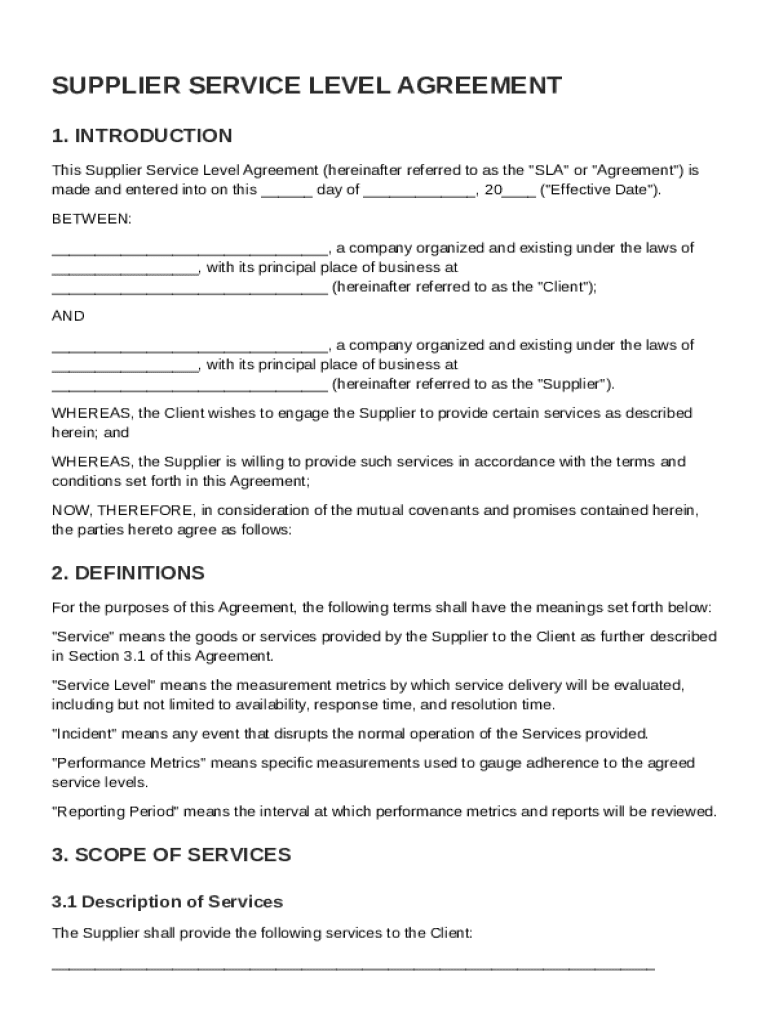
A Supplier Service Level Agreement (SLA) Template is a structured framework designed to formalize the service expectations between a supplier and a client. It details the agreed-upon terms and conditions, including performance metrics and responsibilities. The template acts as a legal document that ensures both parties understand their obligations, reducing the potential for disputes. By codifying these expectations, the SLA serves as a reference point to maintain consistent service quality and accountability.
Key Components of the SLA
- Service Scope: Defines the range of services to be provided.
- Performance Standards: Sets expectations for service quality, including metrics for evaluation.
- Responsibilities: Details the duties of both the supplier and client in fulfilling the agreement’s terms.
- Monitoring and Reporting: Outlines procedures for tracking performance and communicating results.
- Incident Management: Specifies steps for addressing service failures or disruptions.
How to Use the Supplier Service Level Agreement Template
Using the template effectively requires clear understanding and customization to fit specific needs. Here’s a step-by-step guideline:
- Identify Parties: Clearly state the names and contact details of the supplier and client.
- Define Services: Explicitly outline the services to be provided to avoid ambiguity.
- Set Performance Metrics: Agree on measurable criteria for evaluating service effectiveness.
- Establish Communication Channels: Decide on methods and frequency of communication for reporting and collaboration.
- Include Duration and Amendments: Determine the SLA’s effective period and the process for making amendments.
Practical Scenarios
- IT Services: A tech company might use an SLA to ensure uptime and response times for software support.
- Logistics: A logistics provider may define delivery schedules and accuracy rates within the SLA.
Key Elements of the Supplier Service Level Agreement Template
A well-structured template comprises several key elements crucial for effective implementation:
- Service Obligations: Clearly states what each party is required to do.
- Performance Monitoring: Describes methods for tracking and assessing performance.
- Review Processes: Defines how often and under what conditions the SLA will be reviewed.
- Compliance and Governance: Outlines the legal framework governing the SLA.
- Termination Conditions: Specifies the conditions under which the SLA can be terminated by either party.
Edge Cases
- Non-performance Penalties: Conditions where penalties are applied for failing to meet SLA standards.
- Force Majeure: Clauses that relieve parties from obligations in the event of uncontrollable events.
Important Terms Related to Supplier Service Level Agreements
Understanding specific terminology is essential for interpreting the SLA correctly:
- Uptime: Percentage of time a service is operational.
- Downtime: Periods when the service is unavailable.
- KPIs (Key Performance Indicators): Metrics used to assess performance.
- Breach of Contract: Failure to meet terms as stipulated in the agreement.
- Remediation Plan: Measures taken to correct a service defect or failure.
Legal Use of the Supplier Service Level Agreement Template
The template serves as a legally binding document, ensuring:
- Contractual Clarity: Prevents misinterpretations by having clearly defined terms.
- Dispute Resolution: Provides a mechanism for addressing disagreements through predefined processes.
- Compliance: Ensures adherence to industry standards and regulations.
- Liability Limitation: Protects parties by outlining liability limits in the event of service failure.
Enforcement and Compliance
- Governing Law: Indicates which jurisdiction’s laws apply to the agreement.
- Arbitration Clause: Specifies process for resolving disputes outside of court.
Steps to Complete the Supplier Service Level Agreement Template
Completing the template involves several key steps, which ensure comprehensiveness and accuracy:
- Gather Information: Collect necessary data about the services and expectations.
- Customize Clauses: Adjust template clauses to suit the specific service and relationship details.
- Review and Approvals: Both parties review and approve the document to ensure mutual agreement.
- Document Signatures: Finalize the agreement with signatures from authorized representatives of both parties.
Detailed Considerations
- Performance Metrics Revision: Regularly update metrics to reflect current service capabilities.
- Supplementary Documentation: Attach additional documents that provide further clarity, if needed.
Who Typically Uses the Supplier Service Level Agreement Template
Different entities use the SLA template based on their need to formalize service relationships:
- Corporations: Large businesses maintaining vendor efficiency and accountability.
- SMEs: Small to medium enterprises ensuring reliable service from suppliers.
- Government Agencies: Public sector organizations for accountability in service delivery.
- Educational Institutions: Universities for contracting third-party services.

Real-World Examples
- Telecommunications: Providers ensure network reliability and customer service response times.
- Healthcare Providers: SLAs with medical equipment suppliers for prompt maintenance and support.
Examples of Using the Supplier Service Level Agreement Template
The following real-world scenarios illustrate the SLA's application:
- Software Development Projects: Establish timelines, deliverables, and quality expectations with tech vendors.
- Manufacturing and Supply Chains: Define supply timelines and defect management procedures with product suppliers.
Case Study
For a multinational corporation, utilizing an SLA in supplier contracts ensures clarity and helps maintain robust processes across diverse geographical locations.
By leveraging these blocks, businesses and organizations can maximize the utility and efficacy of their Supplier Service Level Agreement Template, ensuring efficient service delivery and minimization of operational risks.