




01. Edit your form online
Type text, add images, blackout confidential details, add comments, highlights and more.

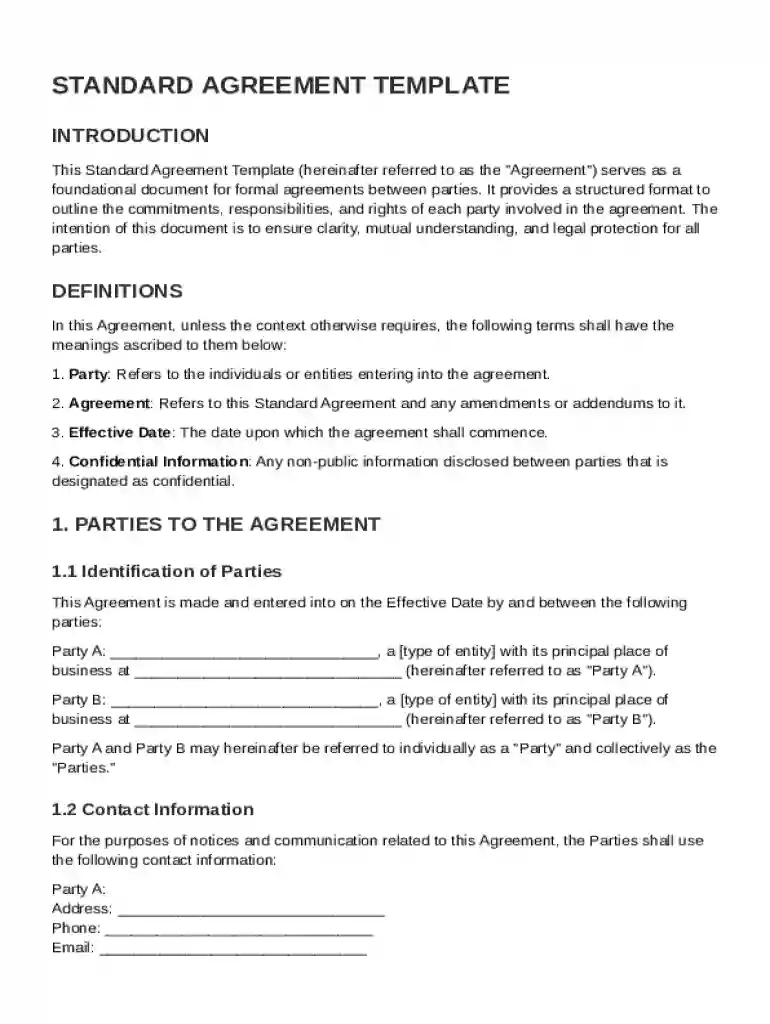
Type text, add images, blackout confidential details, add comments, highlights and more.

Draw your signature, type it, upload its image, or use your mobile device as a signature pad.

Send it via email, link, or fax. You can also download it, export it or print it out.
The Standard Agreement Template is a crucial document utilized in formalizing agreements between two or more parties. It serves as a guide to delineate commitments, responsibilities, and rights involved in a contractual relationship. Essential sections typically include definitions, parties' identification, and purpose, ensuring clarity in all aspects of the agreement. By providing explicit terms, the template offers legal protection and clear communication, reducing potential misunderstandings and disputes.
Consider a consultancy agreement using the Standard Agreement Template. The consultant and the client define terms such as "services," "deliverables," and "payment terms," ensuring both parties have a clear understanding of expectations and financial matters.
Utilizing the Standard Agreement Template effectively involves a series of steps to customize it to your specific needs. The process ensures that the final agreement reflects the particular dynamics of the parties involved and the nature of the contract.
Understanding critical legal terms within the Standard Agreement Template is essential to ensure clarity and enforceability of the contract. Here are some terms often encountered:
In a service contract, the dispute resolution term might specify that any disagreements are settled through arbitration, providing a structured approach to managing conflicts outside of court.
Each section of the Standard Agreement Template serves a specific function to legalize and detail the agreement between parties. Recognizing these elements can aid in tailoring the template to your needs.
The enforceability and requirements of a Standard Agreement Template can vary based on state laws, which may dictate certain elements of the contract.
In California, certain contracts may require additional disclosures or compliance with consumer protection laws, emphasizing the need for state-specific customization.
The legal application of the Standard Agreement Template ensures that agreements are enforceable and protect all parties involved. It must adhere to applicable statutes and contractual law.
Consider a business partnership using this template to delineate roles, responsibilities, and profit-sharing. They ensure compliance with business laws, securing their agreement’s enforceability.
The digital creation and management of Standard Agreement Templates call for ensuring the chosen software supports the necessary features and formats.
For instance, a user may start drafting a contract in Google Docs, import it into DocHub for annotation and signatures, and then save it back to the cloud for distribution.
Both digital and paper versions of the Standard Agreement Template have particular advantages, depending on the circumstances and requirements of the parties involved.
Entities considering which version to use might weigh factors such as ease of editing, distribution needs, and legal preferences for maintaining original signatures.
The Standard Agreement Template is versatile, catering to a diverse audience that requires formalized agreements.



A tech startup may use it for vendor agreements, ensuring all technological services and products are delivered as promised, clearly defining roles and payment terms.
Filling out the Standard Agreement Template involves structured steps to ensure each agreement is customized and legally sound.
In scenarios where parties operate in different jurisdictions, the template might include additional jurisdiction clauses that specify applicable laws.
At DocHub, your data security is our priority. We follow HIPAA, SOC2, GDPR, and other standards, so you can work on your documents with confidence.





Mar 24, 2022 Discover the essential components of a robust consulting agreement. Learn how to create a solid contract with these 12 key elements.
Standard Contract Templates Participant, Speaker, Evaluator Agreement Entertainer, Artist, and Promoter Agreement Standard Service Agreement under $15K.


