Definition and Meaning
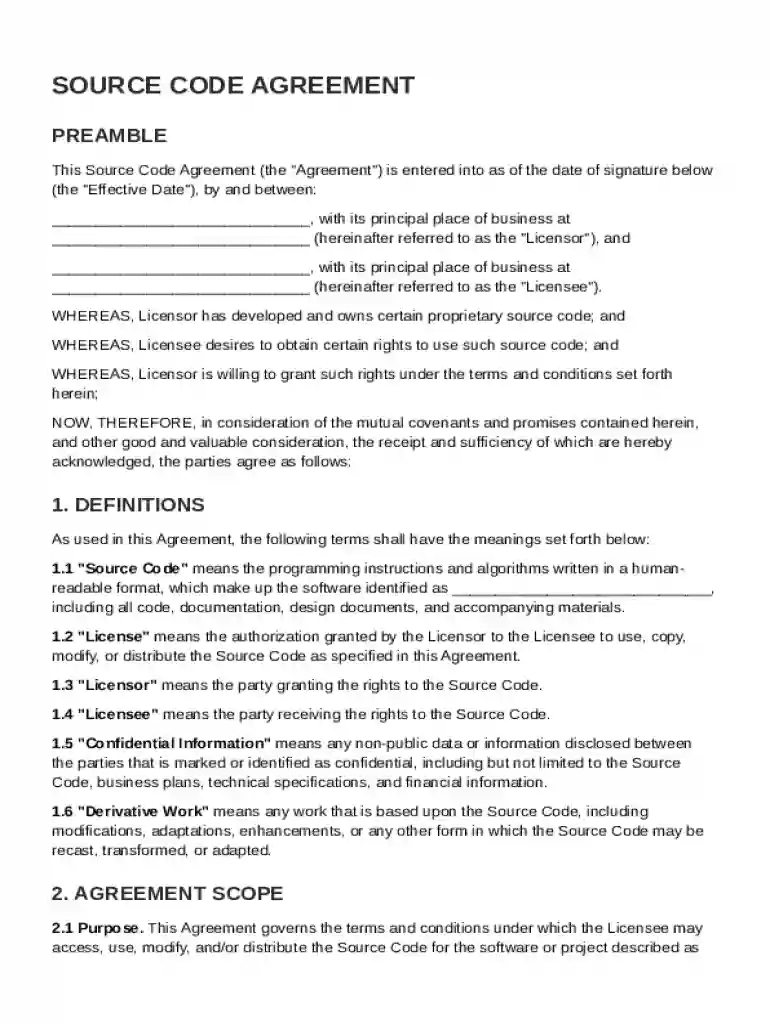
The Source Code Agreement Template is a legal document that formalizes the usage rights of proprietary source code between a Licensor and a Licensee. This agreement delineates specific terms under which the Licensee can use, modify, and distribute the source code, ensuring both parties are clear on their rights and obligations. It incorporates fundamental definitions such as 'Source Code', which refers to the program or software script being licensed, 'License', which details the permissions granted, and 'Confidential Information', which underscores data protection requirements.
Key Elements of the Source Code Agreement Template
The template incorporates essential components that are crucial for protecting both the Licensor’s and Licensee's interests. These elements include:
- Scope of License: Specifies the extent of rights granted to the Licensee, including any limitations or restrictions.
- Ownership Rights: Reinforces that the Licensor retains ownership of the source code while granting specific usage rights to the Licensee.
- Confidentiality Obligations: Outlines the responsibilities of the Licensee in safeguarding the source code from unauthorized access or disclosure.
- Warranties and Indemnification: Provides assurances regarding the source code's quality and legal compliance, coupled with indemnification clauses for protection against legal claims.
- Termination Conditions: Details circumstances under which the agreement may be terminated by either party.
- Dispute Resolution Procedures: Establishes methods for resolving disagreements, such as mediation or arbitration.
Detailed Explanation of Important Terms
Understanding the terms used in a Source Code Agreement Template is critical. Key terms to be aware of include:
- Licensor: The entity or individual who owns the source code and grants rights for its use.
- Licensee: The party receiving the rights to use the source code as outlined in the agreement.
- Intellectual Property Rights: Legal rights protecting inventions in the software, ensuring the creator maintains control over their use.
- Non-Exclusive License: Allows the Licensor to license the source code to multiple parties apart from the Licensee.
- Derivative Works: Modifications or enhancements made to the original source code, typically addressed in terms of ownership and rights.
Steps to Complete the Source Code Agreement Template
Completing a Source Code Agreement Template involves several precise steps to ensure legality and comprehensiveness:
- Identify Parties: Clearly indicate the Licensor and the Licensee with relevant contact information.
- Define the Source Code: Provide a detailed description of the source code being licensed, including its version and intended use.
- Establish Terms of Use: Determine the scope of the license, including the territory and duration.
- Articulate Ownership and Rights: Specify ownership of the source code and any created derivative works.
- Stipulate Confidentiality Measures: Define the confidentiality obligations, such as who can access the source code.
- Include Warranties and Indemnification: Outline any warranties provided by the Licensor and indemnification stipulations.
- State Termination Clauses: Describe events that could lead to agreement termination and the process involved.
- Outline Dispute Resolution: Choose methods for resolving disputes, like mediation or arbitration.
Legal Use of the Source Code Agreement Template
The Source Code Agreement Template is designed to conform with legal standards for software licensing within the United States. Its structure supports compliance with intellectual property law, particularly focusing on:
- The ESIGN Act: Ensures electronic signatures acquire legal validity, facilitating document execution digitally.
- Confidentiality Law: Emphasizes the importance of protecting proprietary software-based information from unauthorized use or disclosure.
- Intellectual Property Rights: Guards against infringement and ensures proper use and distribution of licensed materials.
Variations and Alternatives to the Source Code Agreement Template
Though the standard Source Code Agreement Template is comprehensive, there are variants and alternatives:
- Non-Disclosure Agreement (NDA): For focused confidentiality without licensing aspects.
- End User License Agreement (EULA): Tailored for users obtaining licenses for personal use only.
- Open Source License: Comparable agreement but with terms allowing broader public access and modification privileges.
- Master Services Agreement: May include broader terms encompassing service provisions alongside source code rights.
State-by-State Differences
While the Source Code Agreement Template provides a fundamental structure, state-specific modifications might be necessary due to differing regional laws and regulations regarding intellectual property, privacy, and licensing. These differences can impact:
- Enforcement of Non-Compete Clauses: Varies with strictness from state to state.
- Legal Frameworks: Some states have unique stipulations for software licensing or additional protections for software creators.
- Privacy Regulations: States may have varying data protection rules impacting confidentiality sections of the agreement.