
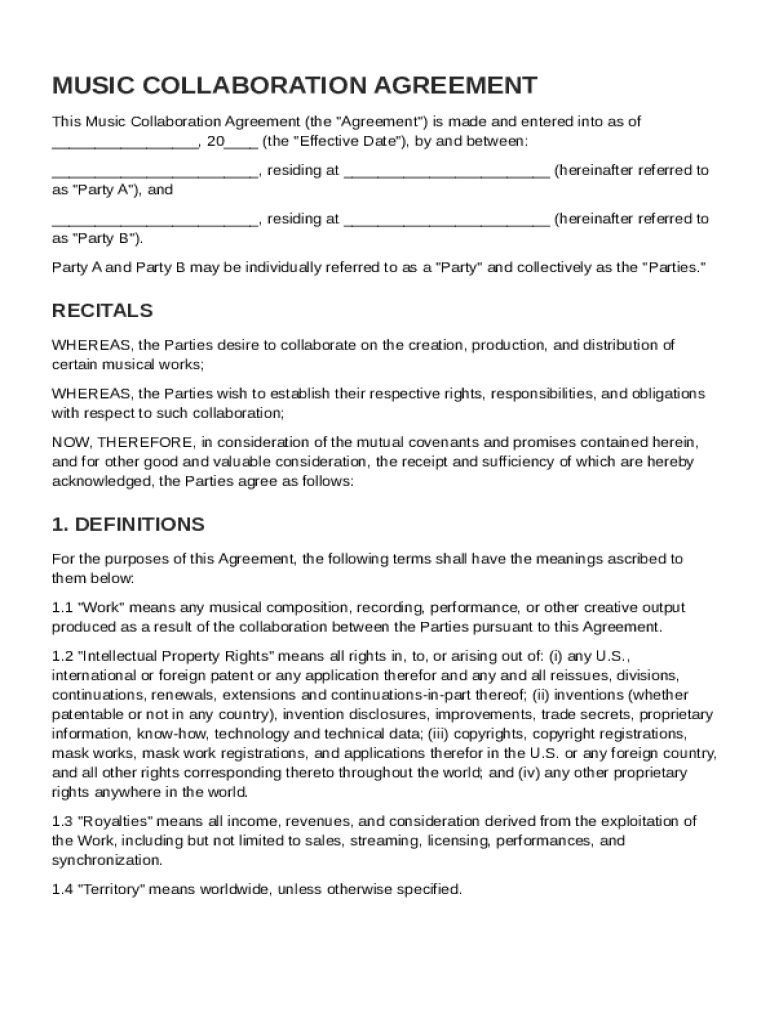







Definition and Meaning
The "Music Collaboration Contract Template" is a legal document designed to structure and formalize the relationship between two or more parties collaborating on creating, producing, and distributing musical works. It provides a clear framework that outlines each party's roles, responsibilities, contributions, and rights, ensuring an organized and fair collaboration. By defining key aspects such as intellectual property rights, royalties, and compensation, the contract helps safeguard the interests of all participants and clarifies expectations throughout the creative process.
How to Use the Music Collaboration Contract Template
To effectively utilize a music collaboration contract template, the following steps should be undertaken:
-
Download or Access the Template: You can obtain this template from various online platforms that offer legal document templates. Ensure the version downloaded is recent and aligns with U.S. laws.
-
Customize the Template: Personalize the contract by filling in specific details about the parties involved, the project scope, and any unique clauses or conditions relevant to your collaboration.
-
Review and Edit: Carefully go over every section to ensure it accurately represents the agreed terms and complies with legal standards. It is advisable to consult with a legal professional to validate the contract's completeness and legality.
-
Sign the Document: Once finalized, all parties should sign the document using legally binding electronic signatures or traditional handwritten signatures.
-
Keep a Record: Store the signed agreement safely, either digitally or as a hard copy, to safeguard against future disputes.
Key Elements of the Music Collaboration Contract Template
The music collaboration contract template typically includes several critical components:
- Party Details: Identification of Party A and Party B, including legal names and contact details.
- Definitions: Explanation of key terms like 'Work', 'Intellectual Property Rights', and 'Royalties'.
- Purpose and Scope: Description of the project's aims, scope, and desired outcomes.
- Ownership and Contributions: Allocation of rights to contributions and any resulting works, including creative input and financial investment.
- Compensation and Royalties: Clearly defined payment structures and royalty distributions tied to the success and monetization of the final musical work.
- Confidentiality: Obligations to maintain the secrecy of proprietary or sensitive information exchanged during the collaboration.
- Dispute Resolution: Agreed processes for addressing disagreements, including mediation, arbitration, or legal action.
Important Terms Related to the Music Collaboration Contract Template
The effectiveness of a music collaboration agreement often hinges on understanding several crucial terms:
- Intellectual Property Rights: Legal entitlements related to the ownership and usage of original musical content created during the collaboration.
- Royalties: Payments made to rights holders for the use of their music, often based on sales, streams, or other usage metrics.
- Work: The musical piece(s) created as part of the collaboration, potentially including compositions, recordings, and performances.
- Contribution: Specific resources, skills, or elements that each party brings to the collaboration.
- Confidentiality Agreement: A clause within the contract that prevents the disclosure of proprietary information.
Steps to Complete the Music Collaboration Contract Template
Filling out the music collaboration contract template involves several precise actions:
- Gather Required Information: Collect all necessary details about the collaborating parties and the project.
- Input Specific Details: Enter the names, roles, and duties of all parties involved.
- Specify Financial Terms: Clearly delineate how contributions, payments, and royalties will be managed.
- Review Legal Sections: Ensure that confidentiality, intellectual property, and dispute resolution clauses meet each party's requirements and legal standards.
- Verify Completeness and Clarity: Double-check for any missing information or ambiguities that could cause future issues.
- Consult a Legal Expert: If needed, seek legal advice to verify the accuracy and sufficiency of the contract's provisions.
- Finalize Signatures: Once final details have been approved, have each party sign the document.
Legal Use of the Music Collaboration Contract Template
The music collaboration contract template serves a critical legal role in defining the relationship between collaborators. It can serve as evidence in legal settings, affirming agreed terms and protecting parties from claims or misunderstandings:
- Protection of Interests: Safeguards collaborators' intellectual property rights and financial interests.
- Clear Legal Recourse: Provides predefined dispute resolution processes should disagreements arise.
- Compliance with Laws: Ensures that the collaboration operates according to applicable copyright and contract laws in the United States.
Who Typically Uses the Music Collaboration Contract Template
This type of contract is commonly used by:
- Independent Musicians: Artists partnering to produce new music without major label involvement.
- Record Producers: Individuals overseeing the technical and artistic elements of musical production.
- Music Composers and Songwriters: Creators developing original music for performance or recording.
- Bands and Music Groups: Ensemble groups harnessing collective skills to produce collaborative works.
- Music Licensing Companies: Entities managing the rights and distribution of music co-created by multiple artists.


Examples of Using the Music Collaboration Contract Template
Several real-world scenarios illustrate the application of a music collaboration contract template:
- Songwriting Duos: Two songwriters decide to pen an album together, using the template to detail ownership and profit-sharing arrangements.
- Producer Collaborations: A producer collaborates with a recording artist to develop a track, requiring explicit agreements on recording rights and royalties.
- Virtual Collaborations: Artists from different geographic areas collaborate on a digital music project, necessitating the use of electronic signatures and explicit digital rights arrangements.
- Band Member Agreements: Members of a band agree to work on an album and need a framework to allocate profits based on contributions to songwriting, performance, and production.
Each example underlines the diverse contexts in which a music collaboration contract template can help solidify mutual understandings and protect parties' interests.




