
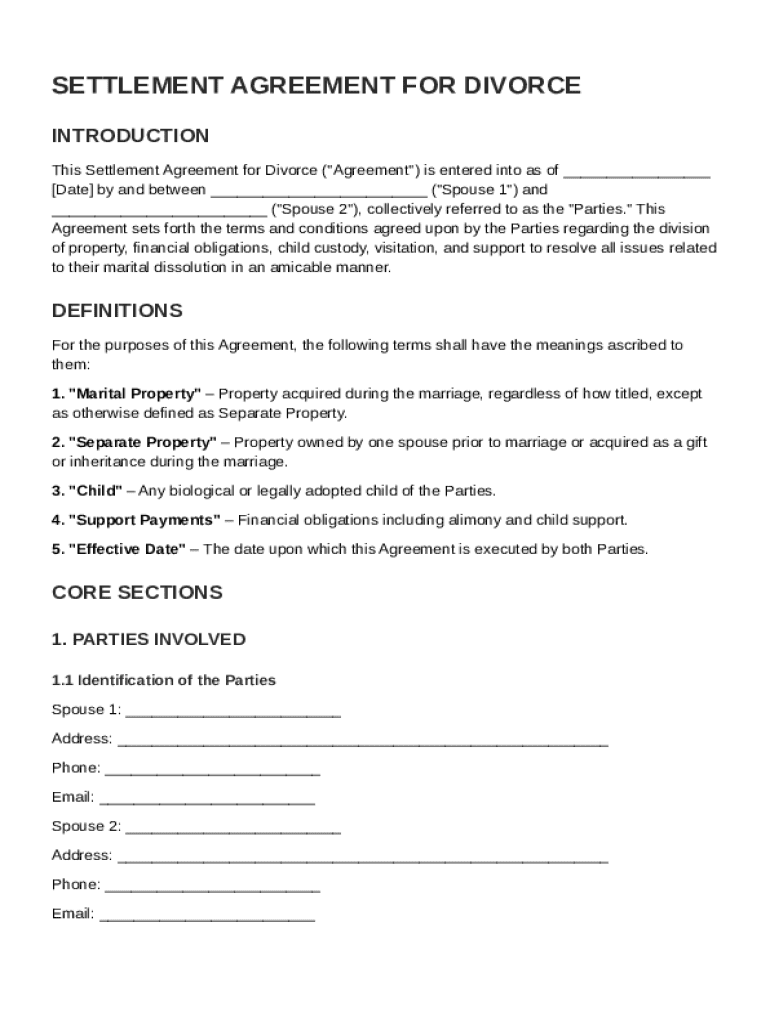







Definition & Meaning
A Settlement for Divorce Agreement Template is a structured document that outlines the terms agreed upon by two parties undergoing a divorce. This legal document covers critical aspects such as the division of marital property, shared financial obligations, and arrangements concerning child custody and support. The primary aim of this template is to provide a clear and legally binding framework that facilitates the amicable resolution of all divorce-related matters. It ensures that both parties' rights and obligations are detailed and understood.
Key Components of the Agreement
- Marital Property Division: Specifies how assets and liabilities acquired during the marriage will be divided.
- Child Custody and Support: Details the custody arrangement and financial support for any children involved.
- Spousal Support: Addresses the need and terms for any alimony payments.
- Dispute Resolution: Provides mechanisms for resolving disagreements post-divorce.
How to Use the Settlement for Divorce Agreement Template
Using the settlement template involves a structured approach to ensure that all legal nuances are appropriately addressed. Begin by reviewing the document to understand its framework. Make sure all relevant parties provide input before filling out the specific sections. It is essential to customize the document to reflect the specific circumstances of both parties involved.
Steps for Utilization
- Review the Template: Begin by going through the entire template to understand its structure and requirements.
- Gather Information: Collect all necessary financial documents, property valuations, and details regarding children for accurate input.
- Fill Out the Form: Enter the specific details for each section, ensuring accuracy and completeness.
- Discuss with Legal Professionals: It’s advisable to consult with legal professionals to ensure alignment with state laws and personal legal rights.
- Finalize the Agreement: Once all parties agree, finalize the details, and obtain necessary signatures.
Steps to Complete the Settlement for Divorce Agreement Template
Completing a settlement template requires careful attention to detail and collaboration between both parties to ensure mutual agreement on each section. Here’s a step-by-step guide to navigate this process:
Step-by-Step Process
- Identify Sections: Understand each part of the document, including property division, support, and custody.
- Input Accurate Data: Enter financial information accurately, including income, assets, debts, and other relevant data.
- Negotiate Terms: Engage in discussions to reach consensus on contentious issues like asset division and support terms.
- Draft Terms: Write down the agreed terms in a clear, legally acceptable format within the template.
- Review and Edit: Examine the document for any inaccuracies or required modifications.
- Legal Review: Have a legal professional review the document for compliance with state laws.
- Sign and Notarize: Once reviewed, both parties should sign the agreement, and it may be necessary to have it notarized.
Important Terms Related to Settlement for Divorce Agreement Template
A comprehensive understanding of the terms within a settlement agreement is crucial. Knowing these terms ensures all parties are aligned on legal and financial implications.
Key Terms to Know
- Separation Date: The official date when the parties began living separately, important for financial and legal reasons.
- Custodial Parent: The parent who is granted primary care and custody of children after divorce.
- Alimony: Also known as spousal support, this is a financial payment made to a former spouse post-divorce.
- Equitable Distribution: A legal principle followed in most states for fairly dividing marital assets and debts.
Legal Use of the Settlement for Divorce Agreement Template
Making sure that the document adheres to legal standards is paramount for enforceability. This section guides the proper legal use of the divorce agreement template.
Ensuring Legal Validity
- Compliance with State Laws: Follow specific state guidelines as divorce laws can vary by jurisdiction.
- Clear and Concise Language: Use precise language to avoid ambiguities that could lead to disputes.
- Mutual Agreement: Confirm that both parties have willingly agreed to the terms without duress or coercion.
- Court Approval: In some cases, presenting the agreement to a court for official approval might be required.
State-Specific Rules for the Settlement for Divorce Agreement Template
Different states have unique divorce laws that affect how settlement agreements should be drafted. Understanding state-specific rules ensures compliance and legal recognition.
Examples of State Variations
- Community Property States: States like California require a different approach to property division compared to equitable distribution states.
- Child Support Guidelines: Many states have specific child support calculation guidelines that must be adhered to in the agreement.
- Alternative Dispute Resolution: Techniques such as mediation or arbitration might be encouraged or required in certain jurisdictions.
Examples of Using the Settlement for Divorce Agreement Template
Applying the template in various scenarios can help illustrate its versatility and utility. Real-world applications demonstrate how the template can serve different needs.
Practical Scenarios
- Simple Divorces: For couples with limited assets and no children, the template can be completed quickly.
- Complex Divorces: Involving significant assets or business interests, where detailed provisions for asset division are needed.
- High-Conflict Cases: Utilized alongside mediation efforts to reach consensus on contentious points.
Software Compatibility
In the digital age, ease of use with various software platforms can simplify the completion and management of divorce documents. Compatibility ensures a seamless workflow.
Compatible Platforms
- Document Editing Software: Compatible with platforms like Microsoft Word and Google Docs for ease of editing.
- Electronic Signature Tools: Integration with platforms like DocHub or Adobe Sign for obtaining signatures.
- Cloud Storage Services: Syncs with cloud storage platforms such as Google Drive and Dropbox for secure document storage and sharing.




