




01. Edit your form online
Type text, add images, blackout confidential details, add comments, highlights and more.

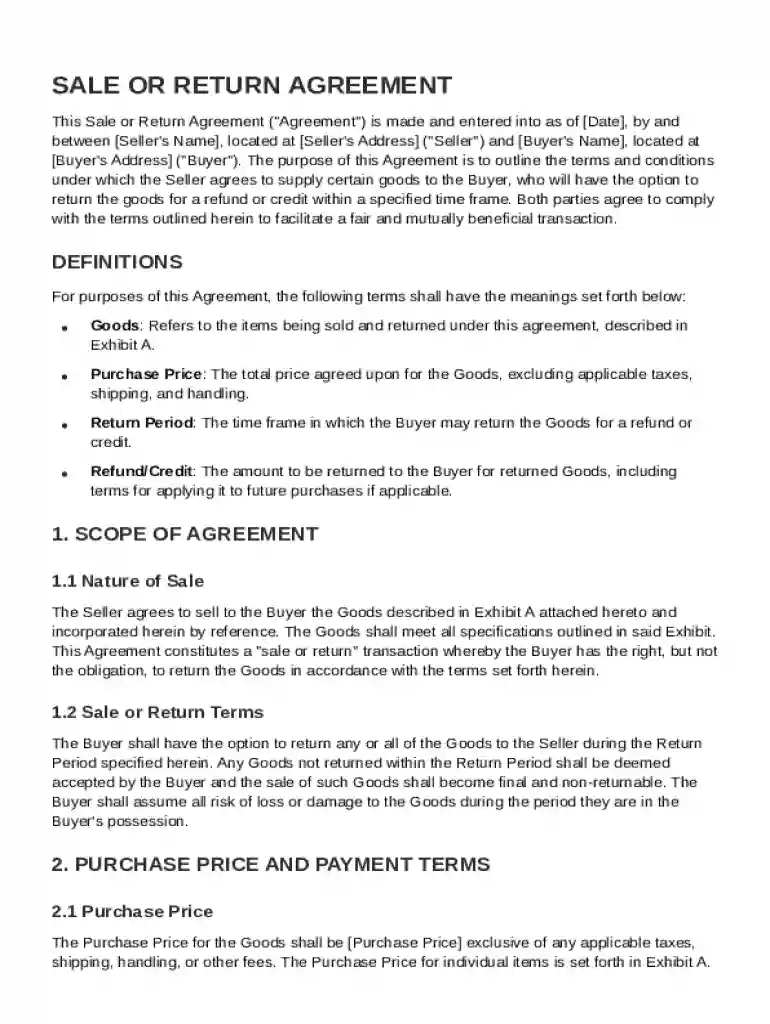
Type text, add images, blackout confidential details, add comments, highlights and more.

Draw your signature, type it, upload its image, or use your mobile device as a signature pad.

Send it via email, link, or fax. You can also download it, export it or print it out.
The Sale or Return Agreement Template is a legally binding document that outlines the terms for the sale of goods between a Seller and a Buyer, granting the Buyer the option to return the items within a specified Return Period for a refund or credit. This type of agreement is particularly useful in scenarios where the Buyer needs assurance about the quality and suitability of the goods before committing to the purchase permanently. The agreement typically includes sections covering definitions, pricing, payment terms, delivery details, return policies, liabilities, and governing law to ensure a fair transaction that protects the interests of both parties.
Using the Sale or Return Agreement Template involves several key steps to ensure it is tailored to the specific needs of the transaction. Begin by carefully reviewing the template to understand the standard terms and conditions included. Customize sections such as the Purchase Price, Return Period, and Payment Terms to reflect the negotiated terms between the Buyer and Seller. Ensure all parties involved in the transaction are identified correctly and that their roles and responsibilities are clearly defined. Finally, review the legal terminology with a professional, if necessary, to ensure compliance with applicable laws.
Completing the Sale or Return Agreement Template requires attention to detail to accurately reflect the transaction specifics. Here are the essential steps:
These steps ensure that both parties have a clear understanding of their obligations and what is expected in case the goods are returned.
Understanding the jargon associated with the Sale or Return Agreement is essential for proper execution. Here are key terms often found in this type of agreement:
Familiarity with these terms aids in ensuring that the agreement is understood and adhered to by all parties involved.
Certain elements are fundamental to the structure and effectiveness of a Sale or Return Agreement. These include:
Including these key elements ensures the agreement comprehensively covers the necessary aspects of the sale and potential return of goods.
The template serves as a legal framework for sales transactions, providing clarity and legal protection to both parties. It must be used in accordance with U.S. laws governing the sale of goods. Ensure that the agreement complies with the Uniform Commercial Code (UCC) when applicable and any state-specific regulations. This may involve modifications to standard terms or the inclusion of particular clauses required by law. Additionally, the agreement should be executed by individuals with proper authority to sign on behalf of their respective entities to avoid disputes over authorization.
The Sale or Return Agreement is commonly used by various parties who engage in the sale of goods with flexible purchasing terms. Typical users include:
These users leverage the flexibility of return agreements to support their business models while protecting their interests through contractual terms.


Illustrating the practical application of the template can aid understanding:
These scenarios demonstrate how different businesses utilize this agreement to minimize risk and optimize inventory handling.
At DocHub, your data security is our priority. We follow HIPAA, SOC2, GDPR, and other standards, so you can work on your documents with confidence.


If no binding. Contract is created by the Contract Date or if Purchaser withdraws any pending offer prior to Sellers acceptance of that offer and notification
Sec. 1 Scope of Application. (1) These contractual conditions (GTC) apply to all contracts concluded between Leica Geosystems AG, including its affiliated.


