
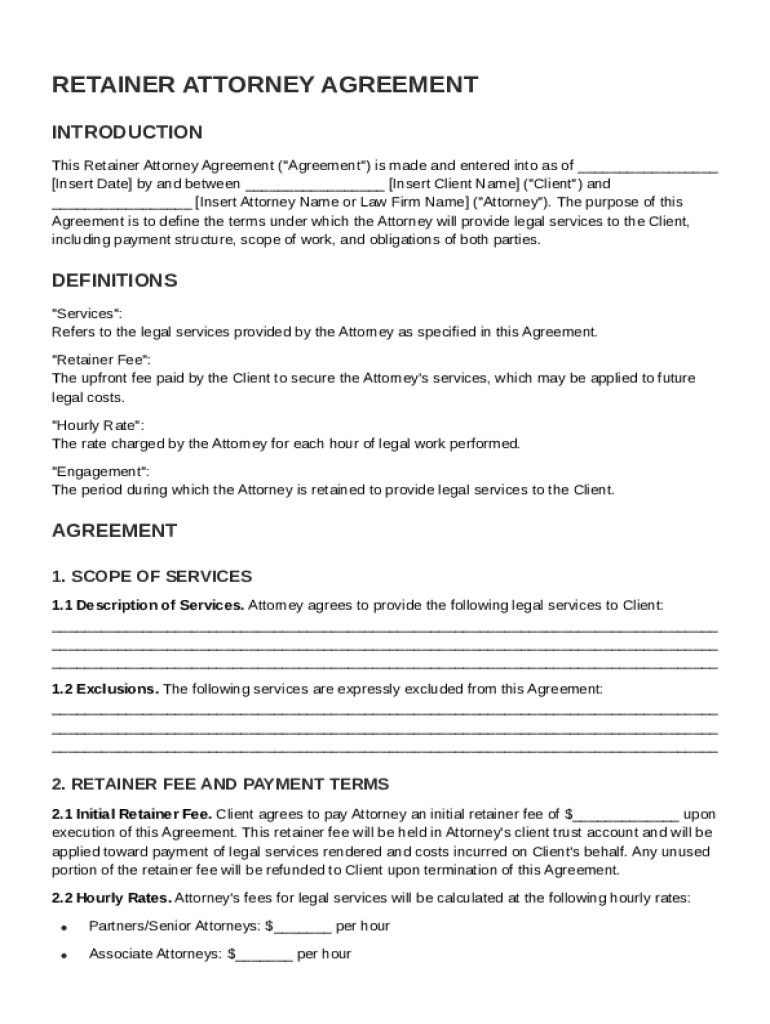







Definition & Meaning
The Retainer Attorney Agreement Template is a structured document that outlines the contractual relationship between an attorney and their client. This template is used to establish clear terms regarding the scope of legal services to be provided, the payment structure including any retainer fees and hourly rates, and the obligations of both parties. Typically, these agreements ensure that the client and attorney are aligned on confidentiality, communication protocols, and dispute resolution methods, often via mediation. The agreement is governed by the laws of a specified state, providing a clear legal framework for the engagement.
Key Elements of the Retainer Attorney Agreement Template
When drafting or reviewing a Retainer Attorney Agreement, it is essential to consider several key elements to ensure comprehensive coverage and clarity. These elements include:
-
Scope of Services: Clearly defines the legal services that the attorney will provide. This may encompass a variety of legal tasks, from consultations to court representations.
-
Payment Terms: Details the retainer fee, hourly rates, and other financial arrangements. It may include specifics on payment due dates and methods.
-
Confidentiality: Establishes the importance of confidentiality regarding client information and outlines any exceptions under which disclosures might be legal.
-
Termination Clause: Provides the conditions under which either party can terminate the agreement and any repercussions of early termination.
-
Dispute Resolution: Outlines the preferred methods for resolving any disputes that arise, often advocating for mediation before litigation.
Steps to Complete the Retainer Attorney Agreement Template
Completing a Retainer Attorney Agreement involves several steps to ensure that all necessary components are addressed. Here’s a step-by-step guide:
-
Initial Consultation: Begin with a discussion between the client and attorney to outline the expected services and terms.
-
Draft Agreement: Use the template to draft the agreement, ensuring all sections are completed with specific details pertinent to the engagement.
-
Review & Modify: Both parties should review the document for accuracy. Any necessary modifications should be made at this stage.
-
Legal Compliance Check: Verify that the agreement complies with relevant state laws and ethical guidelines.
-
Finalize Agreement: Once both parties agree on the terms, they can finalize the document, setting the stage for formal signatures.
-
Signature & Storage: Sign the document using a legally binding electronic signature platform, such as DocHub, and store copies securely for both parties.
Legal Use of the Retainer Attorney Agreement Template
The Retainer Attorney Agreement Template must be used in a manner consistent with legal standards to ensure enforceability. Legal use includes:
-
Ensuring that the document is used for its intended purpose, clearly establishing a client-attorney relationship.
-
Aligning the agreement with state-specific regulations, as laws governing attorney-client agreements may vary across different jurisdictions.
-
Including mandatory disclosures and disclaimers required by law, such as those related to potential conflicts of interest.
-
Adhering to ethical guidelines set forth by legal governing bodies, maintaining integrity and transparency in the client-attorney relationship.
State-Specific Rules for the Retainer Attorney Agreement Template
The regulations governing Retainer Attorney Agreements can differ significantly by state, impacting the content and enforceability of the agreement. Key state-specific considerations might include:
-
Fee Structures: Some states impose restrictions on retainer fees and stipulate specific disclosures that must accompany any billing arrangements.
-
Confidential Information: Variations exist in how states define and protect confidential client communications, which impacts how these clauses are drafted.
-
Mediation and Arbitration Clauses: States might have different precedents or rules about enforcing mediation or arbitration clauses within attorney agreements.
Important Terms Related to Retainer Attorney Agreement Template
Understanding the legal terminology within a Retainer Attorney Agreement is essential for both parties. Key terms may include:
-
Retainer Fee: An upfront payment to secure the attorney's services, often placed into a client trust account.
-
Billable Hours: The amount of time an attorney spends on a client's case that can be billed under the agreement.
-
Jurisdiction: The state laws that govern the agreement and any disputes arising from it.
-
Mediation: A method of alternative dispute resolution involving a neutral third-party facilitator.
Examples of Using the Retainer Attorney Agreement Template
The practical application of a Retainer Attorney Agreement can vary, but common scenarios include:
-
Business Transactions: When a corporation hires an attorney for ongoing legal counsel on transactions and corporate governance.
-
Family Law: Engaging a lawyer for a divorce proceeding requires a clearly defined agreement to manage expectations and costs.
-
Litigation: When an individual or organization is involved in litigation, an attorney may be retained to manage the case through to its resolution.
Digital vs. Paper Version
With advancements in digital technology, the choice of using a digital versus a paper version of the Retainer Attorney Agreement Template poses differences in efficiency and accessibility. A digital version offers:
-
Convenience: Easier editing, sharing, and storing of documents.
-
Security: Enhanced protection with digital encryption and password protection features offered by platforms like DocHub.
-
Eco-friendly: Reduces the need for physical paper, contributing to environmental sustainability.
On the other hand, a paper version might be preferred in traditional settings or where a physical signature is required by law or client preference.




