




Definition & Meaning
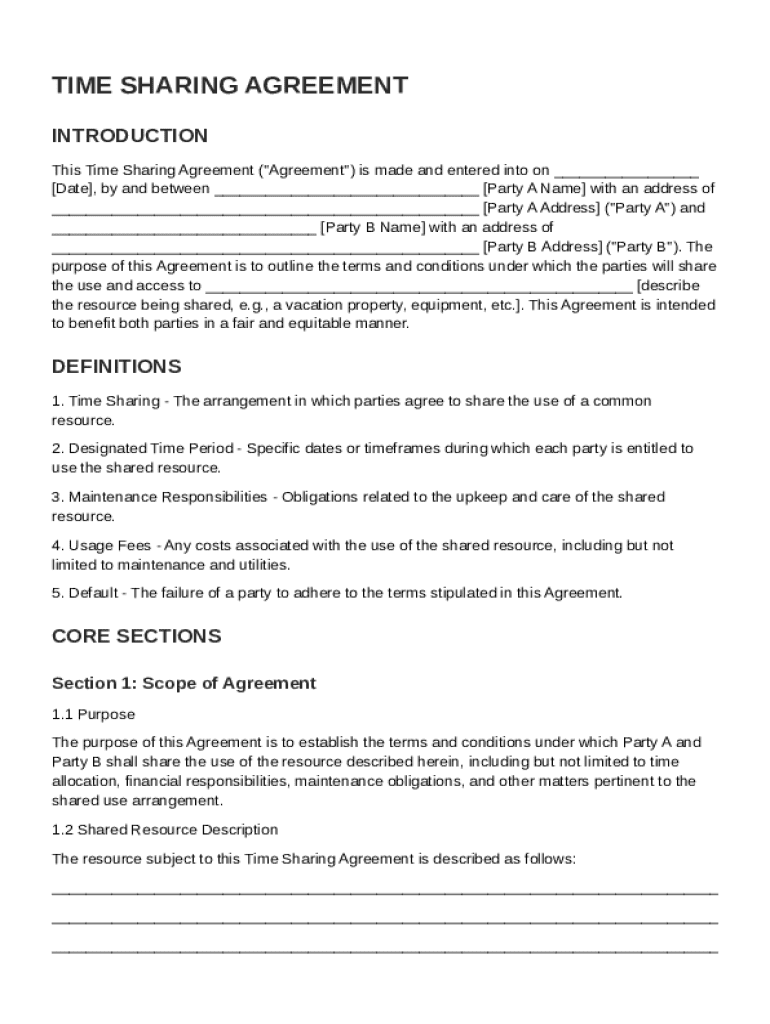
A Time Sharing Agreement Template is a structured document used between two or more parties to outline the shared use of a particular resource, such as property, equipment, or digital assets. This template specifies how the resource will be allocated in terms of time and responsibilities, including financial obligations, maintenance duties, and resolution mechanisms for potential disputes. Designed to ensure fair access and management of the shared entity, this agreement is particularly vital in legally formalizing shared arrangements, thereby providing clarity and reducing the risk of conflicts.
Examples of Resources Shared in Time Sharing Agreements
- Real Estate: Vacation homes or office spaces where multiple parties want to alternate use.
- Equipment: Items like vehicles or machinery shared between businesses for efficiency.
- Digital Assets: Shared use of expensive software licenses or online services.
Key Elements of the Time Sharing Agreement Template
A comprehensive Time Sharing Agreement Template includes several critical components which detail the responsibilities and rights of each party involved.
Core Components
- Parties Involved: The template clearly identifies Party A and Party B, along with their respective roles.
- Resource Description: A detailed explanation of the shared resource, ensuring all parties agree on what is being utilized and in what manner.
- Time Allocation: This specifies the schedule of usage, detailing how time is divided between the parties.
- Financial Responsibilities: Clearly outlines how costs such as maintenance and utilities will be shared, which may vary based on usage time.
- Maintenance Obligations: Details who is responsible for upkeep and the standards of maintenance required.
- Insurance Requirements: Specifies necessary insurance coverage to protect against potential liabilities associated with shared use.
- Dispute Resolution: Provides a framework for how disagreements will be addressed, potentially through arbitration or mediation.
- Termination Conditions: Outlines conditions under which the agreement may be ended, whether due to breach of terms or mutual consent.
Practical Scenarios
- Vacation Property: Families jointly purchasing a holiday retreat.
- Shared Office Space: Startups collaborating in a common workspace to save on costs.
Steps to Complete the Time Sharing Agreement Template
Completing a Time Sharing Agreement Template involves several precise steps to ensure all parties understand and agree to the terms.
Step-by-Step Process
- Identify Parties and Resource: Clearly define the parties involved and the specific resource to be shared.
- Draft Time Allocation: Agree upon and document the time-sharing schedule for all parties.
- Determine Financial Responsibilities: Discuss and record who will handle costs associated with the resource, including maintenance and utilities.
- Set Maintenance and Insurance Terms: Identify who will manage upkeep and obtain necessary insurance.
- Address Dispute Resolution and Termination: Establish procedures for resolving disputes and conditions for terminating the agreement.
- Review and Sign: All parties should review the document to ensure comprehension and agreement before signing.
Who Typically Uses the Time Sharing Agreement Template

Common Users
- Families: Sharing vacation properties or cabins.
- Small Businesses: Sharing specialized machinery or leased office space.
- Collaborative Ventures: Groups collaborating on projects requiring shared resources.

Example Scenarios
- Startup Collectives: Entrepreneurs sharing a robotics lab for developing prototypes.
- Peer Groups: Friends co-owning a boat for recreational use.
Important Terms Related to Time Sharing Agreement Template
Understanding certain key terminologies is crucial to navigating a Time Sharing Agreement Template effectively.
Glossary of Key Terms
- Party A and B: Specify the involved parties in the sharing agreement.
- Resource: The asset or property being shared.
- Allocation Schedule: The agreed timeline that dictates the resource usage.
- Maintenance Clause: Terms detailing upkeep responsibilities.
- Dispute Clause: A predefined approach to settle disagreements.
Example Usage of Terms
- Allocation Schedule might allocate a resource like a vacation home with Party A using it in summer months while Party B takes winter.
Legal Use of the Time Sharing Agreement Template
Legal Considerations
Utilizing a Time Sharing Agreement Template requires understanding the legal framework that protects all parties involved.
- Enforceability: Ensures all terms are legal and binding under U.S. law.
- Regulatory Compliance: Stipulations must align with local ordinances or federal laws regarding shared ownership or use.
- Document Authentication: Legal validation through notarization might be required to enhance authenticity and enforcement in disputes.
Risk Mitigation
- Avoiding Ambiguity: Clear definitions prevent differing interpretations which can lead to disputes.
- Legal Review: It's advisable to have legal experts review the agreement to understand implications and obligations fully.
State-Specific Rules for the Time Sharing Agreement Template
In the United States, state-specific regulations can influence the structure and enforcement of a time-sharing agreement.
Variation Across States
- Property Laws: Real estate sharing might have additional state regulations, particularly in vacation-heavy states like Florida or California.
- Tax Implications: States such as New York may have unique tax codes affecting shared resources.
Examples of Using the Time Sharing Agreement Template
Real-World Application
- Corporate Shared Assets: Businesses employing time-sharing agreements for high-value equipment.
- Community Projects: Local communities sharing public spaces or resources for events and gatherings.
Case Studies
- Real Estate Sharing: Two families with alternating holiday schedules effectively reducing ownership costs of a shared beach house.
- Equipment Leasing: Tech startups in Silicon Valley sharing 3D printing machinery as a cost-saving measure.