Restaurant Improvement Contract Template 2026

Get Form
Restaurant Improvement Contract Template Preview on Page 1

Here's how it works

01. Edit your form online
Type text, add images, blackout confidential details, add comments, highlights and more.

02. Sign it in a few clicks
Draw your signature, type it, upload its image, or use your mobile device as a signature pad.

03. Share your form with others
Send it via email, link, or fax. You can also download it, export it or print it out.

Definition and Purpose of the Restaurant Improvement Contract Template

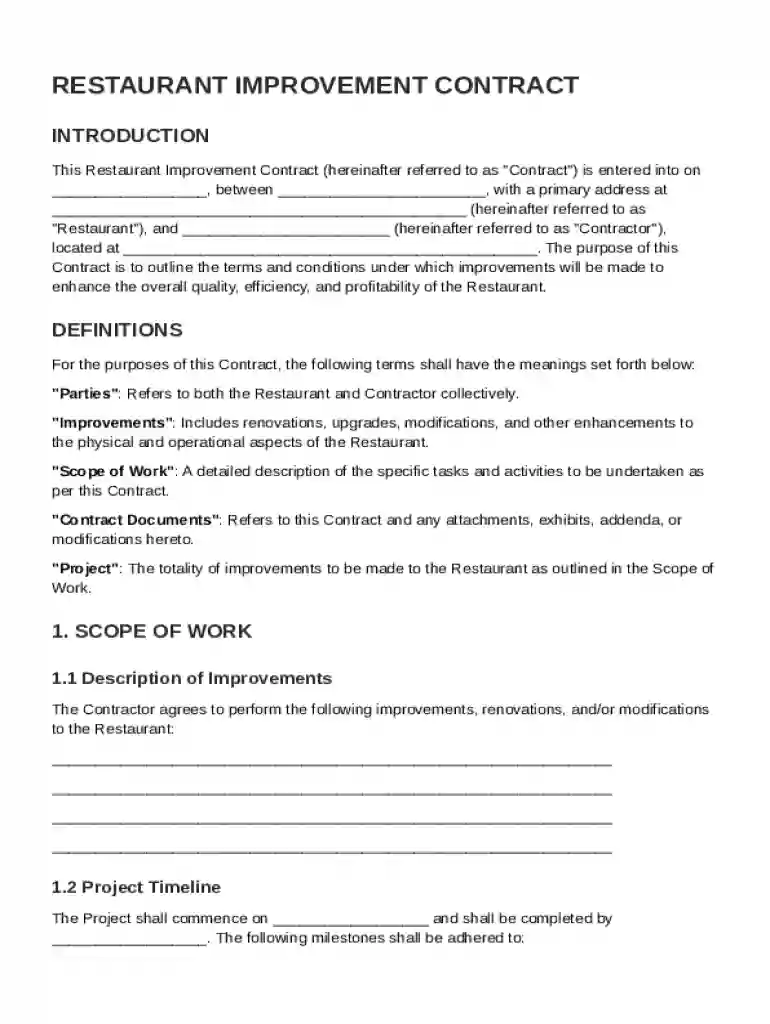
The Restaurant Improvement Contract Template is a formal document that outlines the terms and conditions between a restaurant and a contractor engaged to enhance the restaurant's operational efficiency, quality, and profitability. This template is critical for defining the project scope, detailing the work to be accomplished, project timelines, compensation agreements, and confidentiality clauses. It helps in establishing clear communication and expectations regarding the renovation or improvement project.

Key Elements of the Contract

  • Scope of Work: Clearly defines the tasks and responsibilities of the contractor, such as interior remodeling, kitchen upgrades, or equipment installation.
  • Project Timeline: Specifies the start and end dates for the project, along with any key milestones or deadlines.
  • Compensation Terms: Details how and when the contractor will be paid, including any advance payments or milestone-based payments.
  • Responsibilities: Outlines the duties and obligations of both the restaurant and the contractor during different phases of the project.
  • Confidentiality: Describes the confidentiality requirements to protect sensitive business information shared during the project.

How to Use the Restaurant Improvement Contract Template

Using the Restaurant Improvement Contract Template effectively requires an understanding of its structure and the specific needs of the restaurant project. The template provides a framework, but customization is often necessary.

  1. Review and Understand the Template: Begin by reviewing each section thoroughly to understand its purpose and components.
  2. Customization: Modify sections to reflect the specific improvement plans, including project scope and financial terms.
  3. Consultation: Engage with legal or advisory professionals to ensure compliance with local laws and accuracy in contractual terms.

Tips for Customization

  • Incorporate details specific to your restaurant, such as unique features of your establishment that may impact the project.
  • Adjust timelines according to seasonal business variations which might affect the project execution.

Steps to Complete the Restaurant Improvement Contract Template

Completing the Restaurant Improvement Contract Template requires careful attention to detail to avoid future disputes. Here’s how to do it effectively:

  1. Identify Stakeholders: List all parties involved, including the restaurant owner, contractor, and any subcontractors.
  2. Define Project Details: Specify the improvements planned, detailing all tasks involved.
  3. Set Timeline and Milestones: Establish a clear timeline, including start and end dates, along with phased milestones.
  4. Outline Payment Terms: Define payment schedules and conditions, ensuring financial clarity.
  5. Agree on Terms and Conditions: Finalize all terms, including confidentiality and dispute-resolution clauses, ensuring mutual agreement.

Step-by-Step Instructions

  • Number each contractual aspect for easy reference during discussions.
  • Use conditional clauses to cover variations and potential change orders.

Important Terms Related to the Template

Understanding the terminology used in the Restaurant Improvement Contract Template is crucial for both parties. Key terms include:

  • Amendment Clause: Allows modifications to the contract by mutual consent.
  • Force Majeure: Details circumstances under which parties are exempt from liability due to unforeseen natural events.
  • Liability Limitation: Sets the extent of responsibility for each party in case of contractual breaches.

Contractual Language

  • Use precise legal terms to avoid ambiguity.
  • Include definitions for any technical terms specific to restaurant improvements.

Legal Use and Compliance

The Restaurant Improvement Contract Template must comply with state and federal laws to ensure enforceability and protection for both parties.

  • Local Regulations: Be aware of zoning laws and construction permits required for the project.
  • Contractual Legality: Ensure the contract adheres to U.S. contract law to be legally binding and enforceable.

Compliance Tips

  • Seek legal advice to navigate complex legal requirements.
  • Include clauses that adhere to health and safety regulations applicable to restaurant premises.

Who Typically Uses the Restaurant Improvement Contract Template

The template is primarily used by restaurant owners and contractors specializing in restaurant renovations to formalize their working relationship.


  • Restaurant Owners: Use the contract to ensure clarity and accountability in improvement projects.
  • Contractors: Utilize the template to define project parameters and protect against unexpected changes or requests.
decoration image ratings of Dochub

Practical Scenarios

  • Owners of small independent restaurants looking to upgrade their kitchen facilities.
  • Chain restaurant corporations entering agreements for standardized improvements across multiple locations.

State-Specific Rules and Differences

Contractual requirements may vary across states, necessitating adaptations to the Restaurant Improvement Contract Template to align with specific local laws.

  • Permits and Inspections: Some states may have unique requirements for building modifications, especially concerning health and safety.
  • Legal Provisions: Adapt dispute resolution techniques to fit state laws, such as mediation requirements before litigation.

Regional Considerations

  • States with high seismic activity might require additional structural provisions.
  • Urban locations may have more stringent environmental regulations impacting project materials or processes.

Examples and Case Studies

To illustrate the effectiveness of the Restaurant Improvement Contract Template, consider relevant examples:

  • A small business owner in New York successfully renovated their dining area with minimal disruption to operations by using a detailed project timeline.
  • A multi-state restaurant franchise leveraged the template to maintain consistency and legal compliance across diverse geographic locations.

Lessons Learned

  • Clear communication and detailed documentation can prevent disputes regarding contractor performance.
  • Regular progress meetings help in aligning expectations and resolving issues proactively.

By providing comprehensive, structured guidance, the Restaurant Improvement Contract Template streamlines the improvement process, ensuring clarity, compliance, and successful project execution.

be ready to get more

Complete this form in 5 minutes or less

Get form

Got questions?

We have answers to the most popular questions from our customers. If you can't find an answer to your question, please contact us.
Contact us
A: A comprehensive food service contract should include the following components: the parties involved, the scope of services, duration of the contract, payment terms, service levels and performance standards, responsibilities of both parties, confidentiality and non-disclosure agreements, liability and indemnification
A restaurant management contract is an agreement between a restaurant owner and a management company, where the latter agrees to take full responsibility for running the restaurant.
How to draft a contract in 13 simple steps Start with a contract template. Understand the purpose and requirements. Identify all parties involved. Outline key terms and conditions. Define deliverables and milestones. Establish payment terms. Add termination conditions. Incorporate dispute resolution.
Write the contract in six steps Start with a contract template. Open with the basic information. Describe in detail what you have agreed to. Describe how the contract will end. Say which laws apply and how disputes will be resolved. Include space for signatures.
Legally, you can absolutely write your own service agreement. Contracts dont require special formatting, magic phrases, or a law degree to be valid. If both parties agree to the terms, something of value is exchanged, and the agreement is clearyouve got a contract. But clarity doesnt always equal protection.

Security and compliance

At DocHub, your data security is our priority. We follow HIPAA, SOC2, GDPR, and other standards, so you can work on your documents with confidence.
Learn more
ccpa2
pci-dss
gdpr-compliance
hipaa
soc-compliance

People also ask

how both parties will handle any disputes. Include both parties details. Describe the work or results. Set out payment details. Assign intellectual property rights. Explain how to treat confidential information. Identify who is liable for loss and damage. Set out insurance obligations. Outline any subcontracting agreements.
Some examples of simple contracts are common types of contracts like service agreements (e.g., hiring a freelancer), NDAs, loan agreements, sales agreements (e.g., vendor/supplier deals), and rental agreements (e.g., camera rental terms).

Related links