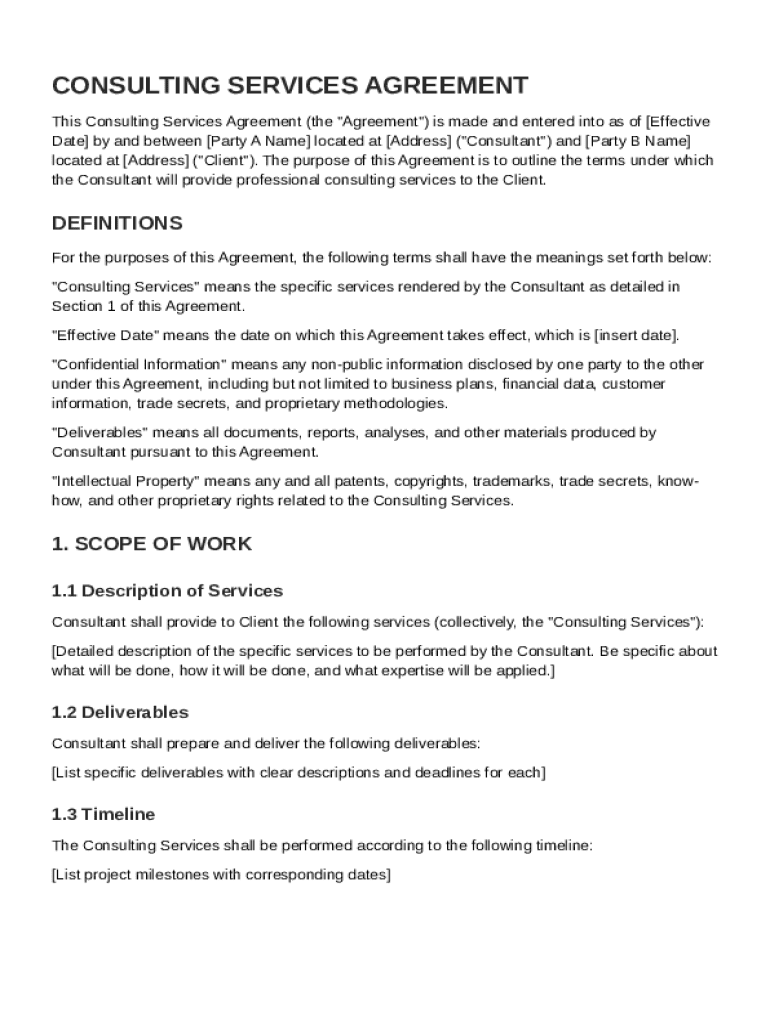







Definition and Meaning of a Professional Contract Template
A professional contract template serves as a pre-designed document that outlines the essential terms and conditions of a professional agreement between a service provider and a client. It is designed to provide clarity and legal framework to both parties involved in a business relationship. The template includes sections such as the scope of work, payment details, confidentiality clauses, intellectual property rights, and termination conditions. Using such templates saves time, reduces errors, and ensures that the agreement is comprehensive and legally binding, thereby minimizing potential disputes.
Key Features of the Template
- Scope of Work: Clearly defines the services to be provided.
- Payment Terms: Specifies payment amount, method, and schedule.
- Confidentiality Agreements: Protects sensitive information shared during the contract.
- Intellectual Property Rights: Details ownership rights of the work created.
- Termination Clauses: Outlines how and when the contract can be ended.
How to Use the Professional Contract Template
Utilizing a professional contract template is a straightforward process that involves adapting a standard template to the specific requirements of an individual agreement. Begin by downloading the template from a trusted source and reviewing each section to ensure it meets your needs.
- Review the Template: Understand each section for applicability.
- Customize the Content: Edit essential terms to suit the specific agreement.
- Consult a Legal Expert: For complex terms, seek professional advice.
- Discuss with the Other Party: Share the draft for feedback and revisions.
- Obtain Signatures: Ensure all parties sign to formalize the agreement.
Practical Example
Consider a consultant agreeing to provide services to a marketing firm. The template will be customized to specify the types of services (e.g., digital marketing), the duration (e.g., six weeks), and the compensation (e.g., a flat rate of $5,000 payable at milestones).
Steps to Complete the Professional Contract Template
Completing the contract template requires methodical attention to detail to ensure accuracy and full compliance with legal standards.
- Gather Information: Collect all relevant data about the parties involved.
- Fill in General Details: Include names, contact information, and date.
- Detail Scope of Work and Obligations: Clearly define each party’s duties.
- Specify Payment Details: Include amount, due dates, and penalties for late payments.
- Seek Legal Review: Before signing, have a legal professional verify the document.
Important Terms Related to Professional Contract Templates
Understanding the terminology used in contract templates is crucial for clarity and avoiding misunderstandings.
- Parties: The individuals or groups involved in the contract.
- Consideration: The benefit each party receives, usually in the form of payment.
- Liability: Legal responsibility for the fulfillment of terms.
- Force Majeure: Relieves a party from liabilities due to unforeseen circumstances.
- Arbitration: A method of dispute resolution outside the court system.
Key Elements of the Professional Contract Template
The critical components of a professional contract provide a solid foundation for the agreement and detail essential responsibilities and expectations.
- Parties Involved: Identification of all parties to prevent legal ambiguity.
- Service Description: Comprehensive detailing of the services offered.
- Duration: Timeframe for the commencement and conclusion of services.
- Compensation Structure: Payment terms, including amounts and schedules.
- Confidentiality: Clauses protecting proprietary information and data security.
State-Specific Rules for the Professional Contract Template
While the professional contract template provides a basic structure, it may need to be tailored to adhere to state laws in the United States. Different states may have unique requirements concerning contract enforceability and specific types of agreements, such as those related to employment or intellectual property.
Examples of State Regulations
- California: May have additional requirements on non-compete clauses.
- New York: Specific disclosures may be needed for independent contractor agreements.
Legal Use of the Professional Contract Template
The legality of a professional contract template lies in its compliance with federal and state regulations. It is essential to ensure that all terms are lawful and enforceable. Clauses must align with labor laws, privacy regulations, and industry-specific guidelines. In cases of disputes, courts will interpret the contract based on these legal standards.
Digital vs. Paper Version of the Professional Contract Template
Opting for a digital or paper version of the professional contract template has its own benefits and considerations.
- Digital Version: Offers convenience and ease of access. Allows for electronic signatures, which are legally binding under the ESIGN Act.
- Paper Version: Provides a tangible record and can be useful in scenarios where digital access is limited or when parties prefer physical documentation for archiving purposes.
Both versions should be stored securely to ensure confidentiality and integrity. Electronic copies should be protected through encryption and access controls, while paper versions should be kept in a secure location.