




01. Edit your form online
Type text, add images, blackout confidential details, add comments, highlights and more.

Type text, add images, blackout confidential details, add comments, highlights and more.

Draw your signature, type it, upload its image, or use your mobile device as a signature pad.

Send it via email, link, or fax. You can also download it, export it or print it out.
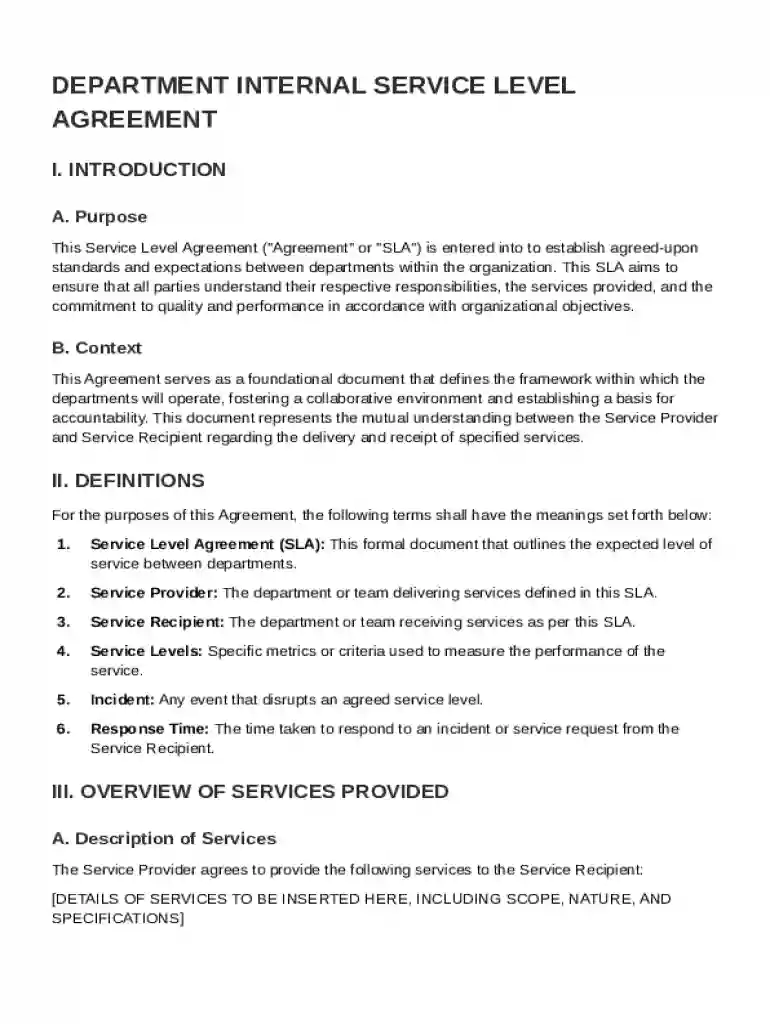
A Department Internal Service Level Agreement (SLA) Template is a formal document used within organizations to define service standards and responsibilities between departments. This template is essential for establishing clear expectations and accountability among teams. It includes detailed descriptions of the services provided, performance metrics, and communication protocols. By doing so, it aims to ensure efficient and effective service delivery, ultimately enhancing departmental collaboration.
Using an SLA template can streamline the process of creating a comprehensive agreement. Begin by identifying the departments involved and the specific services that will be covered. Customize the template to include relevant performance metrics and communication protocols tailored to the organization's needs.
Understanding the terminology within an SLA is crucial for effective communication and implementation. Some key terms include:
The template typically includes several fundamental elements necessary for a complete agreement:
This template serves as a legally binding contract within the organization, ensuring compliance with internal and external policies. It often includes confidentiality clauses and dispute resolution mechanisms.
Finalizing an SLA involves several key steps to ensure all aspects are covered and agreed upon by the involved parties:
SLAs are commonly used by various organizational departments, particularly:


Real-world scenarios often highlight the utility of a well-structured SLA:
By carefully drafting, reviewing, and implementing an internal SLA using this template, organizations can significantly enhance service quality, improve accountability, and foster better cooperation among departments.
At DocHub, your data security is our priority. We follow HIPAA, SOC2, GDPR, and other standards, so you can work on your documents with confidence.
The purpose of this Service Level Agreement is to document commitments between the Office of Information Technology (OIT), as the IT service provider and
In addition to specifying the deployment model, the CSA should clarify how a service is made available to service users on a given cloud provider, for example:
Jan 1, 2021 Outline services to be offered and working assumptions between Shared. Services and its customers. ▫. Quantify and measure service level


