
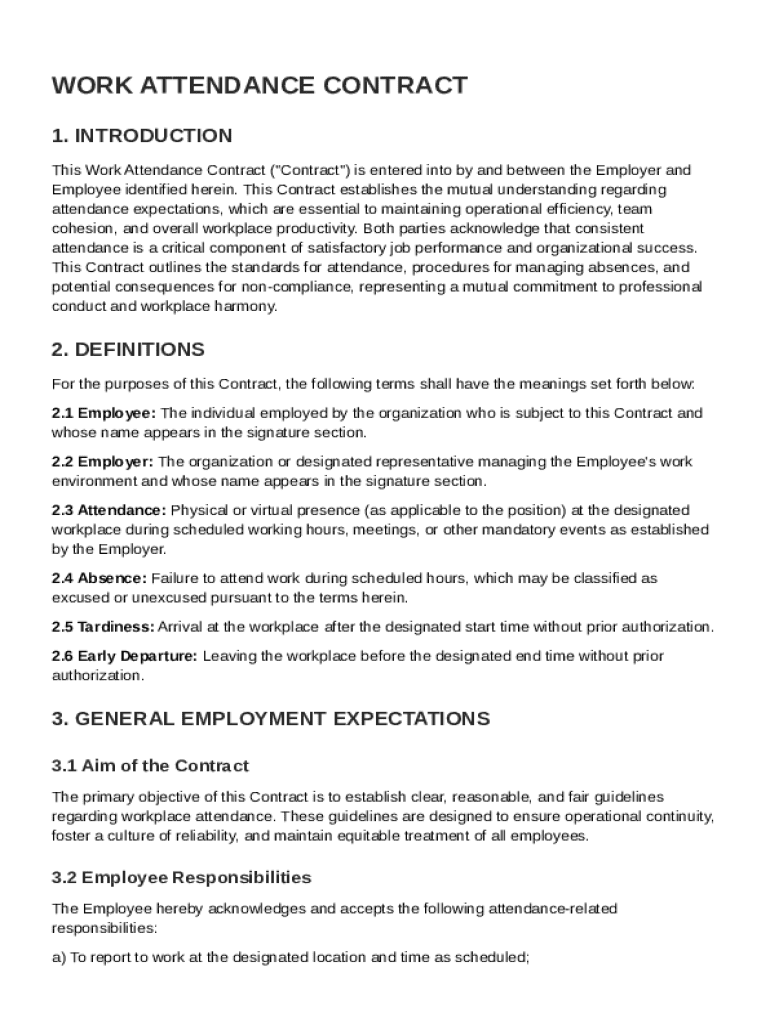







Definition and Meaning
A Work Attendance Contract Template is a detailed document that outlines the expectations and responsibilities regarding employee attendance in a workplace. It governs the policies, procedures, and consequences related to attendance, aiming to boost productivity by ensuring consistent attendance from employees. The template defines essential terms such as "excused absences" and "unexcused absences," setting the groundwork for managing attendance issues.
Key Elements of the Work Attendance Contract
-
Purpose and Scope: Explains the intentions behind the contract and its applicability within the organization. It generally encompasses all employees, imparting importance on regular attendance for operational efficiency.
-
Attendance Policies: Provides a clear outline of rules regarding punctuality, working hours, and breaks. This section also sets expectations about schedule adherence and communicates the effects of frequent delays or early leaves.
-
Types of Absences: Differentiates between excused (e.g., medical leave, bereavement) and unexcused absences, detailing the processes for obtaining approval for excused absences and potential repercussions for unexcused ones.
-
Reporting Procedures: Specifies how and when employees should report their absences, such as via email or phone call, and the requisite time frame for doing so.
-
Consequences for Non-Compliance: Highlights disciplinary actions (e.g., warnings, termination) associated with violations of the contract, promoting adherence among employees.
-
Employee Rights: Guarantees fair treatment under the contract, ensuring employees understand their rights to sick leave, vacation time, and other relevant benefits.
-
Modification and Termination of Contract: Details how changes to the contract will be administered and under what conditions it can be terminated, providing guidelines for renegotiation to meet evolving needs.
How to Use the Work Attendance Contract Template
Utilizing the Work Attendance Contract Template efficiently requires an understanding of its components and a systematic approach to customization.
Steps to Implement the Template
-
Review and Customize: Start by reviewing the template to ensure it aligns with your organizational policies. Modify sections to reflect company-specific rules and state or federal laws pertinent to your business operations.
-
Consult Legal Experts: Engage with legal professionals to verify the contract's compliance with applicable labor laws, ensuring legal enforceability and protection against potential disputes.
-
Communicate with Employees: Once customized, discuss the contract with the employees, facilitating understanding and buy-in. This might include workshops or informational sessions to address any questions.
-
Document Employee Agreement: Have each employee sign the contract to acknowledge understanding and agreement. Maintain signed copies for both company records and the employee's reference.
Practical Examples
-
Manufacturing Industry: A company operating on a 24/7 schedule may emphasize shift time adherence, implementing strict reporting procedures for shift-swapping or absenteeism.
-
Corporate Offices: Flexible work arrangements might reflect in the contract through defined core working hours, while emphasizing remote work protocols.
Important Terms Related to the Work Attendance Contract Template
Understanding the terminology used within the Work Attendance Contract is crucial.
- No-Call/No-Show: Refers to an instance where an employee does not report to work and fails to inform their supervisor.
- OT: Over Time; hours worked beyond the standard working schedule, which may or may not affect attendance records.
- PTO: Paid Time Off; time an employee can take off and get paid, which needs to be accounted for in attendance policies.
Who Typically Uses the Work Attendance Contract Template
The Work Attendance Contract Template is primarily utilized by HR departments in various types of organizations to standardize attendance tracking and management.
-
Small to Medium Enterprises (SMEs): These may use the template to establish structure and consistency during growth phases.
-
Large Corporations: For large employee bases, maintaining uniformity in attendance records and enforcing company-wide policies is crucial.
-
Non-Profit Organizations: Although operating under different monetary constraints, they still require consistent employee attendance for effective program execution.

Legal Use of the Work Attendance Contract Template
Ensuring that the Work Attendance Contract Template is legally binding requires adherence to labor laws and regulations.
Compliance Considerations
-
State and Federal Laws: Align the contract with relevant legal requirements to uphold employee rights and privileges.
-
Regular Updates: Modify the document actively to reflect legislative changes, ensuring ongoing compliance and avoiding legal repercussions.
Case Study
- Case of Consistency: A mid-sized tech firm implemented the template to combat frequent absenteeism. By aligning with state labor laws and incorporating regular performance reviews, the firm noted a 10% improvement in attendance, enhancing overall productivity.
Examples of Using the Work Attendance Contract Template
Practical application of the Work Attendance Contract Template reveals its utility across various scenarios and corporate needs.
Real-World Scenarios
-
Seasonal Industries: In sectors like agriculture where workforce needs ebb and flow, setting expectations through the template provides clarity across seasonal highs and lows.
-
Healthcare: Ensures healthcare professionals provide essential coverage by using structured leave policies and documenting absences.
-
Educational Institutions: Utilized to maintain teaching staff attendance, setting protocols for sick leave and substitute teaching requirements.
Steps to Complete the Work Attendance Contract Template
Filling out the Work Attendance Contract Template requires precision and attention to detail for efficacy.
Detailed Completion Steps
-
Gather Information: Compile data such as employee details, industry-specific attendance requirements, and company policies before beginning.
-
Complete Employee Details: Input each employee’s name, department, role, and contact information accurately.
-
Customize Policy Sections: Adjust sections covering attendance rules, reporting procedures, and consequences to reflect your company's policies.
-
Seek Employee Input: Encourage feedback during initial deployments to identify areas needing clarification or adjustment.
-
Finalize and Distribute: Once completed, distribute the template to each employee for review and signature, ensuring they fully comprehend the content and rationale.
Edge Cases
- Remote Work Considerations: For largely remote teams, adaptations might include alternate reporting measures and tracking mechanisms to suit off-premise communications.
Benefits of Using the Work Attendance Contract Template
The Work Attendance Contract Template comes with multiple benefits, contributing to healthier workplace dynamics and efficiency.
Increased Accountability
- Structured Framework: Establishes clear norms for attendance, thus encouraging employees to adhere to corporate standards.
Enhanced Communication
- Clear Expectations: Articulates expectations unequivocally, facilitating transparency in managing attendance concerns.
Improved Workplace Productivity
- Consistent Attendance: A focus on reliable attendance patterns improves the overall productivity and efficiency of the organization.
Practical Example
- Corporate Reorganization: During a corporate reorganization, a major firm utilized the contract template to assure employees of their roles, thus reducing absenteeism and maintaining morale during transitional phases.




