






Definition and Meaning
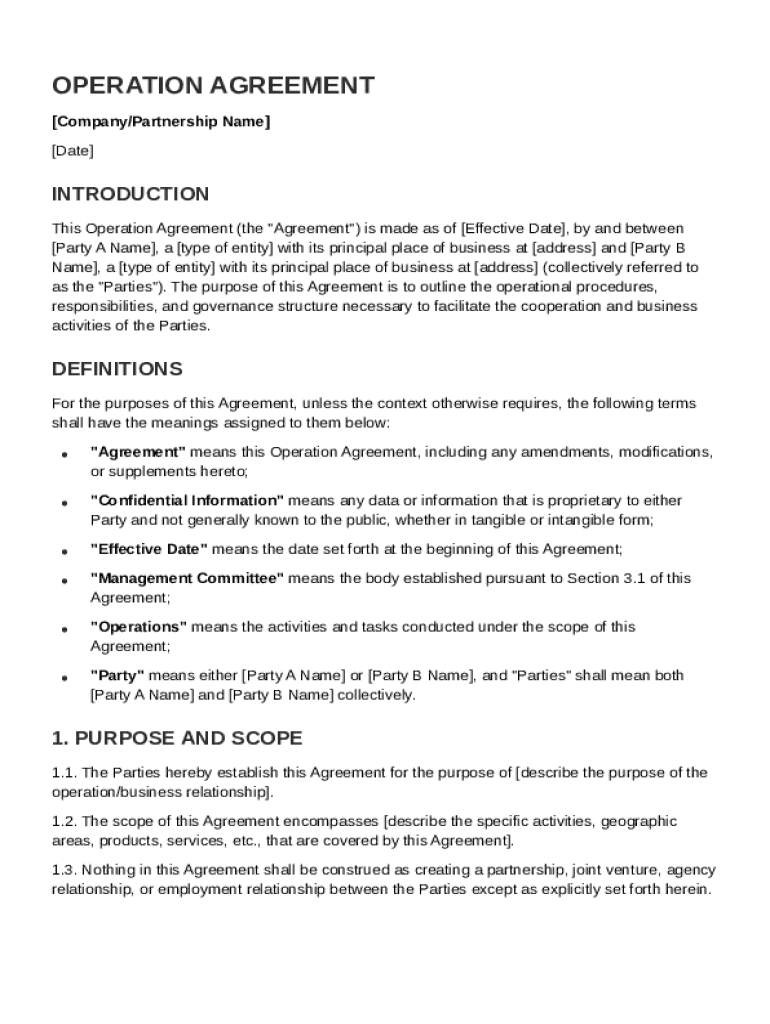
An Operation Agreement Template is a formal document used to outline operational procedures, responsibilities, and the governance structure between two or more parties engaged in a collaborative venture. This type of agreement typically serves as a guide to facilitate cooperation and ensure each party understands their roles and obligations. By defining key terms and stipulating the purpose and scope of the agreement, parties can establish a mutual understanding that underwrites their collaboration. The document often includes sections on financial arrangements, confidentiality, duration and termination clauses, dispute resolution mechanisms, and general provisions that govern the relationship.
Key Elements of the Operation Agreement Template
The Operation Agreement Template encompasses several critical components to provide clarity and structure:
- Purpose and Scope: This section details the primary objectives of the collaboration and the specific activities that fall under the agreement’s purview.
- Responsibilities: Clearly outlining each party’s responsibilities ensures accountability and helps prevent conflicts.
- Management Structure: Often includes the establishment of a Management Committee tasked with oversight responsibilities.
- Financial Arrangements: Specifies how financial resources are shared, allocated, and managed.
- Confidentiality Provisions: Details how sensitive information should be handled to safeguard each party’s interests.
- Duration and Termination: Outlines the agreement’s timeframe and conditions under which it can be terminated.
- Dispute Resolution: Provides mechanisms for resolving disputes, often encouraging arbitration or mediation as primary courses of action.
Steps to Complete the Operation Agreement Template
- Identification of Parties: Begin by detailing the parties involved in the agreement, including their legal names and contact information.
- Purpose and Scope: Clearly define the main goals and activities covered by the agreement.
- Define Responsibilities: Explicitly state the duties and roles of each party involved to avoid ambiguity.
- Set Up a Management Committee: Detail the composition of the committee, including appointments and terms of service.
- Financial Terms: Outline how funding and revenue sharing will be managed across different stages of the collaboration.
- Confidentiality Clause: Describe protocols for handling confidential information.
- Dispute Resolution Process: Establish a procedure for addressing disagreements using methods like arbitration.
- Finalize and Sign: Once all sections are completed and agreed upon, secure signatures from each party to signify consent and understanding.
Legal Use of the Operation Agreement Template
The use of an Operation Agreement Template is legally binding, provided it is prepared and executed in accordance with applicable laws. Each party should ensure compliance with regional and federal regulations, especially concerning specific industry standards. To certify its legality, the parties can consult with legal professionals to review the document before signing. The template includes guidelines that adhere to the ESIGN Act, making any electronically obtained signatures legally valid.
Who Typically Uses the Operation Agreement Template
This form is primarily utilized by businesses, partnerships, and collaborations that operate within the United States. Typical users include:
- Joint Ventures: Entities looking to merge resources while maintaining separate legal identities.
- Non-profits: Organizations involved in cooperative projects for social good.
- Corporate Partnerships: Companies that wish to clarify operational structures and expectations in shared ventures.
- Research Collaborations: Universities and private entities engaged in joint research projects.


State-Specific Rules for the Operation Agreement Template
Certain states may impose additional rules or require specific language in operation agreements. For instance, California mandates additional environmental compliance clauses in certain industries, while Texas might require specific disclosures for energy projects. It is important that users verify state-specific legal requirements which might include mandatory filing of agreements or the necessity for public disclosures under state law. Consulting a local legal expert can help ensure compliance with these regional variations.
Business Entity Types Benefiting from the Operation Agreement Template
Various business entity types can benefit from this template as it provides structure and clarity:
- Limited Liability Companies (LLCs): Helps delineate operational and managerial roles and responsibilities.
- Corporations: Facilitates comprehensive understanding and cooperation amongst shareholders or different divisions.
- Partnerships: Assists in clearly defining financial contributions and profit-sharing models.
- Startups: Provides the framework needed for setting up initial operational guidelines and partnerships.
Examples of Using the Operation Agreement Template
The Operation Agreement Template can be adapted to various collaborative scenarios:
- Technology Startups: Two companies might collaborate on a new application, specifying development roles and patent ownership within the agreement.
- Manufacturing Ventures: For companies pooling resources to produce a new product line, operational protocols and profit sharing can be distinctly outlined.
- Research and Development Projects: Universities and corporations collaborating on a research project can use the agreement to clarify data sharing and publication rights.
- Construction Projects: Contractors and developers can collaborate with clear terms about project timelines, resource allocation, and liability concerns.
Important Terms Related to the Operation Agreement Template
Understanding specific terms is vital for accurately interpreting the template:
- Governance Structure: Refers to the system by which the collaboration is directed, including decision-making bodies like the Management Committee.
- Duration and Termination Clauses: Outlines the time period of the agreement’s validity and conditions leading to its cessation.
- Compliance: Involves adhering to all applicable legal and regulatory requirements.
- Confidentiality: The protection of sensitive operational information shared between parties.
- Dispute Resolution: Mechanisms employed to amicably resolve conflicts that arise out of differing interpretations or unmet obligations under the agreement.
By ensuring a comprehensive understanding and application of these elements, parties utilizing an Operation Agreement Template are equipped to establish effective and legally secure operational partnerships.