






Definition and Purpose of a Notarized Child Custody Agreement Template
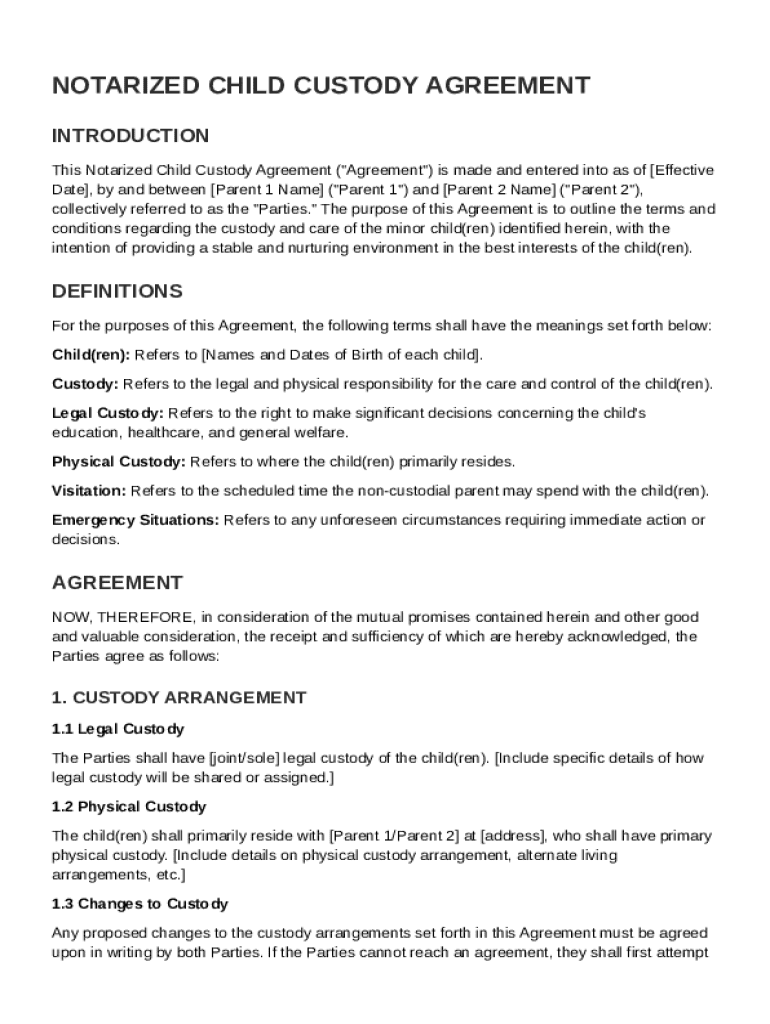
A Notarized Child Custody Agreement Template serves as a formal document outlining the terms of custody and care arrangements for minor children following a separation or divorce. This document is crucial because it delineates both physical and legal custody, specifying who the child will live with and who will make significant decisions regarding their welfare, such as education and healthcare. The agreement also covers visitation rights, ensuring both parents maintain a meaningful relationship with their children. Additionally, it addresses financial responsibilities, including child support obligations, thereby preventing disputes about financial arrangements. The document aims to foster cooperation between parents and offers clarity and security regarding each parent's roles and responsibilities.
Key Elements of the Notarized Child Custody Agreement Template
When drafting a Notarized Child Custody Agreement, it is essential to ensure it contains specific elements that make it comprehensive and legally binding. Key components include:
- Custody Details: Define legal and physical custody arrangements, detailing whether custody is sole or joint.
- Visitation Schedules: Establish regular and holiday schedules for non-custodial parents, ensuring clarity on pick-up and drop-off conditions.
- Decision-Making Authority: Clarify who has the right to make critical decisions regarding the child's health, education, and upbringing.
- Child Support: Outline financial responsibilities, including the amount, frequency, and method of payment.
- Dispute Resolution: Include provisions for resolving any disagreements regarding the agreement's terms, which may involve mediation or legal intervention.
Steps to Complete the Notarized Child Custody Agreement Template
Completing the Notarized Child Custody Agreement Template involves a series of steps to ensure accuracy and legality:
- Gather Information: Collect relevant details about each parent and child, including full names, addresses, and contact information.
- Define Custody Terms: Specify the type and extent of custody, be it sole or joint, for both legal and physical custody.
- Draft Visitation Schedule: Include regular and holiday visitation schedules, taking into account both parents' availability.
- Agree on Child Support: Agree on the contribution amounts, payment frequency, and which parent will receive the support.
- Notarization: Have the document signed in the presence of a notary public to authenticate the agreement and make it legally enforceable.
Importance of Obtaining a Notarized Child Custody Agreement
Obtaining a notarized child custody agreement is vital for several reasons. Primarily, it provides a legally binding framework that protects the rights and responsibilities of both parents and ensures the child's welfare is prioritized. By having the agreement notarized, parents can prevent misunderstandings and potential conflicts, providing a sense of stability and predictability for the child. Additionally, it is essential for situations where one parent may need to prove custodial rights in varying scenarios, such as school enrollment or medical emergencies.
State-Specific Rules and Considerations
Each U.S. state may have nuanced differences in the requirements for a valid child custody agreement. Understanding state-specific rules is crucial, as they dictate how custody disputes are resolved and what standard practices must be adhered to. For instance, states like California require the inclusion of a parenting plan, while others might mandate attendance at parenting classes. Consulting with a legal professional within your state can provide valuable insights and ensure the agreement complies with local regulations.
Legal Use and Recognized Authority
A Notarized Child Custody Agreement serves a legal purpose by formalizing custody terms between parents, ensuring enforceability in courts if disputes arise. It is acknowledged by family courts across the United States and provides a documented basis that can support or defend parental rights in legal proceedings. It is imperative that such agreements are constructed with precision, reflecting both parties’ intentions and compliance with state laws to have full legal recognition.
Who Typically Uses a Notarized Child Custody Agreement Template
Primarily, parents undergoing separation or divorce who have minor children are the principal users of a notarized child custody agreement template. However, other parties such as grandparents or legal guardians, who may seek custodial rights or visitation privileges, can also utilize this template to establish their legal standing. The template serves as a foundational tool for any adult responsible for the care and upbringing of a minor child.
Examples and Practical Applications
Real-world scenarios illustrate how a notarized child custody agreement can be applied effectively:
- Separation Scenario: Parents living apart use the document to decide on a joint custody arrangement, facilitating cooperation in raising their kids despite separate households.
- Relocation Case: A parent planning to move to a new state negotiates terms that allow for extended holiday visits to maintain the child-parent relationship.
- Financial Adjustments: Adjustments in financial obligations are seamlessly updated in the agreement, avoiding discrepancies and financial strains.
These examples demonstrate the practicality of having a detailed and structured custody arrangement that caters to the child's best interests while respecting parental rights.