Property Lock Out Agreement Template 2026

Get Form
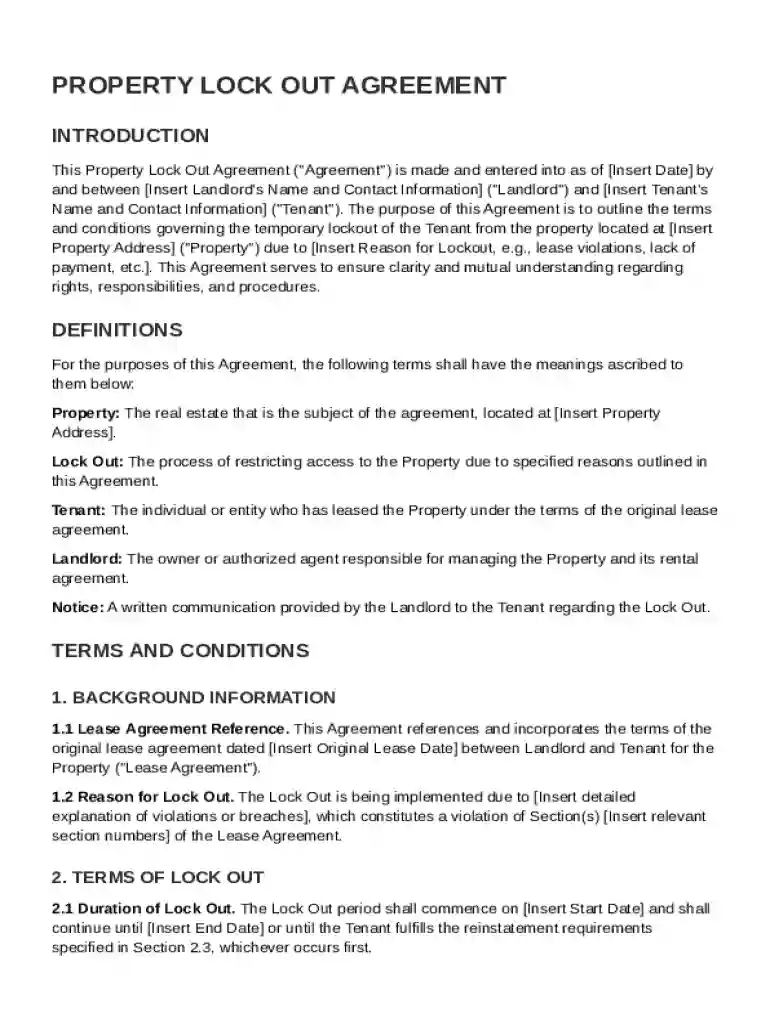
Property Lock Out Agreement Template Preview on Page 1

Here's how it works

01. Edit your form online
Type text, add images, blackout confidential details, add comments, highlights and more.

02. Sign it in a few clicks
Draw your signature, type it, upload its image, or use your mobile device as a signature pad.

03. Share your form with others
Send it via email, link, or fax. You can also download it, export it or print it out.

Definition & Meaning

The Property Lock Out Agreement is a legal document that stipulates specific terms and obligations for both the Landlord and Tenant when a tenant is temporarily prohibited from accessing their rental property. This agreement is typically initiated due to breaches in lease conditions and serves to clearly outline the circumstances under which a tenant's access is restricted. Key details include the responsibilities of both parties, notification protocols, and conditions for reinstatement. It helps ensure that all parties are fully aware of their rights and obligations during this process, preventing any misunderstandings.

How to Use the Property Lock Out Agreement Template

To effectively use the Property Lock Out Agreement Template, parties should begin by familiarizing themselves with its comprehensive structure and provisions. Landlords and tenants should:

  1. Review the Terms: Thoroughly read and understand each clause to ensure clarity on responsibilities and conditions.
  2. Customize the Template: Modify any sections that require specific details pertinent to the property or the involved parties, such as names, addresses, and specific lease violations.
  3. Include Notifications: Specify how and when notifications should be sent, ensuring compliance with any legal notification requirements.
  4. Obtain Signatures: Both parties should sign the completed document, acknowledging their agreement to the terms outlined.

This structured approach enhances clarity and ensures the template is both legally sound and relevant to the specific situation.

Steps to Complete the Property Lock Out Agreement Template

Completing the Property Lock Out Agreement Template involves several key steps:

  1. Gather Information: Collect all necessary details about the tenant, landlord, and property involved. This includes contact information and lease details.
  2. Identify Violations: Clearly describe the lease violations that led to the lockout initiation.
  3. Set Conditions: Outline the lockout conditions, including its expected duration and any requirements for reinstating access.
  4. Insert Legal Clauses: Ensure that any relevant legal requirements, such as jurisdiction-specific clauses, are included in the agreement.
  5. Final Review: Double-check the document for completion and accuracy before signing.
  6. Signature Collection: Both parties should sign the agreement to enforce its terms.

These steps ensure the agreement is completed accurately and is enforceable.

Key Elements of the Property Lock Out Agreement Template

When creating or reviewing a Property Lock Out Agreement, certain elements must be present to ensure its effectiveness:

  • Identification of Parties: Clear identification of both the landlord and tenant involved in the agreement.
  • Reason for Lock Out: A detailed explanation of the specific lease violations triggering the lockout.
  • Notification Requirements: Information on how tenants will be informed about lockout conditions.
  • Access Conditions: Define under what circumstances and procedures a tenant may regain access to the property.
  • Legal Jurisdiction: Stipulate where any legal disputes arising from the agreement will be settled.
  • Liability Clauses: Clearly outline the responsibilities and liabilities of each party during the lockout period.

These elements collectively ensure that the agreement is thorough and legally compliant.

Legal Use of the Property Lock Out Agreement Template

The Property Lock Out Agreement Template must be used within the framework of applicable laws to remain legally enforceable. In practice, this involves:

  • Compliance: Ensuring the agreement complies with state and federal landlord-tenant laws.
  • Notification Adherence: Adhering to legal notification standards for enforcing a lockout.
  • Fair Treatment: Guaranteeing that the lockout and associated conditions are applied fairly without discrimination against the tenant.
  • Documented Violations: Keeping thorough documentation to support the violations cited in the agreement.

This ensures that the agreement is not only valid but also ethically implemented.

Important Terms Related to Property Lock Out Agreement Template

Familiarity with several terms is crucial when dealing with a Property Lock Out Agreement:

  • Lease Violation: Any breach of terms agreed upon in the original lease contract.
  • Reinstatement: The process by which a tenant can regain access to the property following a lockout.
  • Notification: The formal means by which landlords communicate breach notices or lockout intentions.
  • Liability: Legal responsibility for obligations outlined in the agreement.
  • Jurisdiction: The legal authority under which the agreement is governed and disputes are settled.

Understanding these terms helps in correctly interpreting and applying the agreement.

State-Specific Rules for the Property Lock Out Agreement Template

While the template serves as a universal guide, state-specific legal variances play a significant role:

  • Tenant Rights: Laws vary state-by-state regarding the rights tenants have during a lockout.
  • Notification Time Frames: Each state may stipulate different notification periods landlords must adhere to.
  • Legal Protections: States have unique regulations protecting tenants which must be integrated into the agreement.

Reviewing and adapting the agreement to comply with state-specific guidelines ensures its legal soundness and applicability.

Examples of Using the Property Lock Out Agreement Template

Practical application of the Property Lock Out Agreement Template can be understood through various scenarios:

  • Non-Payment of Rent: A tenant consistently fails to pay rent on time, prompting a landlord to initiate a lockout while adhering to the notification obligations and payment arrangements.
  • Unauthorized Alterations: A tenant conducts significant property modifications without permission. The lockout agreement becomes a tool of resolution, outlining restoration requirements.
  • Habitual Noise Complaints: Continued noise disturbances lead to lease violations. The template assists in detailing expectations and conditions for reinstating tenant access.

These examples highlight the template's usefulness across standard tenancy disputes, ensuring clarity and fairness for all invested parties.

be ready to get more

Complete this form in 5 minutes or less

Get form

Got questions?

We have answers to the most popular questions from our customers. If you can't find an answer to your question, please contact us.
Contact us
Lockouts refer to a situation where an employer temporarily prevents employees from working, typically as a measure during labor disputes or contract negotiations. In the context of business agreements, a lockout often involves the employer refusing to allow employees to access the workplace or perform their duties.
Lock-out agreements are often entered into between parties involved in commercial negotiations. They attempt to increase the opportunities for a successful conclusion by excluding either one or both of the parties from seeking or entertaining approaches from third parties.
A lockout is a situation in which employers close a place of work and prevent workers from entering it until the workers accept the employers new proposals on pay or conditions of work.
A purchase and sale agreement, or PSA, is a document that is written up and signed after a buyer and seller mutually agree on the price and terms of a real estate transaction. This practice typically apply to real estate transactions, but it can also be applied to other business agreements.
How do I create a Real Estate Purchase Agreement? Add general information. State what type of property is being sold. Establish the sale details. Set conditions for the sale. Describe the property. Provide buyer and seller details. Add final details. Outline tactics for conflict resolution.

Security and compliance

At DocHub, your data security is our priority. We follow HIPAA, SOC2, GDPR, and other standards, so you can work on your documents with confidence.

Learn more
ccpa2
pci-dss
gdpr-compliance
hipaa
soc-compliance

People also ask

This leaves so-called lock-out and lock-in agreements. A lock-out agreement is one which provides that the seller will not negotiate with any third party for a set period of time. A lock-in is the mirror image, requiring both parties positively to negotiate in good faith. Lock-outs are perfectly lawful.
These components, and the language describing them, clarify the details of the contract for both parties. Buyer and Seller Names and Information. Date of the Transaction. Asset Details. Purchase Price and Terms. Inclusions and Exclusions. Contingencies. Disclosures. Representations and Warranties.

Related links