
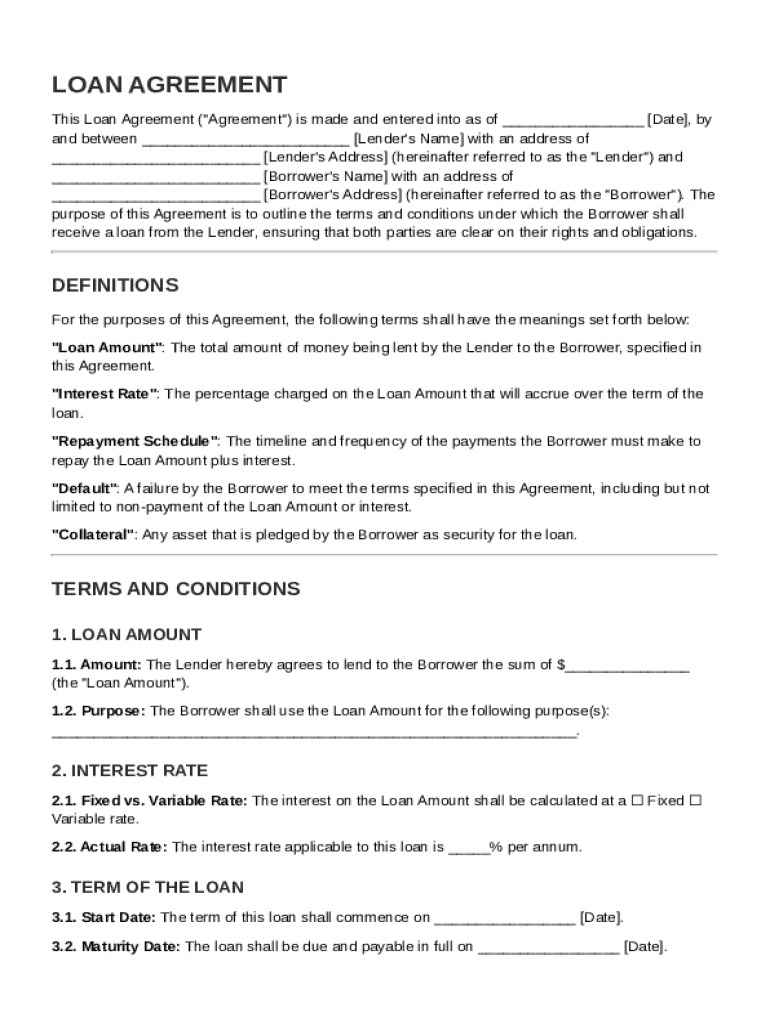







Key Elements of the Legally Binding Loan Agreement Template
A Legally Binding Loan Agreement Template is a critical document that outlines the terms and conditions of a loan between a lender and a borrower. Essential elements of this template include:
- Loan Amount: The specific sum of money the lender agrees to provide to the borrower.
- Interest Rate: The percentage of the loan amount charged as interest, which can be fixed or variable.
- Repayment Schedule: Detailed timelines for when payments are due, including installment amounts and frequencies.
- Collateral Requirements: Assets pledged by the borrower to secure the loan.
- Consequences of Default: Outlines what occurs if the borrower fails to meet the repayment terms.
Steps to Complete the Legally Binding Loan Agreement Template
Completing the template requires careful attention to detail to ensure all necessary elements are precise and enforceable:
- Identify the Parties: Clearly state the names and contact details of both the lender and the borrower.
- Detail Loan Terms: Specify the loan amount, interest rate, repayment schedule, and any fees.
- Include Collateral Information: Describe any assets used as collateral, if applicable.
- Define Default Terms: Specify actions taken if the borrower fails to repay, including penalties.
- Sign and Date: Both parties must review, sign, and date the agreement for it to take effect.
How to Use the Legally Binding Loan Agreement Template
Utilizing this template ensures clarity and mutual understanding between the lender and borrower:
- Drafting Process: Customize the template with specific terms and personal information relevant to the loan.
- Negotiation: Use the draft to discuss terms and make necessary adjustments with the other party.
- Review and Finalize: Both parties should review the finalized document and clarify any lingering questions.
- Execution: Once agreed upon, both parties sign the document, rendering it legally binding.
Legal Use of the Legally Binding Loan Agreement Template
Understanding the legal implications is essential to ensure the document is enforceable:
- Compliance with Laws: The template must align with relevant state or federal regulations governing loan agreements.
- Inclusion of Legal Clauses: Add provisions for amendments, confidentiality, and dispute resolution to fortify the agreement.
- Enforcement: In the event of non-compliance, the agreement provides a basis for legal action or arbitration.
Important Terms Related to Legally Binding Loan Agreement Template
For a clear understanding, familiarization with key legal and financial terms is valuable:
- Principal: The original amount of money borrowed or still owed, excluding interest.
- Amortization: The process of gradually reducing debt through regular payments.
- Acceleration Clause: Provision allowing the lender to demand full repayment if certain conditions are breached.
- Severability: A clause ensuring that if part of the agreement is invalid, the rest remains enforceable.
Who Typically Uses the Legally Binding Loan Agreement Template
This template is versatile and applicable to various user groups:
- Individual Borrowers and Lenders: For personal loans between individuals who require a formalized agreement.
- Businesses: Companies may use it for corporate financing or inter-company loans.
- Financial Institutions: Formal loan agreements for client lending.


State-Specific Rules for the Legally Binding Loan Agreement Template
Awareness of state-specific regulations can impact the construction of the document:
- Interest Rate Caps: Some states impose legal limits on interest rates, affecting agreement terms.
- State-specific Disclosure Requirements: Certain states require specific disclosures to be included in the agreement.
- Usury Laws: State laws governing the maximum interest that can be charged on borrowed money.
Examples of Using the Legally Binding Loan Agreement Template
Real-life scenarios illustrate the application and adaptability of the template:
- Personal Loans: John borrows $5,000 from a friend, using the template to define repayment over two years with a fixed interest rate.
- Business Expansion: A small business owner uses the template to secure a loan from a partner for operational expansion.
- Family Loans: A parent loans their child money for a vehicle, detailing terms to ensure repayment.
State-by-State Differences
Understanding regional nuances is essential for compliance:
- Document Requirements: Some states require notarization or witnesses for the agreement to be valid.
- Interest and Fee Regulations: Variations in permissible administrative fees or additional charges may apply.
- Statutory Variances: Differences in statutes of limitations for enforcing loan agreements across states.
Versions or Alternatives to the Legally Binding Loan Agreement Template
Exploring different versions might cater to specific needs:
- Customizable Templates: Tailored agreements for unique circumstances such as revolving credit or balloon loans.
- Standard Format: Basic templates suitable for simple loans with clear, straightforward terms.
- Online Templates: Digital versions available via document editing platforms integrated with legal processing services.
Business Types that Benefit Most from Legally Binding Loan Agreement Template
Certain business entities may find the template particularly useful:
- Startups and SMEs: Often use the template for structured loans during early-stage financing.
- Real Estate Firms: Utilize the template for property-related loans that require legal and financial clarity.
- LLCs and Partnerships: Engage in member loans that require documentation for legal and tax purposes.
Required Documents
Preparation is key; several documents may be needed alongside the loan agreement:
- Proof of Income: Demonstrates the borrower's ability to repay the loan.
- Credit Reports: Provides the lender with the borrower's creditworthiness.
- Collateral Documentation: Details of any assets used as security for the loan.
Digital vs. Paper Version
Choosing between digital and physical formats can affect flexibility and usage:
- Digital Benefits: Easier modifications and sharing; stored securely with access control.
- Physical Copies: Helpful for jurisdictions requiring original signatures; accessible for non-digital users.
- Integration with Platforms: Online templates often incorporate electronic signatures and cloud storage options for convenience and security.




