




Definition and Purpose of a Private Party Car Loan Agreement Template
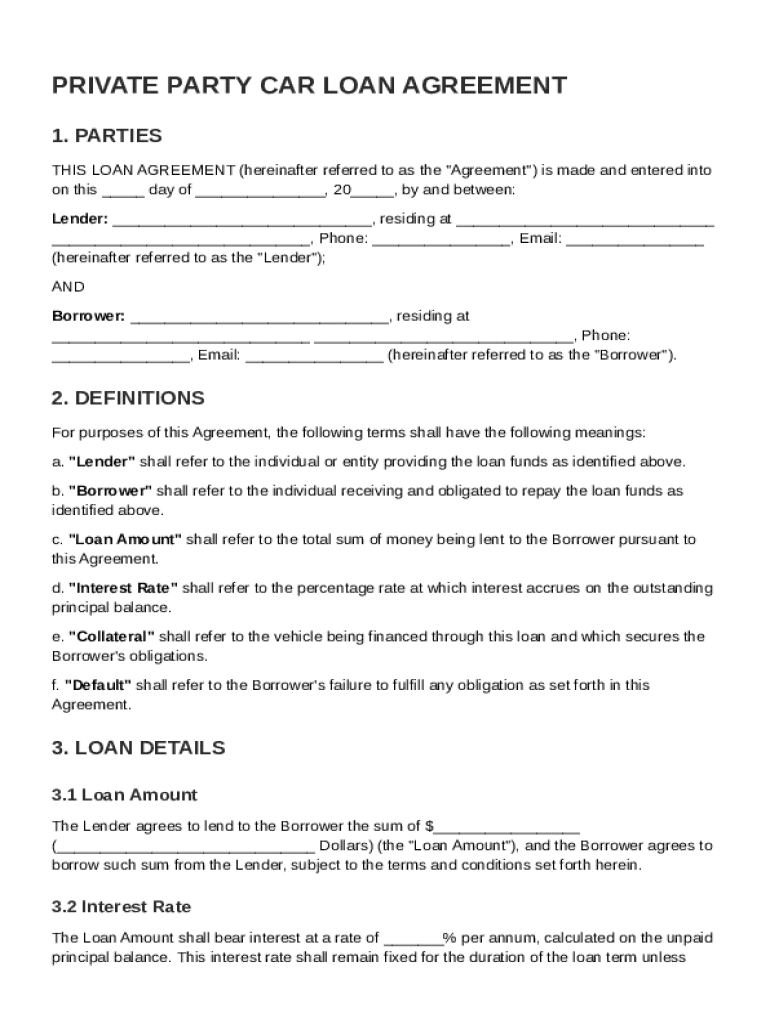
A Private Party Car Loan Agreement Template serves as a formal contract between a lender and a borrower involved in a private car loan transaction. This document is crucial for outlining the terms and conditions governing the loan. The comprehensive nature of the template ensures that both parties have a clear understanding of their obligations, mitigating potential disputes. A typical loan agreement template includes details such as the loan amount, interest rates, payment schedule, and collateral information. It confirms the responsibilities of the borrower to repay the loan while also protecting the lender's interests. The template's structured approach helps maintain transparency and fairness in these agreements.
Key Elements in the Template
- Parties Involved: Identification of the lender and borrower, including full names and contact information.
- Loan Details: Specification of the loan amount and interest rate applied.
- Payment Terms: Clear outline of the payment schedule, including start and end dates.
- Collateral Description: Details of the vehicle being used as collateral including make, model, and VIN.
- Default Conditions: Conditions under which the borrower is considered in default and potential remedies available to the lender.
- Legal Clauses: Governing law, modification terms, and severability clause.
How to Use the Private Party Car Loan Agreement Template
When using the Private Party Car Loan Agreement Template, the first step is to gather all necessary information about the transaction. Begin by filling out both parties’ details to ensure proper identification. Provide accurate descriptions of the vehicle to be used as collateral, including serial numbers and any unique identifiers, as these specifics are critical for legal enforcement.
Steps for Completion
- Fill Out the Parties' Information: Complete the lender's and borrower's information sections.
- Input Loan Particulars: Specify the principal amount, interest rate, and payment schedule.
- Detail the Collateral: Provide detailed information about the car, making sure to list its identification numbers.
- Review Default and Remedy Provisions: Ensure both parties understand the consequences of default as well as the remedial measures.
- Include Legal Clauses: Make sure all legal stipulations are relevant to the jurisdiction overseeing the agreement.
Steps to Complete the Private Party Car Loan Agreement Template
To accurately complete the Private Party Car Loan Agreement, it's vital to follow a methodical approach:
- Gather Required Information: Collect all necessary data, including the identification and contact details of both parties, as well as the car specifications.
- Use the Template: Open the digital document on a platform like DocHub for seamless editing and filling.
- Fill Out Each Section: Begin with the personal details and then proceed with entering the loan terms, ensuring clarity and accuracy.
- Add Legal Provisions: Incorporate any state-specific legal requirements or additional clauses needed for the agreement’s enforceability.
- Review and Revise: Double-check all the information entered to ensure there are no errors or omissions.
- Sign and Notarize: Secure signatures from both parties and arrange for a notarization if required by the jurisdiction.
Legal Use of the Private Party Car Loan Agreement Template
The Private Party Car Loan Agreement Template helps ensure the loan terms are legally binding. It is important to understand that while this template provides a comprehensive foundation, legal advice may be required to align the document fully with specific state laws. The legally binding aspect of this agreement is contingent upon accurate completion and both parties understanding their obligations. The inclusion of a notary acknowledgment enhances the legal authenticity of the document.
State Compliance
- State-Specific Laws: Discuss variations and compliance with state-specific laws that might affect the agreement.
- Notary Requirements: Many states require notarized signatures to enforce the agreement legally.
Important Terms Related to the Private Party Car Loan Agreement Template
Understanding the jargon and terminology used within the Private Party Car Loan Agreement is critical for both parties. Here are some key terms to be familiar with:
- Principal: The original sum borrowed.
- Interest Rate: The percentage charged on the borrowed sum.
- Amortization: The schedule of loan repayments.
- Collateral: The vehicle used as security for the loan.
- Default: Failure to meet the loan repayment terms.
- Remedy: Legal recourse available in the event of a default.
Each of these terms serves as a cornerstone in the contractual context of a car loan, ensuring clarity and conciseness.
State-Specific Rules for the Private Party Car Loan Agreement Template
The application of the Private Party Car Loan Agreement Template can vary significantly depending on state laws. Some states have specific provisions regarding interest rates, loan amounts, or mandates requiring additional documentation for financing vehicles privately.
Examples of State Differences
- Interest Rate Caps: Some states impose limits on the interest rates that can be charged.
- Default Clauses: Different states have unique stipulations on what constitutes a default and the recourse available.
- Disclosure Requirements: States may require specific forms or language to be included within the agreement to protect consumer rights.
Examples of Using the Private Party Car Loan Agreement Template
Illustrative examples can help clarify the practical use of the template:
- Scenario 1: A college student loans a vehicle from a family member. The template is used to formalize the terms, including a nominal interest rate, to ensure legal compliance.
- Scenario 2: An individual sells their car to a friend with a structured payment plan. The agreement clearly defines the payment schedule and collateral details to prevent misunderstandings.
Real-World Application
- Family Transactions: Outlines how the template helps maintain impartiality in family loans.
- Peer-to-Peer Sales: Highlights the importance of legal documentation in maintaining trust and clarity.
Legally Binding Electronic Signatures in the Agreement Process
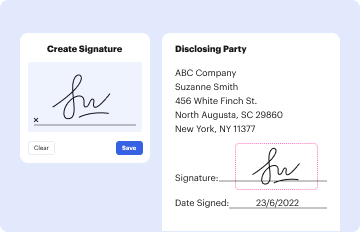
Utilizing DocHub's tools for electronic signatures ensures that car loan agreements are both secure and legally binding. The ESIGN Act supports electronic signatures' validity, making the process swift and efficient without compromising legality.
Features of Electronic Signatures
- Draw, Type, or Upload: Users can create signatures in various ways, ensuring flexibility.
- Storage and Reuse: Signatures can be saved and used for future agreements, streamlining subsequent processes.
This feature is essential for individuals seeking a swift, reliable way to validate legal agreements without the need for physical documents.