Rental Arbitrage Lease Agreement Template 2026

Get Form
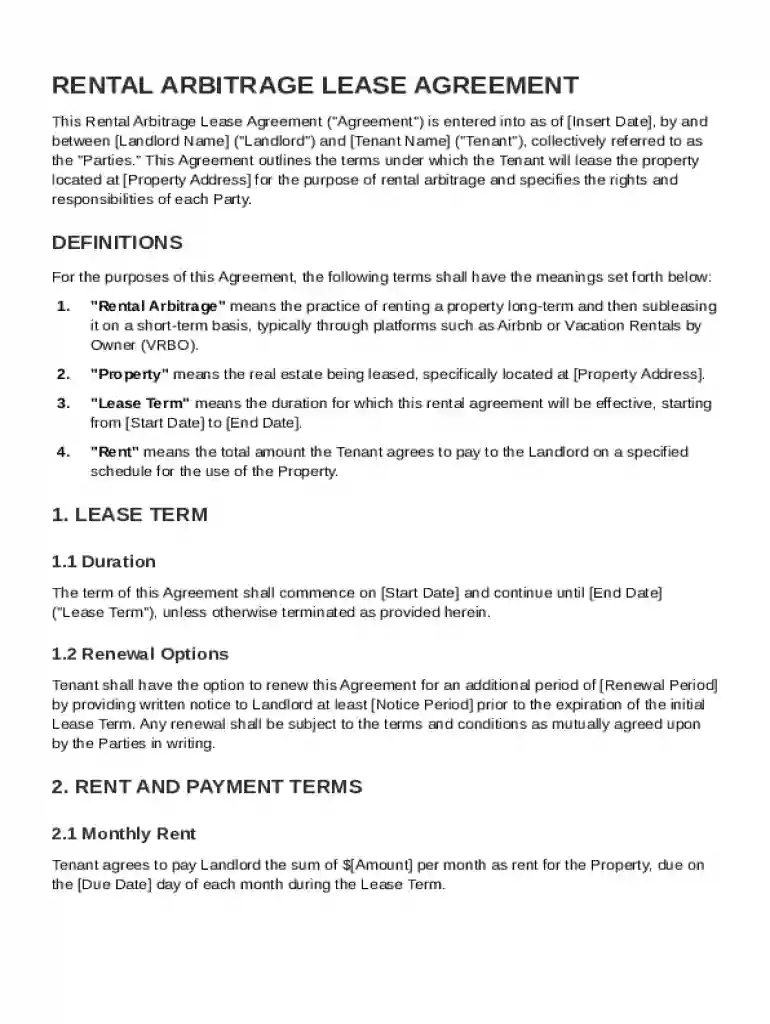
Rental Arbitrage Lease Agreement Template Preview on Page 1

Here's how it works

01. Edit your form online
Type text, add images, blackout confidential details, add comments, highlights and more.

02. Sign it in a few clicks
Draw your signature, type it, upload its image, or use your mobile device as a signature pad.

03. Share your form with others
Send it via email, link, or fax. You can also download it, export it or print it out.

Definition & Meaning

The Rental Arbitrage Lease Agreement Template is a legal contract used between a landlord and a tenant for leasing property with the intention of subleasing it on platforms such as Airbnb, VRBO, or similar. It acts as a formal agreement that outlines the terms and conditions of such an arrangement, ensuring that both parties are aware of their rights and obligations. This template assists in legally protecting both the landlord's property and the tenant's business interests by clearly defining usage terms, financial responsibilities, and compliance duties.

Key Elements of the Rental Arbitrage Lease Agreement Template

This template typically consists of several critical components that form the backbone of the agreement:

  • Lease Duration and Renewal Options: Outlines the start and end dates of the lease term, along with provisions for renewal if applicable.
  • Rent Payment Details: Specifies the amount of rent due, payment frequency, and accepted payment methods.
  • Security Deposit Conditions: Details the amount, handling, and return conditions of the security deposit.
  • Permitted Use of the Property: Clarifies the use intended under the rental arbitrage model, such as short-term vacation rentals.
  • Maintenance Responsibilities: Allocates maintenance responsibilities between the landlord and tenant.
  • Termination Procedures: Outlines the conditions under which the lease can be terminated by either party.
  • Indemnification Clauses: State the tenant's responsibilities to protect the landlord against certain types of legal liabilities.

How to Use the Rental Arbitrage Lease Agreement Template

Utilizing the template requires several key steps to ensure it meets both parties' needs and adheres to local laws:

  1. Download the Template: Obtain the template from a reliable source like DocHub to ensure it contains all necessary provisions.
  2. Review the Template: Both parties should carefully review the terms, modifying any sections to reflect specific agreements made between them.
  3. Personalize the Terms: Fill in personalized details such as names, rental amounts, and specific property use conditions.
  4. Consult with Legal Experts: It’s often beneficial to have a lawyer review the agreement to ensure compliance with local laws.
  5. Sign the Document: Once satisfied, both parties should sign the document electronically or in-person, depending on what is agreed.

Important Terms Related to Rental Arbitrage Lease Agreement Template

Understanding the vocabulary used in these agreements is crucial:

  • Sublease: A lease by a tenant to another party of all or part of premises leased by said tenant.
  • Arbitrage: The practice of taking advantage of a price difference between two or more markets.
  • Short-Term Rental: The rental of a property for a short period, typically under one month.
  • Indemnity: Protection from legal liability for one party, provided by another.

Legal Use of the Rental Arbitrage Lease Agreement Template

The legal framework surrounding rental arbitrage can vary significantly between jurisdictions. Therefore:

  • Compliance with Local Laws: It’s essential to ensure the template complies with state and city laws regarding short-term rentals.
  • Regulatory Requirements: Some areas might require permits or registrations for properties used as short-term rentals.
  • Liability Coverage: Landlords and tenants should both clarify how liability is covered in case of property damage or legal issues arising from third-party use.

Who Typically Uses the Rental Arbitrage Lease Agreement Template

Typically, this template is used by:

  • Real Estate Investors: Individuals or companies looking to capitalize on short-term rental markets.
  • Property Managers: Professionals managing multiple properties for clients and utilizing rental arbitrage.
  • Entrepreneurial Tenants: Renters seeking passive income opportunities through subleasing accommodations.
decoration image ratings of Dochub

Steps to Complete the Rental Arbitrage Lease Agreement Template

Completing this template involves several detailed steps:

  1. Input Basic Information: Fill in the names of the parties, address of the premises, and lease term.
  2. Detail Financial Terms: Specify rent amounts, due dates, and any additional costs or fees.
  3. Set Property Use Guidelines: Provide clear guidelines about subleasing rules and short-term rental approvals.
  4. Outline Responsibilities: Assign maintenance tasks and responsibilities to each party.
  5. Finalize and Sign: Review all information for accuracy and completeness, then sign the document.

State-Specific Rules for the Rental Arbitrage Lease Agreement Template

Since real estate laws differ among states, users must:

  • Research State Laws: Be aware of any state-specific rules or regulations affecting lease agreements and rental practices.
  • Amend the Template: Adjust the template to include any required legal disclosures or clauses mandated by state law.
  • Ensure Compliance: Verifying compliance helps avoid legal disputes or penalties related to lease agreements.

Examples of Using the Rental Arbitrage Lease Agreement Template

Real-world scenarios illustrate the template’s application:

  • Case Study in California: A tenant in Los Angeles utilizes this template to manage an apartment as an Airbnb, earning significant profits while ensuring compliance with local laws.
  • Example in New York: A property investor rents a series of apartments for corporate short-term leases, using this template to manage terms efficiently across multiple locations.
be ready to get more

Complete this form in 5 minutes or less

Get form

Got questions?

We have answers to the most popular questions from our customers. If you can't find an answer to your question, please contact us.
Contact us
What is the 80/20 rule for Airbnb? The 80/20 rule shows up often in short-term rentals: about 80% of bookings or revenue usually comes from 20% of listings. High-performing propertiesones with great photos, strong reviews, and a smooth guest experiencetend to pull in most of the income.
If you are looking to enter the vacation rental market with low startup costs and have flexibility in the properties you manage, rental arbitrage may be a good fit for you. However, if you are risk-averse or have restrictions on subletting in your lease agreement, it may not be the best strategy for your business.
Common contents of a lease agreement include: Names of the lessor and lessee or their agents. Description of the property. Amount of rent and due dates, grace period, late charges.
In what U.S. states is Airbnb rental arbitrage legal? Yes, short-term rental arbitrage is legal through all 50 states of the U.S. However, several major cities have either banned or restricted short-term rentals.
Rental arbitrage is a business model where an individual or entity enters into a long-term lease agreement with a landlord and then re-rents that property on a short-term basis through booking platforms like Airbnb or Vrbo.

Security and compliance

At DocHub, your data security is our priority. We follow HIPAA, SOC2, GDPR, and other standards, so you can work on your documents with confidence.
Learn more
ccpa2
pci-dss
gdpr-compliance
hipaa
soc-compliance

People also ask

Rental arbitrage is a business model where an individual or entity rents a property long-term and then re-rents or sublets that property on a short-term basis on booking platforms like Airbnb or Vrbo.
Original lease agreement: The document must be in writing and signed by both parties. ID proof of landlord and tenant: Valid identification such as a passport, voter ID, or Aadhaar card. Property ownership proof: The landlord must present the title deed or a document that proves their ownership of the property.

Related links