Home Builder Contract Template 2026

Get Form
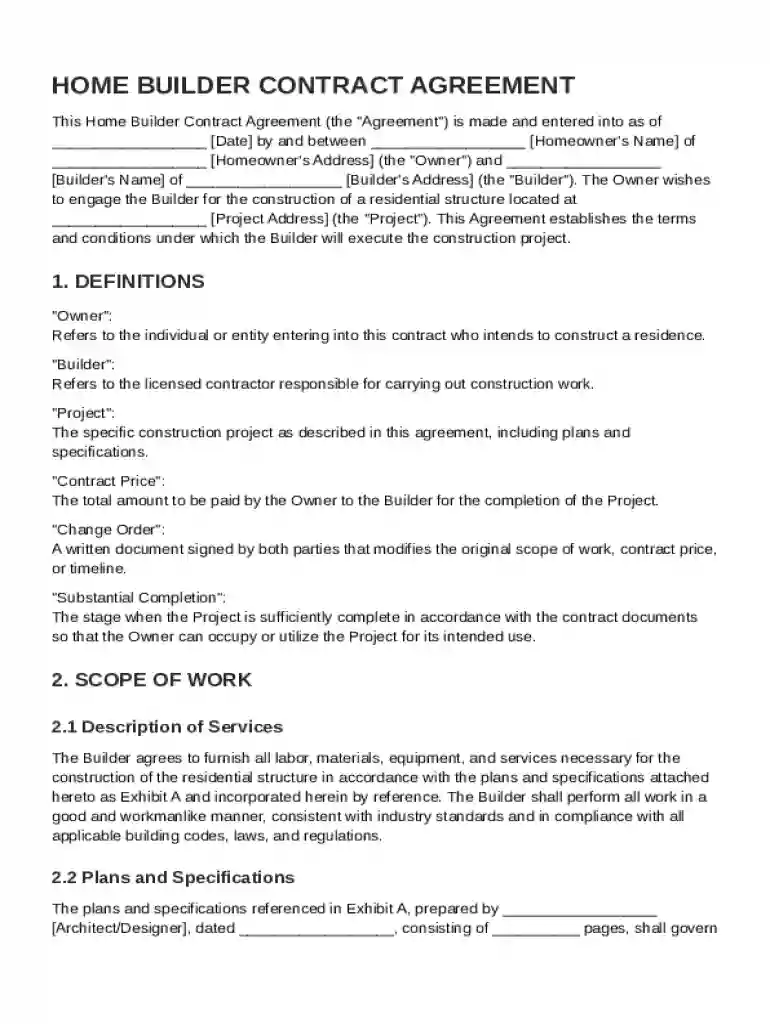
Home Builder Contract Template Preview on Page 1

Here's how it works

01. Edit your form online
Type text, add images, blackout confidential details, add comments, highlights and more.

02. Sign it in a few clicks
Draw your signature, type it, upload its image, or use your mobile device as a signature pad.

03. Share your form with others
Send it via email, link, or fax. You can also download it, export it or print it out.

Definition and Purpose of a Home Builder Contract Template

A Home Builder Contract Template is a predefined document used to outline the agreements between a homeowner and a builder for constructing a residential property. This contract ensures that both parties have a clear understanding of their responsibilities and the scope of work. It includes crucial details such as project specifications, cost estimates, timelines, and payment schedules.

  • Project Specifications: Detailed descriptions of the construction work to be performed, including materials and design.
  • Cost Estimates: Clear breakdown of construction costs to prevent unforeseen expenses.
  • Payment Schedules: Agreement on financial terms, including initial deposits and installment timings.

This template serves as a legal safeguard, promoting transparency and accountability throughout the construction process.

How to Use the Home Builder Contract Template

Using a Home Builder Contract Template involves several steps to ensure that all necessary details are captured and agreed upon by both parties.

  1. Review the Template: Begin by thoroughly reviewing the template to understand the sections and provisions included.
  2. Customize the Details: Customize the template with specific project information such as the property address, contact details, and project scope.
  3. Input Financial Terms: Specify the contract price, payment methods, and schedule for installments.
  4. Incorporate Legal Clauses: Ensure that all necessary legal clauses are included, particularly those related to dispute resolution and termination conditions.
  5. Finalize and Review: Both parties should review the completed template to ensure accuracy and clarity before signing.

This process ensures all relevant aspects of the construction agreement are legally documented.

Key Elements Within the Home Builder Contract Template

The Home Builder Contract Template includes several key components essential for a comprehensive agreement:

  • Scope of Work: Detailed and itemized list of work to be completed.
  • Timelines: Clearly defined start and completion dates for the project.
  • Responsibilities: Defined roles and responsibilities for both the builder and homeowner.

These elements provide structure and clarity, which help in preventing future disputes about missed expectations or incomplete work.

Who Typically Uses the Home Builder Contract Template

Typically, this template is utilized by various parties involved in residential construction:

  • Homeowners: To formalize the construction of their new homes or major renovations.
  • Builders and Contractors: To outline the terms and expectations of their service delivery.
  • Legal Advisors: To ensure legal compliance and to advise their clients during contract negotiations.

Having a standard document assists these parties in navigating the complexities of a construction project smoothly.


decoration image ratings of Dochub

Important Terms Related to Home Builder Contract Template

Understanding certain critical terms within the Home Builder Contract Template is essential:

  • Force Majeure: Situations beyond control that could delay project completion, such as natural disasters.
  • Lien Waivers: Protection against claims that suppliers or subcontractors may place on a property.
  • Substantial Completion: The stage where the home can be occupied even if minor pieces of work remain.

Each term is included to provide clarity and prevent potential legal challenges during or after project completion.

Legal Use of the Home Builder Contract Template

Ensuring the legal validity of the Home Builder Contract Template is crucial for enforceability:

  • Compliance with State Laws: The contract must conform to specific legal requirements applicable in the state where the construction occurs.
  • Signature Requirements: Obtaining signatures from all parties involved, along with witnesses if required, for the contract to be binding.
  • Arbitration Clauses: To outline how disputes will be resolved without litigation.

These elements help in safeguarding both parties' rights, minimizing the potential for costly legal disputes.

State-Specific Rules for the Home Builder Contract Template

Contract requirements can vary significantly by state:

  • Licensing Requirements: Builders must possess the appropriate state licenses to conduct construction work legally.
  • Regulatory Compliance: Must adhere to state-specific building codes and safety regulations throughout the project.
  • Payment Terms Regulations: Some states regulate the amount of money that can be demanded upfront.

Adhering to these state rules ensures that the contract not only meets local legal standards but also protects all involved parties' interests adequately.

Steps to Complete the Home Builder Contract Template

Completing a Home Builder Contract Template involves careful execution of several steps:

  1. Gather Needed Information: Collect all necessary data including personal information of parties, project details, and financial terms.
  2. Input Information: Methodically populate the template sections with the gathered information, focusing on accuracy.
  3. Legal Consultation: Ensure a qualified legal advisor reviews the filled-out document for compliance and adequacy.
  4. Final Review and Adjustment: Both parties conduct a final review to make any necessary adjustments before signing.
  5. Execution: The final step is the execution of the contract by getting the signatures from all involved parties.

These structured steps ensure that the contract is complete, accurate, and legally binding which reduces the risk of future misunderstandings.

be ready to get more

Complete this form in 5 minutes or less

Get form

Got questions?

We have answers to the most popular questions from our customers. If you can't find an answer to your question, please contact us.
Contact us
A contract should contain everything agreed upon by you and your licensed contractor. It should detail the work, price, when payments will be made, who gets the necessary building permits, and when the job will be finished. The contract also must identify the contractor, and give their address and license number.
To that end, before you sign anything and start working, make sure your contract has these 5 key elements. A Detailed Scope of Work. Project Cost and Payment Schedule. Construction Timeline. Change Order Process. Project Issues and Dispute Resolution.
How To Write A Construction Contract With 7 Steps Step 1: Define the Parties Involved. Step 2: Outline the Scope of Work. Step 3: Establish the Timeline. Step 4: Determine the Payment Terms. Step 5: Include Necessary Legal Clauses. Step 6: Address Change Orders and Modifications. Step 7: Sign and Execute the Contract.
A turnkey contract ensures that all the responsibilities during the construction lies with the contractor, which saves a lot of time for the homeowner. The homeowners have to involve a lower risk as all the tasks are performed by the contractor itself.
Some examples of simple contracts are common types of contracts like service agreements (e.g., hiring a freelancer), NDAs, loan agreements, sales agreements (e.g., vendor/supplier deals), and rental agreements (e.g., camera rental terms).

Security and compliance

At DocHub, your data security is our priority. We follow HIPAA, SOC2, GDPR, and other standards, so you can work on your documents with confidence.

Learn more
ccpa2
pci-dss
gdpr-compliance
hipaa
soc-compliance

People also ask

How to draft a contract in 13 simple steps Start with a contract template. Understand the purpose and requirements. Identify all parties involved. Outline key terms and conditions. Define deliverables and milestones. Establish payment terms. Add termination conditions. Incorporate dispute resolution.
Elements of a construction contract Name of contractor and contact information. Name of homeowner and contact information. Describe property in legal terms. List attachments to the contract. The cost. Failure of homeowner to obtain financing. Description of the work and the completion date. Right to stop the project.

Related links