01. Edit your form online
Type text, add images, blackout confidential details, add comments, highlights and more.

Type text, add images, blackout confidential details, add comments, highlights and more.

Draw your signature, type it, upload its image, or use your mobile device as a signature pad.

Send it via email, link, or fax. You can also download it, export it or print it out.
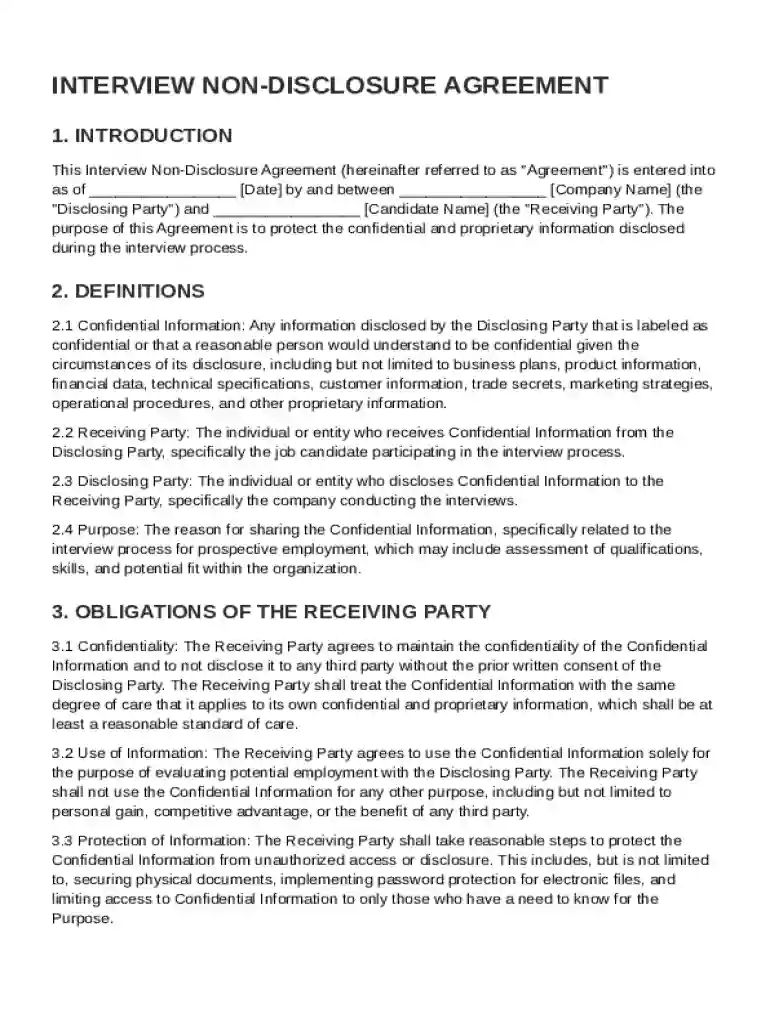
An Interview Non-Disclosure Agreement (NDA) is a legal contract between a company and a job candidate. Its primary purpose is to protect the confidential information shared during the hiring process. This agreement defines what constitutes confidential information and details the obligations of the candidate to maintain confidentiality. It is vital in preventing the unauthorized dissemination of sensitive information shared during interviews, such as trade secrets, client details, or business strategies.
This agreement is crucial in various scenarios, including the hiring of high-level executives or technical staff, where sensitive information is at play. Businesses utilize NDAs to ensure candidates do not disclose proprietary information to competitors or the public, thus safeguarding their competitive edge.
The NDA template typically includes several critical components:
Each section is designed to offer protection and clarity to both parties involved, reducing the risk of misunderstandings or legal disputes.
Legally, NDAs must comply with state and federal laws to be enforceable. In the United States, NDAs are generally governed by contract law, and enforceability can vary by state. For instance, California has specific restrictions on NDAs in employment settings, particularly concerning trade secret protection.
Businesses often consult legal professionals to tailor NDAs according to local laws while ensuring comprehensive protection. Legal use also involves ensuring candidates fully understand the NDA's terms before signing, as informed consent is vital for enforceability.
Employing an Interview NDA is beneficial for several reasons:
For companies, this template mitigates risks and establishes clear boundaries, reassuring them that their information is secure during the recruitment process.
Using an NDA template involves several steps:
Using these steps ensures both parties are on the same page regarding confidentiality expectations, which is crucial for preventing future disputes.
Different terms within an Interview NDA template are essential to understand:
Familiarization with these terms aides in clearer communication between the company and job candidates.
The process of completing the NDA template encompasses a sequence of actions:
These steps streamline the process, making it efficient yet thorough.
While NDAs are commonly used across the U.S., different states may have unique requirements or restrictions:
Understanding state-specific laws can prevent rewriting agreements that could be deemed unenforceable, thus ensuring compliance and the effectiveness of the NDA.
This template is frequently utilized by:
The typical users reflect businesses that rely on confidentiality to maintain a competitive edge.


At DocHub, your data security is our priority. We follow HIPAA, SOC2, GDPR, and other standards, so you can work on your documents with confidence.