




01. Edit your form online
Type text, add images, blackout confidential details, add comments, highlights and more.

Type text, add images, blackout confidential details, add comments, highlights and more.

Draw your signature, type it, upload its image, or use your mobile device as a signature pad.

Send it via email, link, or fax. You can also download it, export it or print it out.
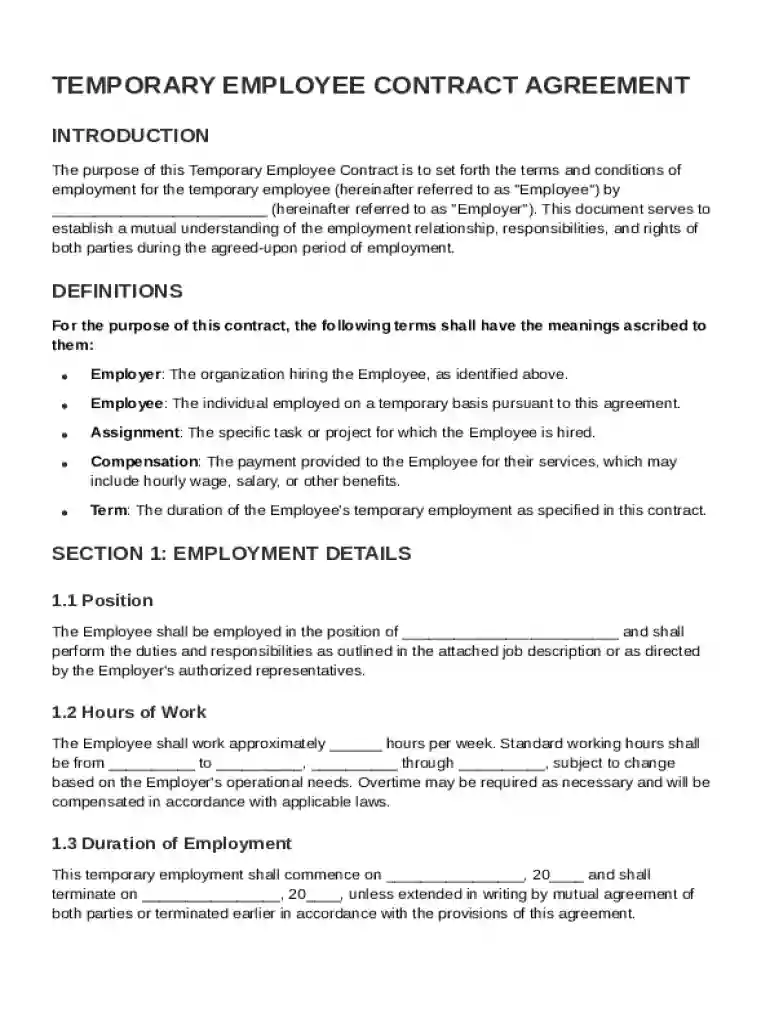
The Temporary Employee Contract Template serves as a legal document used to outline the specific terms and conditions under which a temporary employee is hired. It delineates the relationship between the employer and the employee, ensuring that both parties have a clear understanding of what is expected. This document typically includes vital details such as the job position, duration of employment, and compensation arrangements. The use of this contract ensures that temporary employment engagements are structured, fair, and legally compliant.
This section focuses on the critical components that comprise a Temporary Employee Contract Template, aiming to establish a comprehensive understanding of its structure and contents.
For instance, if a business hires a temporary worker to assist during the holiday season, the contract would state that employment ends on a specific date, or once demand decreases.
Completing the Temporary Employee Contract Template involves several specific steps to ensure accuracy and compliance with both company policies and legal requirements.
Terms within the Temporary Employee Contract Template are pivotal in shaping the understanding of employment agreements. Clearly defining these terms prevents misinterpretations that could result in disputes.
Utilizing the Temporary Employee Contract Template legally ensures that both employers and employees are protected under applicable labor laws, reducing the risk of disputes and potential litigation.
A retail company hiring temporary staff for inventory management can use this template to legally bind the terms, thereby preventing arbitrary dismissals or unwarranted pay alterations.
Different states have varying rules regarding employment laws, which must be considered when drafting a Temporary Employee Contract to remain compliant and legally binding.
For those using digital documentation systems, compatibility with various software is necessary for seamless integration and utility.
By providing easy editing, sharing, and signing capabilities, DocHub ensures that users can maintain efficient workflows and uphold legal documentation requirements.
The choice between using a digital or paper version of the contract has implications for accessibility, security, and environmental considerations.
While some entities may still prefer physical copies for traditional reasons, they pose challenges such as limited accessibility and increased risk of loss or damage.
At DocHub, your data security is our priority. We follow HIPAA, SOC2, GDPR, and other standards, so you can work on your documents with confidence.







Examples of contract templates include Temporary Labour Contract, Permanent Labour Contract, Commercial Contracts, Terms Conditions or SLAs with customers
Temporary employment has no minimum hours, can end anytime, no appeal rights, no leave accrual, no time off pay, no tenure, and no PERS eligibility.
This is to confirm that you have been hired as a temporary worker in the (Name of Department). Your hourly rate is $ and you will be paid weekly; a


