




01. Edit your form online
Type text, add images, blackout confidential details, add comments, highlights and more.

Type text, add images, blackout confidential details, add comments, highlights and more.

Draw your signature, type it, upload its image, or use your mobile device as a signature pad.

Send it via email, link, or fax. You can also download it, export it or print it out.
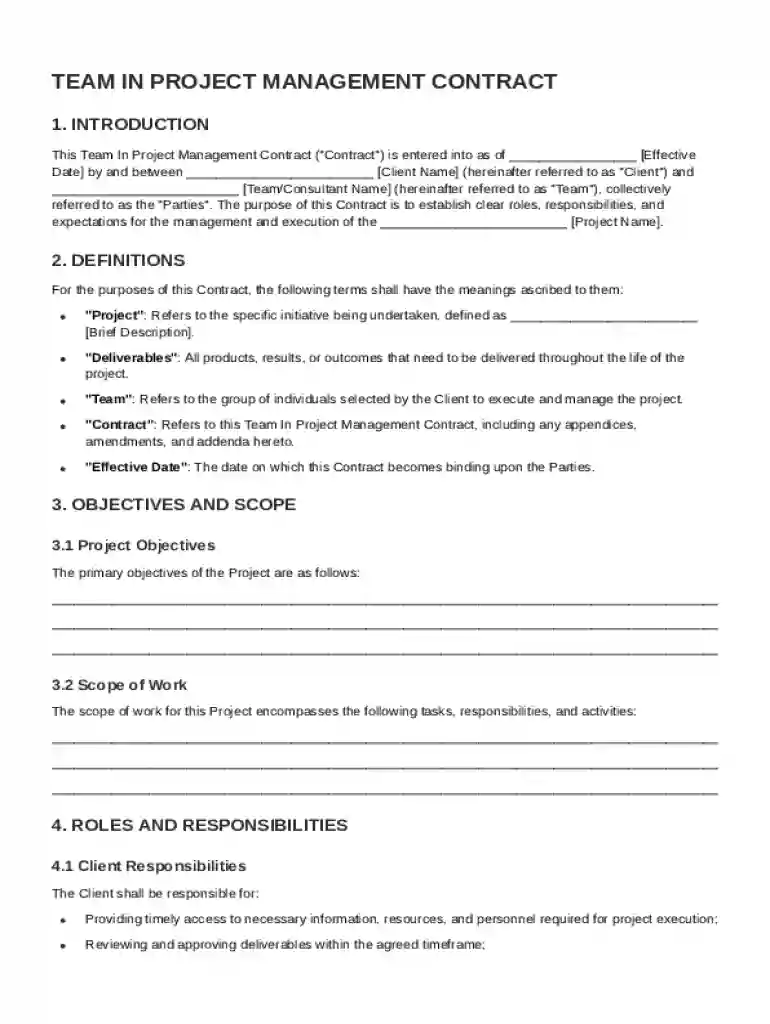
A Team In Project Management Contract Template is a structured document used to formalize agreements between a client and a team involved in project management. This template outlines all necessary details such as roles, responsibilities, objectives, and authorized activities within a project. Aimed at streamlining project execution, these agreements help reduce misunderstandings and create a legal framework for all parties.
The contract template typically encompasses:
Several crucial components make up the Team In Project Management Contract Template, ensuring the clarity and enforceability of the agreement.
Project Timeline: A detailed schedule that includes start and end dates, major milestones, and delivery timelines. This assures all parties are aware of deadlines and can plan their actions accordingly.
Termination Conditions: Outlines circumstances under which the contract can be legally terminated, be it for non-performance or mutual consent. This prevents legal complications if collaboration needs to end prematurely.
Dispute Resolution Processes: Provides a structured approach to handle disagreements, including mediation and arbitration options. These measures help manage conflicts amicably without resorting to litigation.
Governing Law: Specifies the jurisdiction whose laws will apply to the contract, providing a legal framework for its enforcement. It is typically determined by where the client or team resides or operates.
Utilizing a Team In Project Management Contract Template effectively requires understanding its structure and adapting it to fit the specific needs of a project.
Completing the template involves several key steps to ensure accuracy and completeness.
Understanding key terms is essential to properly utilizing the Team In Project Management Contract Template.
State requirements can affect the implementation of a project management contract. While there are general federal guidelines, specifics may vary state by state.
Under U.S. law, the Team In Project Management Contract Template must comply with various legal standards to be enforceable.
Applying the Team In Project Management Contract Template to real-world scenarios can clarify its utility.
Each of these examples underscores the flexibility of the template in different industries, simplifying collaboration and ensuring the project aligns with stakeholder expectations.
At DocHub, your data security is our priority. We follow HIPAA, SOC2, GDPR, and other standards, so you can work on your documents with confidence.


Team Contract Template. Team Name: These are the terms of group conduct and cooperation that we agree on as a team. Participation: We agree to
For small projects, the names of the team members can be included; for larger projects, the chart should name the groups or entities that form the project teams


