




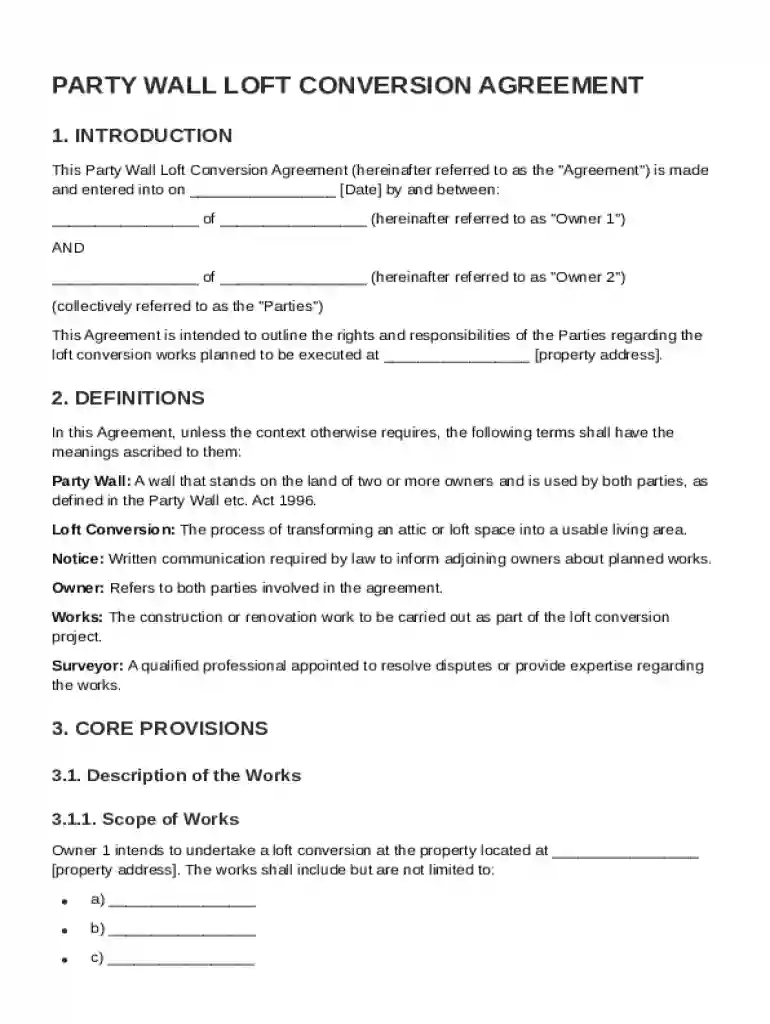
01. Edit your form online
Type text, add images, blackout confidential details, add comments, highlights and more.

Type text, add images, blackout confidential details, add comments, highlights and more.

Draw your signature, type it, upload its image, or use your mobile device as a signature pad.

Send it via email, link, or fax. You can also download it, export it or print it out.
The Party Wall Loft Conversion Agreement Template is a document that serves to outline the rights and responsibilities of two property owners when one party is planning a loft conversion. This template is designed to ensure that both parties are fully informed and protected during the construction process. It includes detailed provisions that cover the scope of work, access rights, notice requirements, and dispute resolution procedures. The agreement is vital in avoiding potential legal disputes by establishing clear guidelines and maintaining open communication throughout the project.
The Party Wall Loft Conversion Agreement Template is structured to cover several critical components to ensure a smooth process during a loft conversion. Understanding these elements helps in drafting a comprehensive agreement that benefits both property owners.
An example scenario could involve agreeing on specific hours during which construction can take place to minimize disturbances, ensuring that both parties are satisfied with the terms laid out in the agreement.
Completing the Party Wall Loft Conversion Agreement Template requires careful attention to detail to ensure that all necessary information is accurately recorded and agreed upon by both property owners.
The Party Wall Loft Conversion Agreement Template is a useful tool for setting clear expectations between neighbors sharing a common wall or boundary during a loft conversion project.
A homeowner looking to expand their living space by converting their loft might use this template to establish a formal agreement with their neighbor to avoid construction disputes.
Understanding the terminology within the Party Wall Loft Conversion Agreement Template is essential for correctly interpreting and using the document.
There is often confusion over "party walls" versus "boundary walls." The agreement will usually clarify this distinction to prevent future disputes.
The Party Wall Loft Conversion Agreement Template serves a crucial legal function by ensuring compliance with statutory requirements for building works affecting shared walls.
In a situation where a homeowner proceeded without serving the proper notice, resulting in damage to a shared wall, the absence of a legally binding agreement led to extended legal action, which could have been avoided with a completed template.
This template is commonly used by homeowners, builders, and legal advisors involved in construction projects affecting a shared wall.


A person wishing to increase property value by installing a loft enlists a lawyer to ensure that the agreement aligns with legal expectations, providing security against potential legal challenges.
The Party Wall Loft Conversion Agreement Template is typically not issued by any official governmental body but is instead drafted by legal professionals, architects, or builders specializing in construction law.
Using a professionally drafted template helps in maintaining neutrality and ensuring that all parties receive fair and equitable treatment under the agreement's terms.
At DocHub, your data security is our priority. We follow HIPAA, SOC2, GDPR, and other standards, so you can work on your documents with confidence.


When used appropriately, geothermal heat pumps can form the cornerstone of a sustainable and high-performing building design with excellent life-cycle cost
Students wishing to loft their beds can rent lofts from the. Office of Campus Life within the first two weeks of the semester. Lofts will be removed by the


