




Definition & Meaning
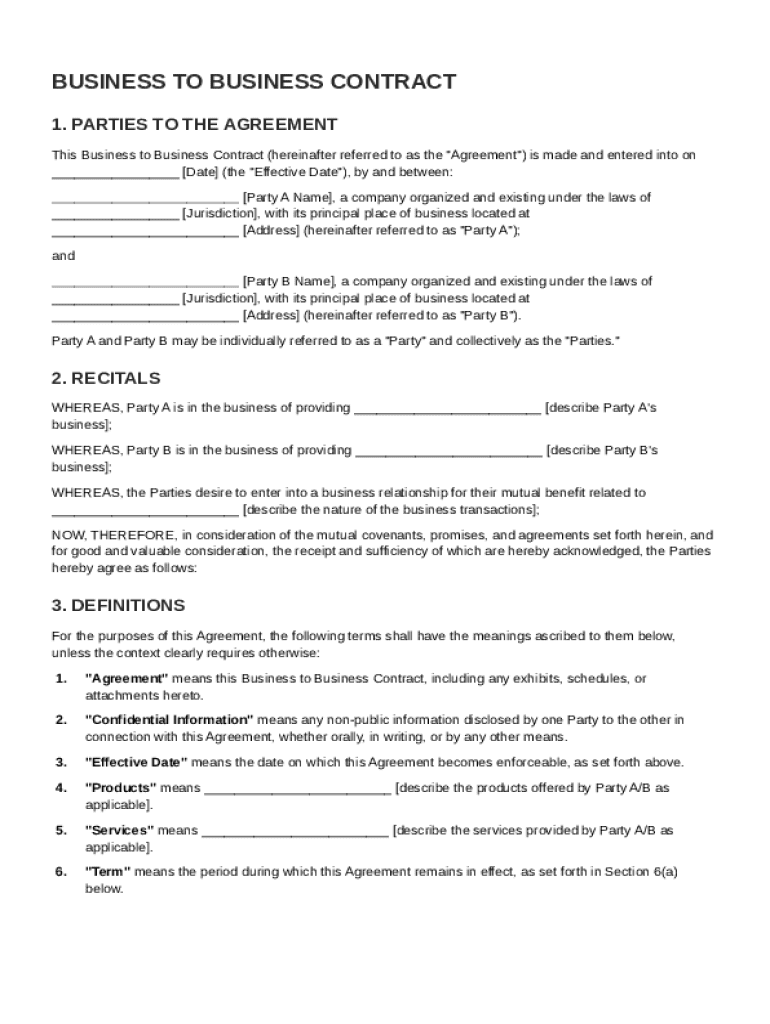
A Business to Business Contract, often referred to as a B2B Contract, establishes the terms and conditions between two business entities entering a collaborative agreement. This type of contract is distinct from consumer-focused agreements as it specifically outlines commercial transactions, detailing each party's responsibilities, scope of work, payment terms, and more.
Key Aspects of B2B Contracts
- Definitions: Clearly specifies the terms and parties involved, minimizing ambiguity.
- Scope of Work: Details the specific services or products provided, ensuring clear expectations.
- Legal Obligations: Outlines the legal responsibilities each party must uphold during the contract term.
Key Elements of the Business To Business Contract Template
This template encompasses crucial components essential for a comprehensive agreement, ensuring that both parties are legally protected and understand their mutual obligations.
Important Components
- Payment Terms: Specifies how and when payments are to be made, including methods and penalties for late payments.
- Confidentiality: Details the handling of sensitive information exchanged during the contract duration.
- Dispute Resolution: Provides mechanisms for resolving conflicts, such as mediation or arbitration, reducing litigation costs.
How to Use the Business To Business Contract Template
Utilizing the B2B Contract Template effectively involves understanding its structure and tailoring it to your specific business needs.
Steps to Customize
- Identify the Parties Involved: Clearly outline who the contract is between, including business names and representatives.
- Detail the Scope of Work: Customize sections to precisely detail the services or products exchanged.
- Review Legal Clauses: Ensure compliance with relevant laws and that each clause is pertinent to your agreement.
Who Typically Uses the Business To Business Contract Template
The template is widely adopted by various business entities that engage in commercial transactions or partnerships.

Common Users
- Small and Medium Enterprises (SMEs): Often use this template to streamline their contractual processes with vendors or service providers.
- Corporations: Employ it in structuring agreements with other large businesses or international partners.
- Startups: Utilize the contract to formalize collaborations or service agreements critical for scaling operations.

Important Terms Related to Business To Business Contract Template
Familiarity with key terminologies is essential when crafting or interpreting a contract to ensure clarity and prevent misunderstandings.
Critical Terminologies
- Indemnity: A provision where one party agrees to protect the other from potential loss or damage.
- Force Majeure: Covers unforeseen events that prevent parties from fulfilling the contract obligations.
- Governing Law: Indicates which jurisdiction's laws will be used to interpret and enforce the contract terms.
Steps to Complete the Business To Business Contract Template
Filling out a B2B Contract Template requires careful consideration and attention to detail to ensure all necessary information is captured correctly.
Comprehensive Steps
- Gather Required Information: Collect details of both parties and any pertinent business identifiers.
- Fill in Template Sections: Input specifics regarding payment schedules, deliverables, and deadlines.
- Consult Legal Counsel: Review the completed document with legal professionals to ensure compliance and accuracy.
Legal Use of the Business To Business Contract Template
Ensuring that your B2B contract is legally enforceable depends on adhering to specific principles and legal standards.
Legal Compliance
- Accurate Representation: Ensure all information presented is truthful and represents the actual agreement.
- Mutual Consent: Verify that both parties have willingly agreed to the terms and conditions outlined.
- Consideration: Reaffirm that each party is offering something of value in compliance with contractual obligations.
Digital vs. Paper Version
Modern contracts increasingly leverage digital platforms for execution, offering distinct advantages over traditional paper contracts.
Pros and Cons
- Digital Format:
- Advantages: Easier to store, secure, and share; enables electronic signatures.
- Disadvantages: Requires familiarity with digital tools; security concerns.
- Paper Format:
- Advantages: Perceived as more formal by some; no technology barrier.
- Disadvantages: Susceptible to physical damage and loss; more challenging to amend.
Software Compatibility (TurboTax, QuickBooks, etc.)
Ensuring compatibility with business management software can streamline contract management and integration with existing workflows.
Compatible Platforms
- Document Management Systems: Platforms like DocHub allow easy editing and signing of contracts.
- Accounting Software: QuickBooks and similar software can integrate with contract details for financial tracking.
- Project Management Tools: Aligns contract terms with project milestones and timelines for enhanced oversight.
Business Types That Benefit Most from Business To Business Contract Template
Certain business structures find the B2B contract template particularly advantageous due to its robust framework and clarity.
Benefitting Entities
- Limited Liability Companies (LLCs): Benefit from well-defined liability clauses and dispute resolution processes.
- Partnerships: Utilize it to formalize roles and revenue sharing, preventing conflicts between partners.
- Corporations: Make use of the template to outline extensive agreements typical of large-scale ventures.
By understanding and utilizing these structured elements and insights into the Business to Business Contract Template, companies can create legally sound and mutually beneficial contracts while enhancing their document workflow with the aid of platforms like DocHub.