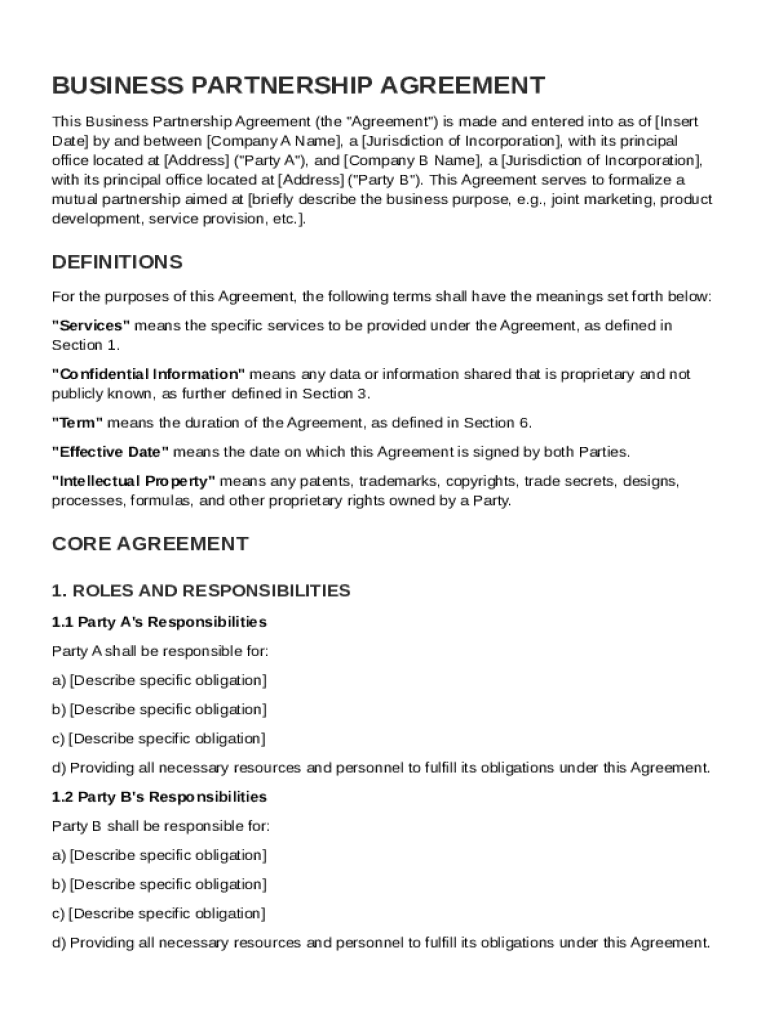







Definition & Meaning
The Business Between Two Companies Contract Template is a pre-structured document that serves as a formal agreement between two corporate entities. It delineates the roles, responsibilities, and expectations of each party involved, ensuring clear communication and understanding. This template is crafted to facilitate partnerships by providing a foundational legal framework that is customizable to suit specific business relationships.
Core Functions
- Establishes Roles and Responsibilities: Clearly defines each party's obligations, ensuring mutual understanding.
- Legal Protection: Acts as a safeguard against disputes by outlining terms, conditions, and procedures for resolution.
- Framework for Collaboration: Provides a structured approach to managing business interactions, supporting efficient cooperation.
Practical Applications
- Useful for various business collaborations, including partnerships, joint ventures, or service agreements.
- Ideal for startups and established companies seeking formalization of business arrangements.
How to Use the Business Between Two Companies Contract Template
Using the Business Between Two Companies Contract Template involves several key steps to ensure it fits the specific needs of the businesses involved.
Step-by-Step Guide
- Download the Template: Obtain the template in a compatible format to edit it easily.
- Identify Parties: Clearly state the legal names of the companies involved.
- Define Terms: Customize sections to reflect specific roles, responsibilities, and terms agreed upon by both parties.
- Add Specific Clauses: Include industry-specific clauses that might cater to the needs of your business, such as confidentiality or non-compete agreements.
- Review with Legal Counsel: Consult with a legal professional to confirm the contract meets regulatory requirements.
- Finalize and Sign: Ensure all parties sign the document to provide it with legal standing.
Customization Tips
- Consider the specific objectives of the partnership when defining each party's roles.
- Use precise language to eliminate ambiguity in responsibilities and expectations.
Important Terms Related to the Business Between Two Companies Contract Template
Understanding specific legal and business terms used within the contract is essential for all parties.
Key Terms
- Confidentiality: Protects sensitive information shared between parties.
- Intellectual Property (IP) Rights: Clarifies ownership and usage rights of any IP involved in the collaboration.
- Compensation Terms: Details how and when payments will be made.
- Termination Conditions: Conditions under which the agreement can be dissolved.
Examples
- Confidentiality clauses prohibit either company from disclosing proprietary information to third parties.
- Termination conditions might include breach of contract or mutual agreement.
Key Elements of the Business Between Two Companies Contract Template
The contract template is organized into essential sections that reflect core aspects of business agreements.
Essential Sections
- Introduction: Identifies the parties, the purpose of the contract, and the effective date.
- Scope of Work: Details the specific tasks and responsibilities of each party.
- Duration: Specifies the length of the contract and any conditions for renewal.
- Dispute Resolution: Provides methods for resolving disagreements, such as mediation or arbitration.
Detailed Breakdown
- Scope of Work: May include deliverables, timelines, and performance metrics.
- Dispute Resolution Methods: Options might consist of local jurisdiction courts or third-party arbitration.
Examples of Using the Business Between Two Companies Contract Template
Real-world scenarios where this contract template may be utilized demonstrate its versatility and relevance.
Case Studies
- A technology company partnering with a marketing firm to expand into new markets.
- Manufacturers defining terms with distributors to ensure product delivery and quality maintenance.
Benefits
- Facilitates transparent partnerships with clear guidelines on collaboration.
- Streamlines operations by reducing misunderstandings through clearly defined roles.
Legal Use of the Business Between Two Companies Contract Template
This section explains the legal standing and applications of using the contract template in a business setting.
Compliance and Enforcement
- Legally Binding: Ensures that agreements are enforceable by law once signed.
- Consistency with Laws: Must align with local, state, and federal laws to avoid conflicts.
Legal Counsel
- Engaging with legal advisors is crucial to adapting the template legally and effectively.
- Ensures compliance with industry-specific regulations, such as those for financial services or healthcare.
State-Specific Rules for the Business Between Two Companies Contract Template
Consideration of state-specific requirements is crucial for the enforceability and customization of the contract template.
State Regulations
- Differences in contract law across states can affect agreements.
- Awareness of state-specific clauses, such as non-compete provisions, is vital.
Adaptability
- Adjust the template to include state-mandated arbitration processes or licensing requirements.
- Consult state law resources or legal professionals for specific regional legal nuances.
Software Compatibility
Utilizing digital versions of the contract template requires understanding its compatibility with various software tools.
Compatible Software Formats
- Document Editors: Works seamlessly with PDF editors and DOC formats for flexibility.
- Integrated Platforms: Compatibility with document workflow tools like DocHub for easy editing and signing.
Integration Examples
- Import contract templates to cloud services like Google Drive for collaboration.
- Use document management systems to organize, store, and track agreements electronically.
Business Types That Benefit Most
Certain business structures find the Business Between Two Companies Contract Template particularly valuable due to their operational needs.
Ideal Business Structures
- Partnerships: Small to midsize enterprises involved in joint ventures.
- Corporations: Larger entities requiring formal documentation for inter-corporate agreements.
Strategic Advantages
- Helps maintain order and consistency in business operations.
- Supports structured expansion efforts by defining clear parameters for inter-company alliances.