Waiver of Liability Agreement Template 2026

Get Form
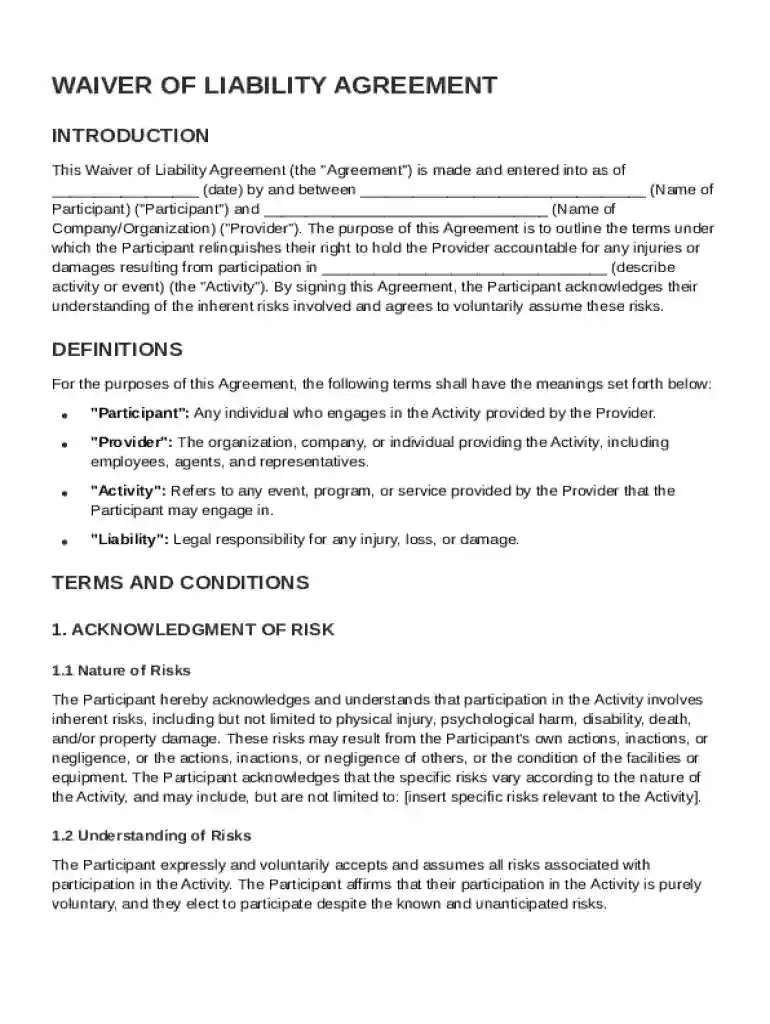
Waiver of Liability Agreement Template Preview on Page 1

Here's how it works

01. Edit your form online
Type text, add images, blackout confidential details, add comments, highlights and more.

02. Sign it in a few clicks
Draw your signature, type it, upload its image, or use your mobile device as a signature pad.

03. Share your form with others
Send it via email, link, or fax. You can also download it, export it or print it out.

Definition & Meaning

A Waiver of Liability Agreement is a legal document in which a Participant agrees to relinquish their right to hold a Provider accountable for any injuries or damages incurred during a specified activity. This document serves as a safeguard for the Provider, ensuring they are not legally bound to compensate for incidents that might occur within the scope of the activity. Within the United States, these agreements are often essential for activities that carry inherent risks, such as sports, adventure tourism, or recreational events.

Components of the Waiver

  • Inherent Risks Acknowledgment: Participants recognize the potential dangers involved in the activity.
  • General Release of Liability: Participants release the Provider from legal responsibility for accidents.
  • Indemnification Clause: Outlines the circumstances where participants compensate the Provider for damages.
  • Medical Disclaimers: Statements regarding medical emergencies and liability.
  • Governing Law: Specifies the state laws that govern the agreement.

Practical Example

Consider a rock climbing gym requiring each climber to sign a waiver before using the facilities. This document outlines that by participating, climbers accept the inherent risks, such as falls, and relinquish the gym from future claims related to potential injuries.

How to Use the Waiver of Liability Agreement Template

To effectively utilize the Waiver of Liability Agreement Template, begin by customizing it to suit the specific activity and risks involved. Personalization is crucial as it ensures the document adequately reflects the nature of the activity and the relationship between the parties involved.

  1. Identify Parties: Clearly define who the Participant and Provider are, including their legal names and contact details.
  2. Specify Activity: Describe the activity in detail, ensuring there's no ambiguity about what the participant is waiving rights over.
  3. Detail Risks: Outline the potential risks involved, ensuring participants understand what they are agreeing to.
  4. Add Legal Provisions: Include indemnification, governing law, and complete agreement clauses to strengthen the legal standing.

Customization Tips

  • Consult a legal professional to adapt the template to comply with specific state laws.
  • Ensure all sections are clear and understandable to avoid disputes about the document's intent.

Key Elements of the Waiver of Liability Agreement Template

Acknowledgment of Risks

Participants must explicitly acknowledge that they understand and accept the risks involved. This section is pivotal as it demonstrates informed consent, a crucial element for the enforceability of the waiver.

General Release Clause

This element ensures that the Participant releases the Provider from liability for any injuries or losses experienced. The clause must be unambiguous and drafted to withstand legal scrutiny.

Indemnification

Participants agree to indemnify and hold the Provider harmless in specific scenarios. This means that if a third party claims damages due to the Participant’s actions, the Participant, not the Provider, will cover these costs.

Medical Treatment Authorization

Outline conditions under which medical treatment is permissible and who is responsible for associated costs. It provides clarity on the actions taken in case of medical emergencies.

Steps to Complete the Waiver of Liability Agreement Template

Completing the Waiver of Liability Agreement Template involves a structured approach to ensure that all parties' rights and obligations are correctly captured.

  1. Gather Information: Collect full names, addresses, contact information, and identification details of each party involved.
  2. Draft Specifics: Use clear, concise language to specify the activity, risks involved, and coverage of the waiver.
  3. Review & Edit: Check for completeness and accuracy. Ensure there are no legal terms that might confuse the Participant.
  4. Seek Legal Advice: Consult with a legal expert to ensure compliance with state-specific rules and potential exclusion clauses.
  5. Finalize & Sign: Once reviewed, both parties should sign the waiver in the presence of a witness or notary public to enhance legal standing.

Additional Considerations

  • Amendment Provision: Include clauses detailing how agreements can be modified in the future.
  • Expiration and Renewal: Define the validity period and any requirements for renewal.

Who Typically Uses the Waiver of Liability Agreement Template

A wide range of individuals and organizations employ waiver of liability agreements to mitigate legal risks associated with various activities.


decoration image ratings of Dochub

Common Users

  • Sports and Recreation Businesses: Gyms, sports leagues, and adventure parks use waivers to protect against injuries participants might suffer.
  • Event Organizers: Both small-scale events like local races and large festivals may require waivers to cover attendees.
  • Service Providers: Entities offering risky activities, such as skydiving or surf lessons, see waivers as essential tools.
decoration image

Business Entity Types

Businesses of all types, from sole proprietors to large corporations, utilize waivers based on their operational risks. Nonprofits organizing events might also require them to protect limited resources.

Legal Use of the Waiver of Liability Agreement Template

Enforceability

While valuable, the enforceability of a waiver of liability can vary significantly between states. Factors impacting enforceability include clarity, conspicuousness, and whether the waiver contravenes public policy. Engaging a legal professional to ensure robustness against these criteria is essential for enforceability.

State-Specific Laws

Some states adhere to stricter laws concerning the specificity and fairness of waivers:

  • California: Requires conspicuous waivers with clear language.
  • New York: Often limits enforceability for gross negligence.

Recommendations

  • Avoid Ambiguity: Use straightforward language to avoid possible legal disputes.
  • Regular Updates: Reassess and update waivers periodically to align with legal changes and court decisions.

Important Terms Related to the Waiver of Liability Agreement Template

Understanding key legal terminologies associated with waiver agreements is crucial for both drafting and signing.

Common Terms

  • Negligence: Failure to exercise a degree of care that is considered reasonable, resulting in unintended damage.
  • Gross Negligence: A severe lack of due diligence or care beyond simple negligence.
  • Indemnity: Security against or exemption from legal liability for damages.

Additional Sapience

Familiarity with legal jargon can demystify the agreement for participants and ensure they comprehend the scope and implications of the document. It might be useful to provide a glossary or explanatory notes alongside the waiver to enhance understanding.

State-Specific Rules for the Waiver of Liability Agreement Template

Each state in the USA may impose unique requirements for waivers. Understanding these state-specific rules is crucial for ensuring a waiver’s enforceability:

  • California: Requires clear, explicit agreement to waive liability.
  • Texas: Enforceability can hinge on whether the waiver clearly states the specific rights waived.
  • Florida: Allows more lenient standards but still emphasizes clear articulation of terms.

Research & Adaptation

Customizing waivers requires up-to-date knowledge of regional laws and judicial inclinations. Organizations should consider legal consultations to revise language and ensure compliance with state-specific mandates.

Examples of Using the Waiver of Liability Agreement Template

Real-World Scenarios

  1. Outdoor Adventure Parks: Use waivers for bungee jumping, zip-lining, or rock climbing, emphasizing physical risks and liabilities.
  2. Sports Leagues: Soccer leagues for minors often require guardians to sign waivers acknowledging potential for sports injuries.
  3. Volunteer Organizations: Entities hosting cleanup events require volunteers to waive claims associated with physical exertion risks.

Case Studies

Consider a mountain biking event organizer who utilized a waiver, clearly outlining risks such as falling or equipment malfunction. When a participant sustained injuries, the waiver protected the organizers from litigation, showcasing its importance in risk mitigation.

Considerations

For activities involving minors, ensure parental consent waivers comply with state regulations, as enforceability can vary significantly in such contexts.

be ready to get more

Complete this form in 5 minutes or less

Get form

Got questions?

We have answers to the most popular questions from our customers. If you can't find an answer to your question, please contact us.
Contact us
I agree to hold the District harmless from any and all claims, loss or damage to my personal property, liabilities and costs, including attorneys fees, as a result of my participation in this Activity, including travel to and from the Activity (including air travel) or any events incidental to this Activity.
1,000+ Free Professional Waiver Templates. docHub offers the largest collection of digital waiver templates for businesses In all industries.
The answer is yesGoogle Forms can be customized to serve as a liability waiver, provided they include all necessary legal language and terms.
Limited design options. Google account requirement. Lack of robust analytics tools. Security and privacy concerns. Lack of advanced conditional logic. Requires an internet connection. File upload restrictions.
The process of creating a waiver should be taken seriously. Waivers are legal documents that list specific terms for your participants to agree to, so its crucial that they are complete and legally sound. Professional help from a lawyer is strongly recommended any time you are working with legal documents.

Security and compliance

At DocHub, your data security is our priority. We follow HIPAA, SOC2, GDPR, and other standards, so you can work on your documents with confidence.
Learn more
ccpa2
pci-dss
gdpr-compliance
hipaa
soc-compliance
be ready to get more

Complete this form in 5 minutes or less

Get form

People also ask

Burying the release in tiny writing Liability waivers should be easily read and understood. Dont bury the liability release at the bottom of your waiver in tiny writing. Its your responsibility to ensure that your customers can read it clearly, and understand it fully. Otherwise, it may not be legally binding.

Related links