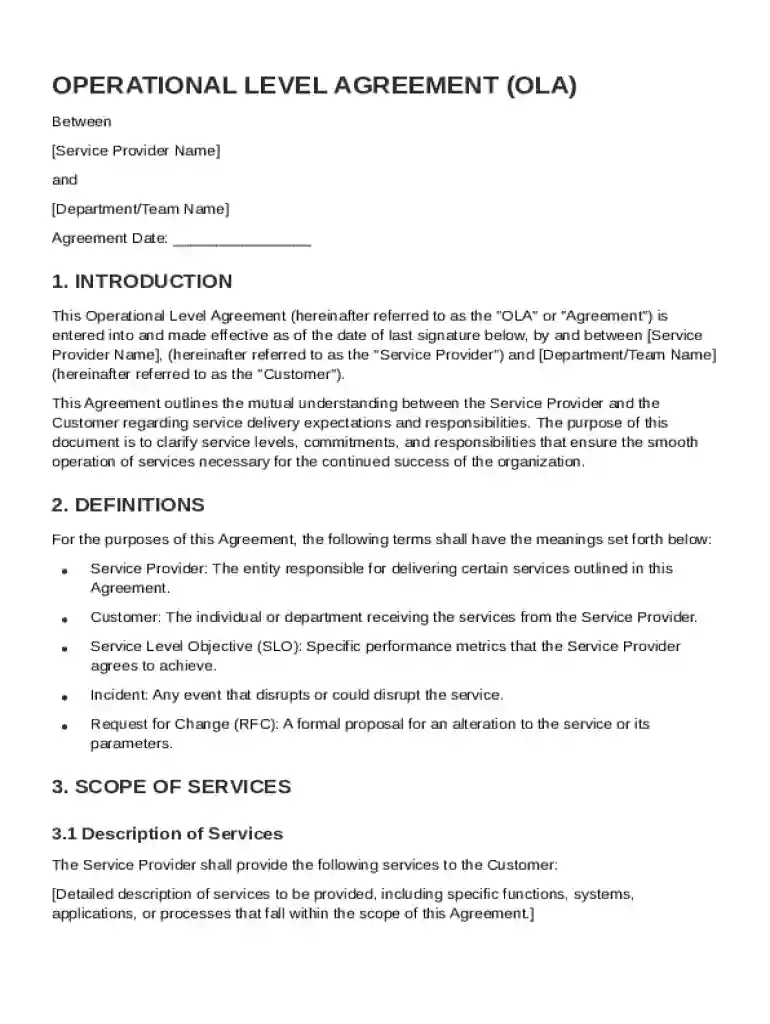
Ola Operational Level Agreement Template 2026

Get Form
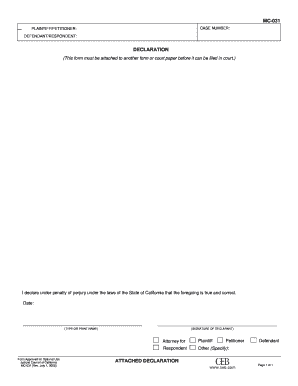
Ola Operational Level Agreement Template Preview on Page 1

Here's how it works

01. Edit your form online
Type text, add images, blackout confidential details, add comments, highlights and more.

02. Sign it in a few clicks
Draw your signature, type it, upload its image, or use your mobile device as a signature pad.

03. Share your form with others
Send it via email, link, or fax. You can also download it, export it or print it out.

Definition & Meaning

An Operational Level Agreement (OLA) is a formal contract that establishes the roles, responsibilities, and expectations between service providers and customers. This agreement focuses on the operational aspects necessary for delivering effective service, including service level objectives (SLOs), the scope of services, and incident and change management processes. By formalizing these components, the OLA promotes transparency, accountability, and efficient operations in service delivery.

Key Aspects

  • SLOs: Establishes measurable goals for service performance.
  • Scope of Services: Clearly defines what services are covered.
  • Incident Management: Outlines processes for handling service disruptions.
  • Change Management: Details procedures for implementing changes to services.

How to Use the Ola Operational Level Agreement Template

The Ola Operational Level Agreement Template serves as a guide for drafting a customized OLA that aligns with the specific needs of your service relationship. It provides a structured format to ensure that all critical components are addressed, allowing service providers and customers to focus on tailoring the content to their unique requirements.

Steps to Use the Template

  1. Customize Basic Information: Input party names, contact details, and relevant dates.
  2. Define Service Scope: Specify the services covered under the agreement.
  3. Establish SLOs: Set performance targets to evaluate service effectiveness.
  4. Outline Processes: Include detailed procedures for incident and change management.
  5. Review & Revise: Ensure all stakeholders have reviewed and agreed to the terms.
  6. Finalize & Sign: Obtain signatures from authorized representatives to formalize the agreement.

Steps to Complete the Ola Operational Level Agreement Template

Finalizing an OLA involves several critical steps to ensure it meets the operational needs and legal considerations of both parties. By following these steps, you can effectively complete the template and establish a solid foundation for service delivery.

  1. Initial Drafting: Start by using the template to create an initial draft. Insert all relevant details specific to your service relationship.
  2. Consult Stakeholders: Engage with all relevant parties to ensure that the draft aligns with their operational needs and expectations.
  3. Detailed Reviews: Perform a comprehensive review for accuracy and completeness. Address any gaps or ambiguities in the service definitions or obligations.
  4. Legal Compliance: Check for compliance with relevant laws and regulations to prevent legal issues.
  5. Approval: Obtain formal approval from both parties' representatives to validate the agreement's terms.

Important Terms Related to Ola Operational Level Agreement Template

Understanding the terminology used in the context of an OLA is vital to crafting an agreement that is clear, precise, and legally sound. Below are some of the important terms associated with this agreement.

  • Service Level Objectives (SLOs): Specific performance targets set for the services outlined in the agreement.
  • Operational Processes: The methods and procedures used to manage and deliver services.
  • Escalation Procedures: Defined steps to follow when issues cannot be resolved at lower levels of operations.
  • Response Times: The timeframes within which service actions, like incident resolutions, must occur.

Key Elements of the Ola Operational Level Agreement Template

The template must include all critical elements to fully encapsulate the operational relationship between service providers and customers. These elements ensure clarity, accountability, and a clear path for resolution of disputes.

Core Elements

  • Parties Involved: Clearly lists all parties entering the agreement.
  • Service Description: A detailed overview of the services to be provided.
  • Performance Metrics: Criteria and benchmarks for measuring service success.
  • Reporting & Review Procedures: How performance and compliance will be monitored and reviewed.
  • Amendment Procedures: Guidelines for modifying the agreement.

Legal Use of the Ola Operational Level Agreement Template

OLAs must conform to legal standards to be enforceable. It is crucial that they are developed with an understanding of the legal framework governing service agreements, ensuring that they are valid and legally binding.

Legal Considerations

  • Enforceability: The agreement should meet all legal criteria to ensure it's enforceable in court.
  • Confidentiality Clauses: To protect sensitive information shared between parties.
  • Dispute Resolution: Methods for resolving any conflicts arising from the agreement.
  • Termination Conditions: Clearly defined conditions under which the agreement may be terminated.

Examples of Using the Ola Operational Level Agreement Template

Real-world applications of an OLA can vary significantly based on the industry and specific service relationships. Here are a few scenarios where using an OLA is particularly beneficial.

Practical Scenarios

  • IT Service Providers: Defining response times and uptime guarantees for network maintenance.
  • Facilities Management: Detailing cleaning schedules and incident response for facility management.
  • Customer Support Services: Setting targets for query resolution times and customer satisfaction measures.

Eligibility Criteria

Not every organization or individual may need an OLA. Understanding the eligibility criteria is essential for effective use of this agreement type. Typically, OLAs are suitable for businesses with defined operational relationships.


decoration image ratings of Dochub

Eligibility Guidelines

  • Organizational Size: Medium to large organizations that need explicit operational contracts.
  • Service Complexity: Agreements where services involve multiple facets or are technologically complex.
  • Collaborative Tasks: Situations involving inter-departmental collaboration requiring defined roles and responsibilities.
be ready to get more

Complete this form in 5 minutes or less

Get form

Security and compliance

At DocHub, your data security is our priority. We follow HIPAA, SOC2, GDPR, and other standards, so you can work on your documents with confidence.

Learn more
ccpa2
pci-dss
gdpr-compliance
hipaa
soc-compliance