




01. Edit your form online
Type text, add images, blackout confidential details, add comments, highlights and more.

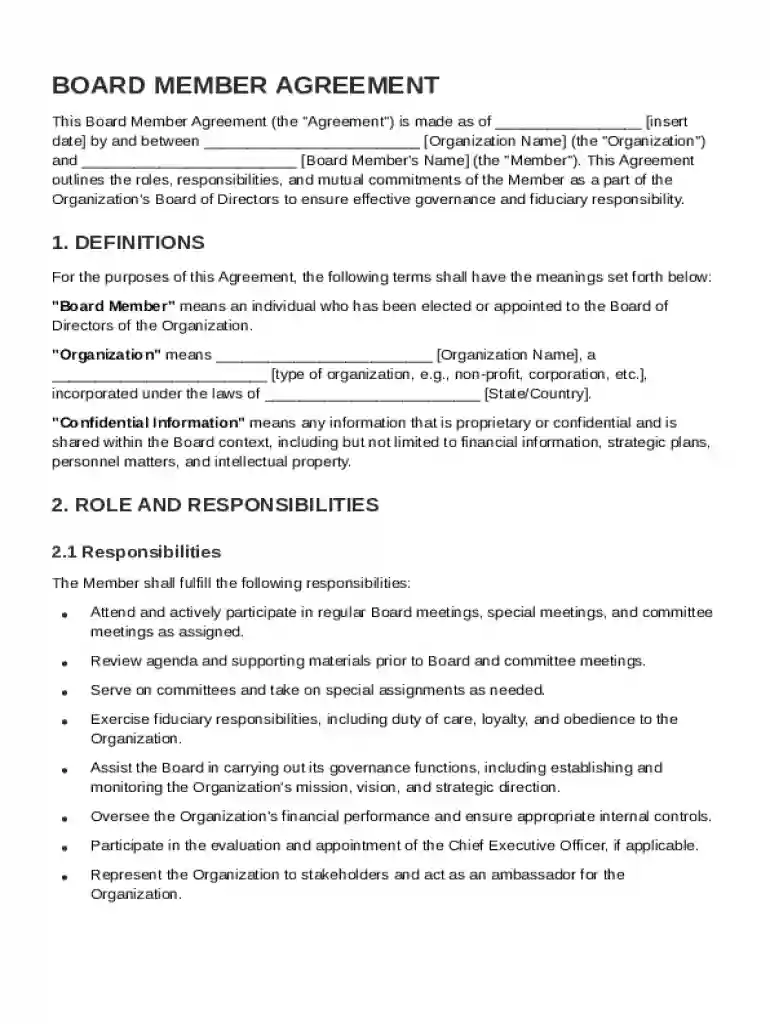
Type text, add images, blackout confidential details, add comments, highlights and more.

Draw your signature, type it, upload its image, or use your mobile device as a signature pad.

Send it via email, link, or fax. You can also download it, export it or print it out.
A "Board Contract Template" is a structured document designed to outline the roles, responsibilities, and expectations of board members within an organization. Typically used in corporate and nonprofit settings, this template helps ensure that all board members are aligned with the organization's goals and governance practices. It serves as a formal agreement that clarifies individual and collective duties, providing a framework for accountability and effective management. The document is essential for outlining terms of service, meeting attendance requirements, fiduciary duties, and ethical standards, contributing to more organized and transparent board operations.
Utilizing the Board Contract Template involves several key steps to ensure it's adapted appropriately for a specific organization. First, input the relevant organizational details such as the name, mission statement, and core values. Modify sections to reflect the specific obligations and expectations of board members, ensuring that each member is aware of their commitment. Review the document with legal counsel to ensure it complies with applicable laws and industry standards. Finally, present the completed template to the board for review and approval, ensuring that all members understand and agree to the terms before signing.
Gather Required Information: Collect all necessary information, including the names of board members, term lengths, and responsibilities.
Fill in Organizational Details: Enter the organization’s name, board size, mission, and any specific goals or objectives.
Outline Member Responsibilities: Clearly define the roles and expectations for each board member, including meeting attendance and fiduciary obligations.
Specify Ethical Obligations: Include sections on conflict of interest policies, confidentiality agreements, and any ethical guidelines that members must follow.
Determine Compensation and Benefits: Clearly define any compensation, stipends, or reimbursements for board members, if applicable.
Review Legal Terms: Ensure the document includes clauses related to governing law, termination conditions, and amendments for future changes.
Finalize and Approve: Review the document with legal counsel and get it signed off by the board to finalize the contract.
Board Member Roles and Responsibilities: Describes the specific duties and obligations of each member, tailored to the organization's needs.
Term Length and Renewal: Specifies the duration of the board member's term and conditions for renewal or extension.
Meeting Attendance and Participation: Mandates the frequency of meetings and expectations for active participation.
Fiduciary Responsibilities: Includes duties related to the oversight of organizational assets and decision-making in the best interest of stakeholders.
Ethical Guidelines and Confidentiality: Details policies surrounding ethical conduct, conflict of interest, and confidentiality.
Termination Clauses: Outlines the circumstances under which a board member’s term may be terminated, including non-compliance with terms.
The Board Contract Template must adhere to legal standards and regulations applicable to board governance in the United States. This includes compliance with federal laws, such as those relating to nonprofit organizations or corporations, and state-specific governance laws. Legal counsel should review the document to ensure that it meets all legal requirements and does not conflict with organizational bylaws or other governing documents. The agreement helps in protecting the organization legally by defining clear governance structures, reducing the risk of disputes or legal challenges.
Fiduciary Duty: The legal obligation of board members to act in the best interest of the organization and its stakeholders.
Conflict of Interest Policy: Guidelines to prevent personal interests from interfering with board members' duties.
Confidentiality Agreement: A clause ensuring that board members do not disclose sensitive information outside the organization.
Governing Law: The jurisdiction whose laws will be used to interpret the contract.
Compensation and Reimbursement: Terms defining any payments to board members for their service.
Organizations across various sectors, such as nonprofits, private companies, and educational institutions, use a Board Contract Template to formalize their governance structures. For instance, a nonprofit might use the template to establish clear roles for board members to ensure that all fundraising efforts are conducted ethically and in alignment with the organization's mission. Similarly, a corporation might employ the template to provide clarity and direction for its board members, focused on strategic growth and compliance with business laws.
Nonprofit Organizations: To define the responsibilities and ethical standards for their board members.
Corporations: For establishing a framework for board governance and shareholder accountability.
Educational Institutions: When organizing their Boards of Trustees or Directors to comply with educational and governmental regulations.
Healthcare Organizations: Used to ensure compliance with health regulations and maintain governance over operational standards.
By providing clear guidelines and responsibilities, the Board Contract Template supports effective governance and legal compliance in diverse organizational contexts.


At DocHub, your data security is our priority. We follow HIPAA, SOC2, GDPR, and other standards, so you can work on your documents with confidence.



This ADVISORY BOARD MEMBER AGREEMENT (this Agreement) is made and entered into this day of , 20, by and between [COMPANY. NAME], a
Board Member Agreement: As a Governing Board member of HealthRIGHT 360, I am fully committed to the mission and have pledged to help carry it out. I


