01. Edit your form online
Type text, add images, blackout confidential details, add comments, highlights and more.

Type text, add images, blackout confidential details, add comments, highlights and more.

Draw your signature, type it, upload its image, or use your mobile device as a signature pad.

Send it via email, link, or fax. You can also download it, export it or print it out.
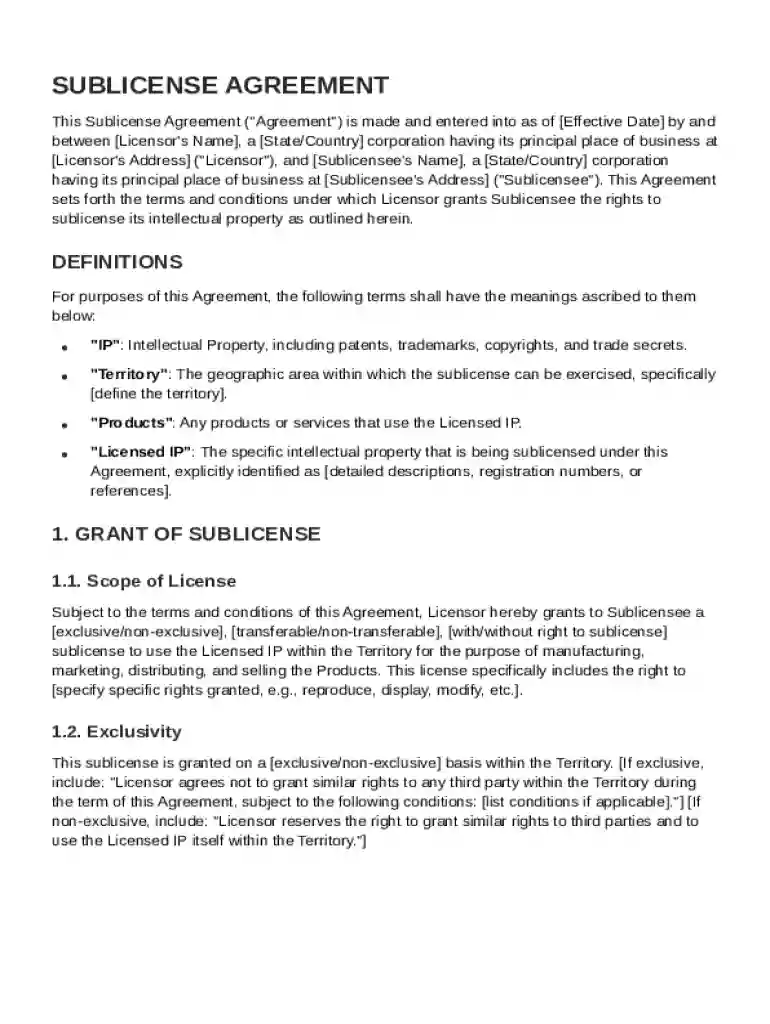
A Sublicense Agreement Template is a legally structured document designed to facilitate the granting of rights to use specific intellectual property (IP). It enables a Licensor to transfer certain usage rights of their IP, such as manufacturing, marketing, or selling products, to a Sublicensee within a defined territory. The template provides a standardized format for outlining the obligations of each party, ensuring clarity and legal compliance. Key elements typically included in the agreement are definitions of terms, scope of the sublicense, exclusivity conditions, payment and royalty structures, confidentiality obligations, and mechanisms for dispute resolution. Importantly, it reiterates that the ownership of the IP remains with the Licensor.
The Sublicense Agreement Template serves as a starting point for crafting a formal sublicense arrangement. Users can customize the template by inserting specific details relevant to their agreement, such as the names of the parties, a precise description of the IP being sublicensed, the geographical territory, and the duration of the license. Users should also tailor the sections on payment terms, confidentiality, and dispute resolution to fit their unique requirements. It's advisable to consult with a legal professional to ensure that all relevant legal standards and obligations are addressed according to jurisdictional requirements.
In the United States, a Sublicense Agreement must comply with both federal and state legal standards. The enforceability of such agreements largely rests on the precision of terms and their adherence to contracts law. Legal obligations like the disclosure of known defects in the IP, adherence to licensing restrictions, and conformity with antitrust laws are critical. Legal counsel is essential in drafting and reviewing the agreement to ensure it covers all necessary legal bases and does not infringe existing laws or rights.
Consider a technology company in California sublicensing their proprietary software to another firm in Texas for localized deployment. The agreement would specify that the Texas firm can use, modify, and market the software exclusively in Texas while adhering to confidentiality and quality standards. Another example might involve an apparel brand sublicensing its trademark in the Midwest, where the agreement would outline specific design constraints to maintain brand integrity across new clothing lines.
Businesses across various sectors can benefit from using Sublicense Agreement Templates, particularly industries involving high-value IP or brand elements. These include technology firms developing software, pharmaceutical companies with specialized patents, and consumer goods companies expanding their reach through third-party manufacturing and distribution partners. In all cases, such templates streamline the legal process, minimizing potential disputes and facilitating smoother expansion and operation initiatives.
While sublicense agreements are guided by federal contract law principles, each U.S. state may impose specific regulations that can impact the terms or enforceability of these agreements. For example, California protects consumers with stringent disclosure requirements that may affect sublicensing practices involving consumer technology products. Consequently, it's vital to review state-specific laws on IP rights, anti-competitive practices, and applicable taxes to ensure all provisions comply with local statutes.
Digital platforms like DocHub enhance the efficacy of managing and editing Sublicense Agreement Templates. With compatibility across multiple file formats and integration capabilities with Google Workspace, users can easily access, modify, and store their agreements. This system not only streamlines the process of legal documentation but also offers the security and collaboration tools necessary to manage these critical agreements efficiently.
At DocHub, your data security is our priority. We follow HIPAA, SOC2, GDPR, and other standards, so you can work on your documents with confidence.