




01. Edit your form online
Type text, add images, blackout confidential details, add comments, highlights and more.

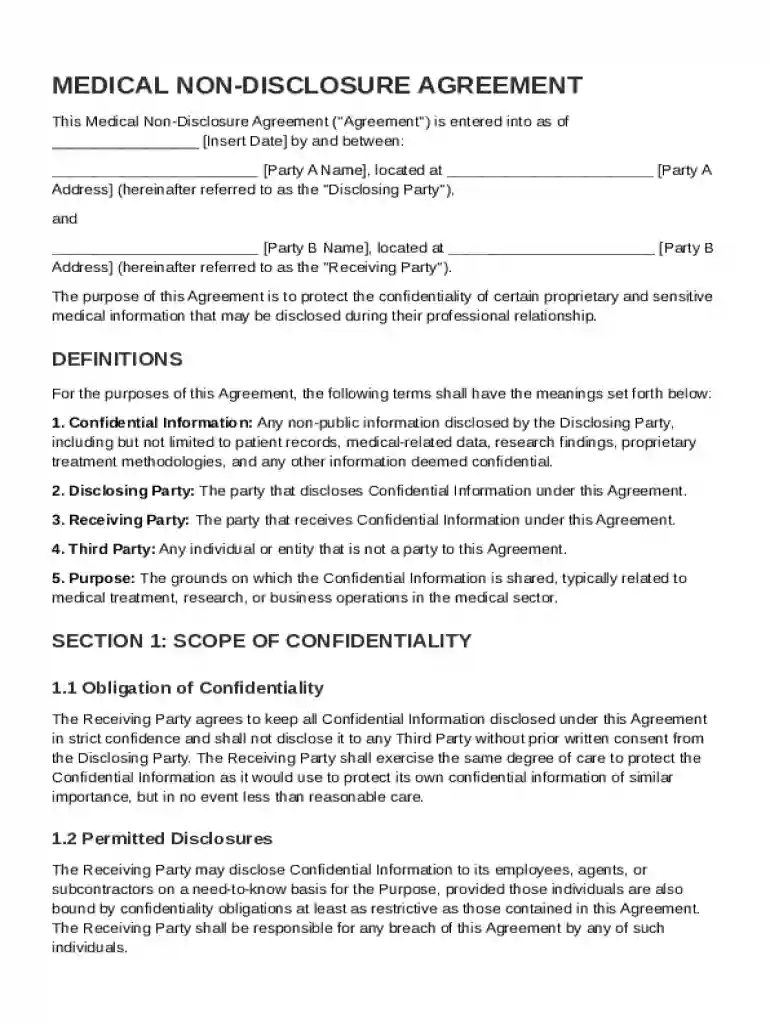
Type text, add images, blackout confidential details, add comments, highlights and more.

Draw your signature, type it, upload its image, or use your mobile device as a signature pad.

Send it via email, link, or fax. You can also download it, export it or print it out.
A Medical Non-Disclosure Agreement (NDA) Template is a pre-structured legal document designed to protect sensitive medical information shared between parties during a professional relationship. It sets a legal framework that ensures any confidential data exchanged remains private and outlines the conditions under which information can be disclosed. The template typically includes sections that define confidential information, exemptions, obligations of the receiving party, the duration of the agreement, and the legal remedies available in case of a breach. This type of agreement is crucial for maintaining the privacy of medical data and is commonly used in scenarios involving healthcare providers, researchers, or medical consultants.
Completing the Medical Non-Disclosure Agreement Template involves several structured steps to ensure all necessary information is captured accurately:
Identify the Parties Involved: Clearly define the disclosing and receiving parties, including their full legal names and contact details.
Define Confidential Information: Specify what constitutes confidential information within the context of the agreement. This could include patient records, research data, or proprietary medical methodologies.
State the Obligations: Outline what each party is obligated to do to protect the confidentiality of the information. This may include restrictions on sharing, duplication, or modifications.
Set the Duration: Specify the length of time the NDA will remain in effect, which can vary depending on the nature of the disclosed information.
Include Exclusions: List any information that is exempt from confidentiality, such as information already in the public domain or independently developed by the receiving party.
Legal Jurisdiction: Determine the state laws that will govern the agreement, ensuring it aligns with local legal requirements.
Signatures: Both parties must sign the document to indicate their understanding and agreement to comply with the terms.
The Medical NDA Template is composed of several critical elements that ensure comprehensive coverage of confidentiality obligations:
Title and Introduction: Clarifies that the document is a Non-Disclosure Agreement designed to protect medical information.
Recitals: Provide background on why the agreement is being entered and outline the intentions of both parties.
Definitions: Precise definitions of what constitutes "Confidential Information" to mitigate misunderstandings.
Obligations: Detailed responsibilities of the receiving party to maintain the confidentiality of the information shared.
Term and Termination: Specifies how long the NDA is in force and outlines conditions under which it can be terminated.
Remedies: Details on what actions can be taken if the agreement is breached, including potential legal consequences.
Miscellaneous: Additional clauses such as amendment procedures, waiver conditions, and assignment rights.
The legal use of the Medical NDA Template is fundamental in various professional contexts to uphold confidentiality:
Healthcare Providers: To protect patient privacy and sensitive health information in compliance with HIPAA regulations.
Research Institutions: When sharing proprietary research data or methodologies that require secure handling.
Consultancies: Consulting firms that need to safeguard client medical data they handle during project engagements.
Properly utilizing a Medical NDA ensures both compliance with legal standards and the protection of sensitive health data, mitigating risk of unauthorized disclosure.
To effectively utilize the Medical NDA Template, familiarity with key terms is essential:
Disclosing Party: The individual or organization that shares confidential information.
Receiving Party: The individual or organization that gains access to the confidential information under the NDA's stipulations.
Confidential Information: Any data, documents, or materials deemed confidential which can include written, electronic, or verbal information.
Breach: Any act that violates the terms of the NDA, potentially leading to legal ramifications.
Governing Law: The specific jurisdiction’s laws that govern the enforceability of the NDA.
Understanding these terms helps ensure that the NDA is utilized correctly and legally, safeguarding both parties' interests.
The enforceability of Medical NDAs can be subject to state-specific laws:
California: Places restrictions on NDAs in the medical field, particularly concerning patient confidentiality and labor rights.
New York: Emphasizes the importance of written consent in NDAs involving medical information, aligning with state privacy laws.
Texas: Requires explicit definitions of confidential information and frequently emphasizes the importance of protecting healthcare data.
Familiarizing yourself with the relevant state laws is crucial for constructing an NDA that is legally sound within that jurisdiction.
Different professionals and organizations utilize Medical NDAs, including but not limited to:
Medical Practitioners: Doctors, nurses, and specialists who handle sensitive patient data.
Research Institutions: Universities and labs conducting medical research requiring confidentiality.
Pharmaceutical Companies: To protect data shared with external consultants or partners.
Each of these entities leverages Medical NDAs to ensure confidential information remains protected, supporting ethical practices and compliance with legal standards.


In practice, the Medical NDA is employed in various scenarios:
A pharmaceutical company sharing test data with a contracted research group to develop new medication: An NDA ensures that the research data is kept confidential.
Hospitals collaborating on a national health study: NDAs protect the transfer of sensitive patient data across institutions.
Tech firms partnering with a healthcare provider to develop medical software: A specific NDA ensures that the software’s proprietary code and patient data remain secure.
These examples highlight the NDA’s utility in preserving confidentiality across diverse professional interactions involving medical information.
At DocHub, your data security is our priority. We follow HIPAA, SOC2, GDPR, and other standards, so you can work on your documents with confidence.






Neither Party or their Agents shall disclose the other Partys Confidential Information to any third parties, except with the prior written consent of the other
Feb 26, 2025 The following terms used in this Agreement shall have the same meaning as those terms in the HIPAA. Rules: BdocHub, Data Aggregation, Designated
Upon request of SunTech, the undersigned will return or deliver to SunTech all tangible forms of such Confidential Information in the undersigneds possession


