





Definition and Meaning
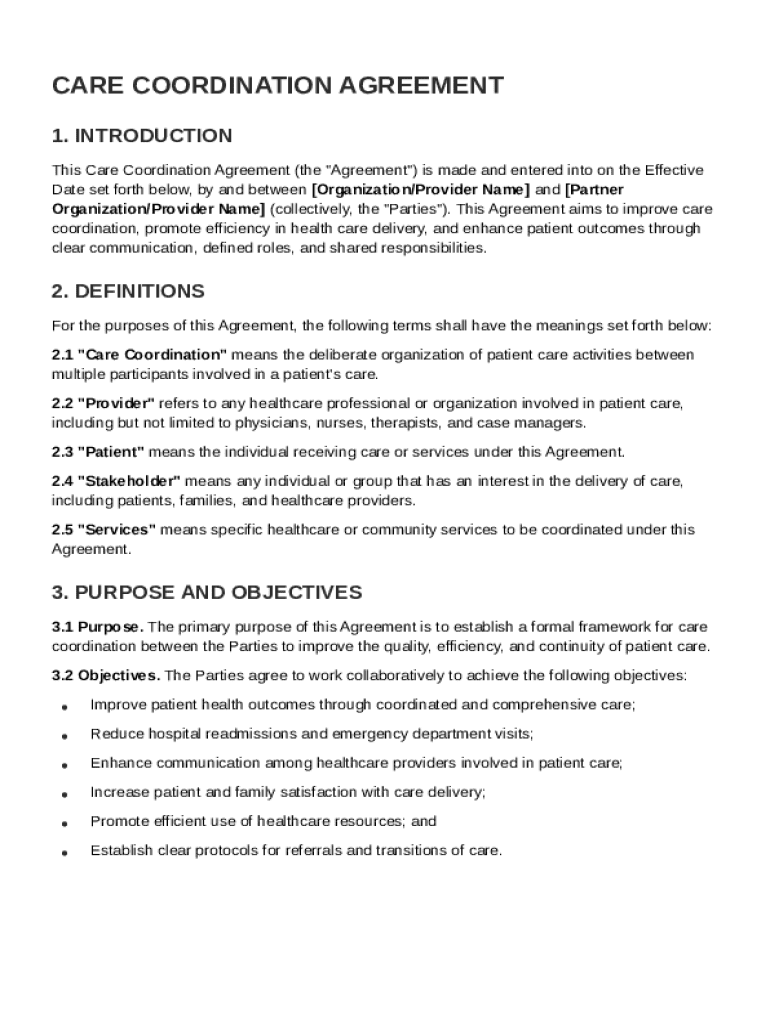
The Care Coordination Agreement Template establishes a structured framework between healthcare organizations to enhance patient care. This formal document details how two or more parties collaborate to improve communication, define roles, and share responsibilities. The goal is to improve overall health outcomes, reduce hospital readmissions, and increase patient satisfaction. This agreement is crucial in creating standardized procedures for patient care coordination while ensuring adherence to legal and privacy requirements.
Purpose and Objectives
- Improve health outcomes: By facilitating better communication and defined roles, the agreement aims to optimize the healthcare services provided to patients.
- Reduce hospital readmissions: Establishing clear communication and protocols helps in reducing unnecessary readmissions, thereby enhancing patient well-being.
- Increase patient satisfaction: Coordinated care efforts lead to a more streamlined experience, improving patient trust and satisfaction.
Key Elements of the Care Coordination Agreement Template
The Care Coordination Agreement Template is composed of several essential components that guide its implementation and execution.
Service Responsibilities
- Responsibility allocation: Clearly indicates which party is responsible for specific care aspects.
- Types of services covered: Includes services like medical consultation, follow-up care, and patient education.
Communication Protocols
- Information exchange: Defines secure and efficient methods for sharing patient information.
- Communication channels: Establishes which channels (e.g., phone, email, digital platforms) will be used for coordination.
Evaluation Metrics
- Performance measures: Outlines how the outcomes will be measured and evaluated.
- Periodic reviews: Scheduled assessments determine the effectiveness of coordination efforts and identify areas for improvement.
Duration and Termination Terms
- Agreement term: Specifies the length of time the agreement is in effect.
- Termination conditions: Details the process for terminating the agreement under specified conditions.
Steps to Complete the Care Coordination Agreement Template
Finalizing a Care Coordination Agreement Template involves several critical steps to ensure it meets legal and operational standards.
Gathering Required Information
- Identify the involved parties and their roles.
- Gather details about the types of services and responsibilities.
- Define communication protocols and channels.
Drafting the Agreement
- Begin by outlining each party's responsibilities, ensuring clarity and understanding.
- Specify service types and detailed protocols for efficient patient information exchange.
Legal Review
- Have the draft reviewed by legal counsel to ensure compliance with privacy laws and regulations.
- Make necessary revisions based on legal feedback.
Sign and Implement
- Obtain signatures from all involved parties to formalize the agreement.
- Distribute to relevant stakeholders and begin implementation.
Legal Use of the Care Coordination Agreement Template
Compliance with federal and state laws is crucial when using a Care Coordination Agreement Template.
Privacy Laws Compliance
- HIPAA regulations: Ensure all communication and data exchanges comply with the Health Insurance Portability and Accountability Act.
- State-specific privacy laws: Each state may have additional requirements beyond federal laws.
Legal Validity
- Obtain legal confirmation that the agreement is enforceable and meets all regulatory standards.
- Include provisions for legal recourse in case of non-compliance by any party.
How to Obtain the Care Coordination Agreement Template
Finding and utilizing the appropriate template is essential for seamless cooperation.
Sources for Templates
- Professional organizations: Healthcare associations often provide template resources to their members.
- Legal advisors: Many legal firms specializing in healthcare law offer templates.
- Document management platforms: Services like DocHub provide customizable templates for various agreements.
Who Typically Uses the Care Coordination Agreement Template
This template is predominantly used by healthcare entities looking to streamline their operations.


Common Users
- Healthcare providers: Including hospitals, clinics, and private practices seeking to establish structured coordination processes.
- Insurers: Insurance companies involved in patient care coordination as part of healthcare plans.
- Administrative bodies: Healthcare administrators implementing policy-driven care coordination strategies.

State-Specific Rules for the Care Coordination Agreement Template
State regulations may impact how a Care Coordination Agreement is structured and implemented.
Navigating State Variations
- Licensing requirements: Some states may have specific rules regarding which entities can enter into coordination agreements.
- Additional obligations: States may impose extra responsibilities, such as reporting and monitoring, that must be adhered to.
Adapting to Local Laws
- Tailor the agreement to meet state-specific legal requirements by consulting with state health departments or legal experts.
Examples of Using the Care Coordination Agreement Template
Practical examples illustrate the template's utility and application in real-world settings.
Case Studies
- Hospital partnerships: An agreement between a hospital and a local clinic to streamline patient transfers and reduce wait times.
- Insurer collaborations: Insurance companies aligning with healthcare providers to implement preventative care measures effectively.
Each of these examples demonstrates how specific coordination efforts can lead to improved patient care and more efficient healthcare systems.