
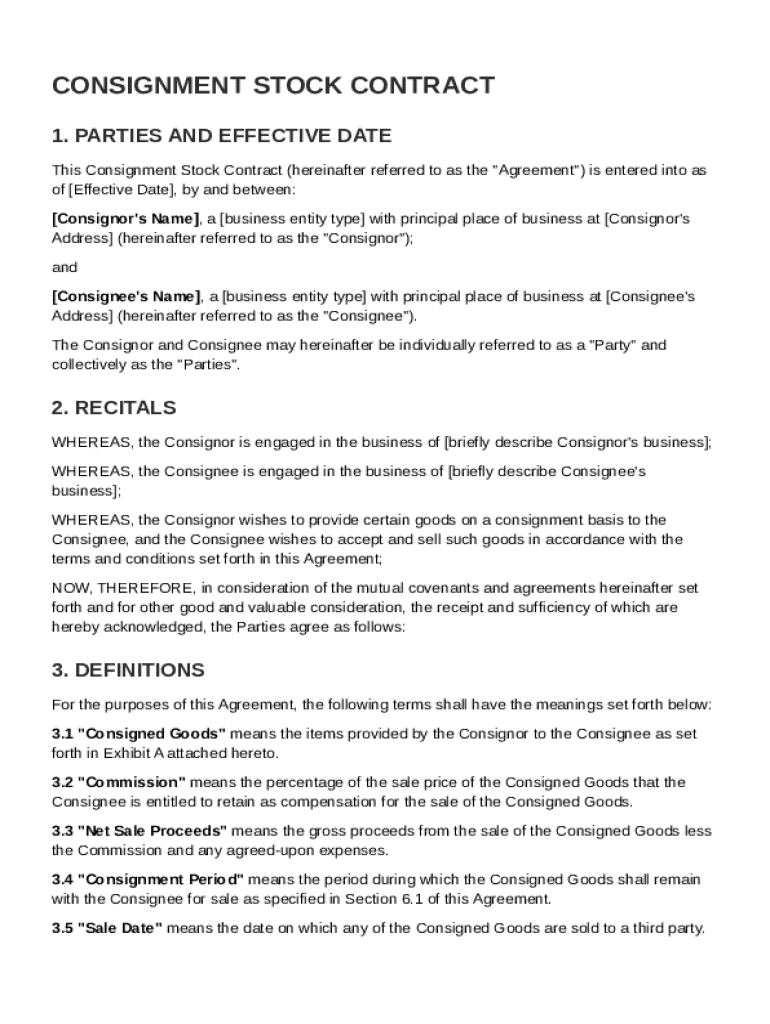







Definition & Meaning
A Consignment Stock Contract Template is a pre-formatted legal document that outlines the agreement between two parties: the consignor, who owns the goods, and the consignee, who is authorized to sell the goods on behalf of the consignor. The template establishes the terms under which the goods are consigned, including how they are stored, handled, and sold. It provides detailed provisions regarding the responsibilities of each party in managing the stock, including payment terms, inventory control, and termination conditions. This legal framework helps ensure that both parties are clear about their roles and obligations, minimizing disputes and enhancing transparency.
Key Elements of the Consignment Stock Contract Template
The Consignment Stock Contract Template incorporates several critical components that define the consignment relationship.
- Parties Involved: Clearly identifies the consignor and consignee, detailing their roles and responsibilities.
- Goods Description: Specifies the type and quantity of goods being consigned, ensuring clarity in inventory management.
- Financial Terms: Outlines the payment schedule, including any commissions or fees payable to the consignee.
- Delivery and Storage: Details how and where the goods will be delivered and stored, including provisions for insurance and maintenance.
- Inventory Management: Establishes processes for inventory tracking and auditing to maintain accuracy in stock levels.
- Termination Conditions: Sets forth the terms under which the agreement can be terminated by either party.
- Confidentiality and Dispute Resolution: Includes clauses to protect sensitive information and establish methods for resolving disagreements.
How to Use the Consignment Stock Contract Template
Using a Consignment Stock Contract Template involves several key steps to customize the document to your specific needs.
- Download the Template: Obtain the template from a reliable source such as DocHub, ensuring it is compatible with your document editing software.
- Fill in Party Information: Enter the full legal names and contact information of the consignor and consignee.
- Detail the Goods: Provide a comprehensive description of the goods, including specifications and quantities.
- Set Financial Terms: Outline the agreed payment method, frequency, and any applicable fees.
- Define Delivery and Storage Parameters: Specify logistics related to the delivery, storage, and insurance of the goods.
- Review and Finalize: Ensure all sections are complete and accurate, then both parties should review the document.
- Sign the Contract: Use electronic signature tools, such as those available on DocHub, to ensure the contract is legally binding.
Steps to Complete the Consignment Stock Contract Template
Completing the Consignment Stock Contract Template requires careful attention to detail.
- Gather Required Information: Collect all necessary details about the consignor, consignee, and goods.
- Download and Open the Template: Access the template on a platform compatible with document editing, such as DocHub.
- Customize the Template: Input specific data into each section of the template, ensuring accuracy and completeness.
- Review Legal Terms: Thoroughly examine all contract terms, potentially consulting with a legal expert to confirm compliance with applicable laws.
- Ensure Mutual Agreement: Verify that both parties understand and agree with the contract's terms before proceeding.
- Finalize with Signatures: Secure signatures using an electronic signature tool; these signatures should adhere to legal standards like the ESIGN Act.
- Distribute Completed Contract: Share finalized copies with all involved parties, storing them securely for future reference.
Important Terms Related to Consignment Stock Contract Template
Understanding the terminology used in consignment contracts is crucial for clarity.
- Consignor: The owner of the goods who entrusts them to another party for sale.
- Consignee: The individual or entity responsible for selling the consigned goods on behalf of the consignor.
- Commission: A fee paid to the consignee, typically a percentage of the sale price of the goods.
- Inventory Management: The process of maintaining accurate records and control over the stock of goods.
- Termination Clause: A provision outlining the conditions under which the contract may be ended by either party.
Legal Use of the Consignment Stock Contract Template
The Consignment Stock Contract Template must be used in compliance with applicable laws to be legally effective.
- Adherence to State Laws: Ensure the contract complies with the laws of the state in which it’s being executed, as these may govern sales and consignment practices.
- ESIGN Act Compliance: The use of electronic signatures must align with the standards set by the ESIGN Act, ensuring the document’s legal standing.
- Conflict Resolution: Clauses should be included to facilitate the resolution of disputes, potentially leveraging arbitration or mediation before resorting to litigation.
- Confidentiality Obligations: Protect proprietary or sensitive information shared between the parties during the consignment process.
Examples of Using the Consignment Stock Contract Template
Real-world scenarios illustrate the utility of a consignment stock contract.
- Retail Store Partnerships: Retailers may use the template to manage consignment agreements with local artisans, specifying terms for the display and sale of handcrafted items.
- Warehouse Storage: Companies might consign bulk stock to a warehouse, using the template to define storage conditions and responsibilities for stock management.
- E-commerce Platforms: Online marketplaces can leverage consignment agreements to expand product offerings without purchasing inventory upfront by partnering with consignors.
Who Typically Uses the Consignment Stock Contract Template
The template is widely used across different industries and business types.
- Retailers: Both brick-and-mortar and online retailers employ consignment contracts to diversify product offerings without incurring upfront inventory costs.
- Manufacturers: Manufacturers occupy consignment agreements to streamline distribution and test new markets without establishing a full retail presence.
- Logistics Companies: Firms specializing in warehousing and distribution utilize these contracts to manage third-party inventory effectively.
- Artists and Craftsmen: Local creators often use consignment contracts to display their work in galleries or shops, receiving a commission upon sale.


State-Specific Rules for the Consignment Stock Contract Template
State-specific legal requirements can impact how a consignment stock contract is structured.
- Governing Law Provisions: Contracts should specify which state’s laws will govern the agreement, as this affects enforceability and dispute resolution.
- Insurance Requirements: Some states may mandate specific insurance coverage for consigned goods, impacting the templates’ terms regarding liability and risk.
- Disclosure Requirements: State laws may require disclosure of certain information related to the goods’ condition, origin, or compliance with consumer protection standards.
Business Types That Benefit Most from Consignment Stock Contract Template
Certain business models gain significant advantages from using a consignment contract.
- Boutique Retailers: Small shops use consignment to offer unique products without tying up capital in inventory.
- Galleries and Art Spaces: Consignment provides a flexible way to display a larger variety of artworks without purchasing them.
- Pop-Up Shops: Temporary retail spaces often rely on consignment to quickly stock diverse products with minimal investment.
- Online Marketplaces: E-commerce platforms utilize consignment to extend product lines and test new sellers within their ecosystem.
Versions or Alternatives to the Consignment Stock Contract Template
Various adaptations of consignment contracts can better fit diverse scenarios.
- Sales Consignment Agreement: Tailored for more traditional retail settings, focusing strongly on sales targets and performance metrics.
- Service Consignment Agreement: Used in scenarios where services, rather than goods, are consigned, necessitating modifications to address service delivery components.
- International Consignment Contract: Incorporates clauses that address cross-border issues such as tariffs, customs, and international dispute resolution.
Understanding the multifaceted nature and applications of the Consignment Stock Contract Template allows businesses and individuals to safeguard their interests while optimizing operational efficiency.




