




01. Edit your form online
Type text, add images, blackout confidential details, add comments, highlights and more.

Type text, add images, blackout confidential details, add comments, highlights and more.

Draw your signature, type it, upload its image, or use your mobile device as a signature pad.

Send it via email, link, or fax. You can also download it, export it or print it out.
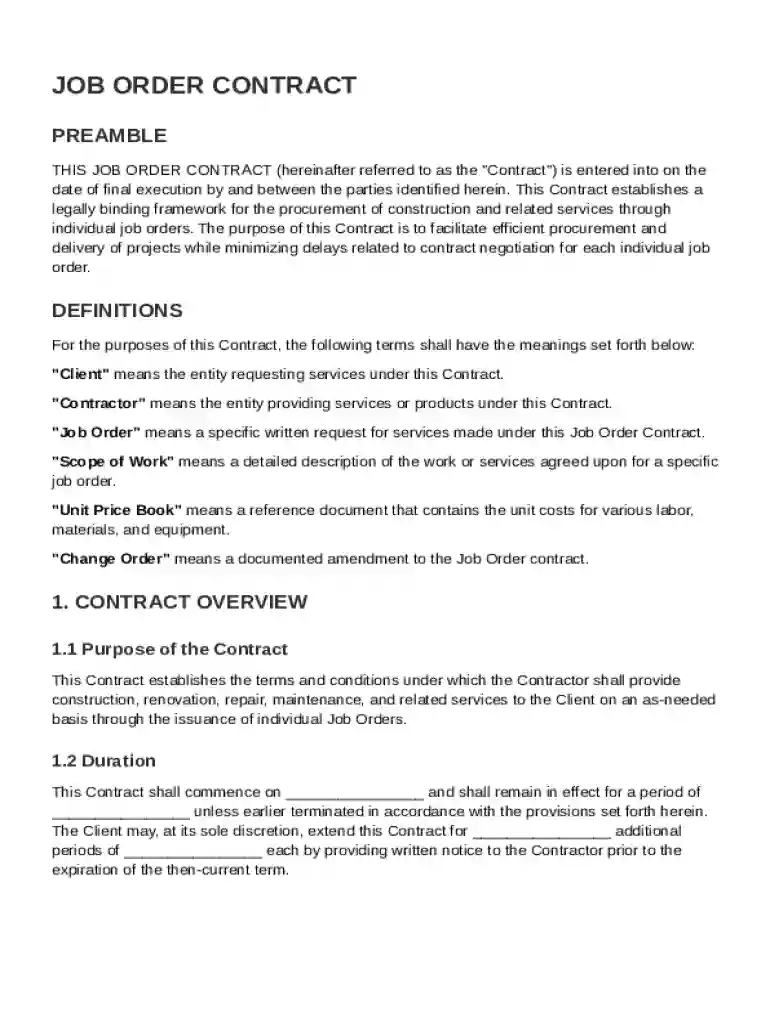
A Job Order Contract Template is a standardized document framework designed to streamline the procurement process for construction and related services through individual job orders. This template delineates the legal and operational boundaries between a client and a contractor, detailing roles, responsibilities, and key processes. By providing a clear structure, it aims to enhance efficiency in project delivery, reduce negotiation times, and ensure compliance with legal standards. The template acts as a guiding document, establishing clear terms for project initiation, execution, and completion under a job order contract agreement.
Utilizing a Job Order Contract Template involves several key steps to ensure adherence to both administrative and legal standards. Initially, the relevant sections tailored to the project specifications should be carefully identified and filled out. The template guides users through detailing project scopes, cost outlines, and timelines. Additionally, it includes fields for signatures from involved parties to solidify the contractual agreement.
The template includes several critical components, each designed to ensure thorough and complete contract documentation. These elements collectively contribute to a comprehensive contractual agreement that mitigates potential misunderstandings or disputes.
In a legal context, the Job Order Contract Template serves as a binding agreement between the contracting parties, governed by relevant state and federal laws. It delineates the legal rights and obligations of each party, providing protections against potential breaches. Contractors and clients must ensure their job order contracts comply with applicable legal requirements to safeguard against disputes or legal actions.
Understanding the terminology within a Job Order Contract Template is crucial for both contractors and clients to ensure accurate comprehension and compliance. These terms form the language of the contract and can significantly impact its execution and interpretation.
Securing the appropriate Job Order Contract Template often starts with identifying the specific requirements of your project or organization. Many templates are available through business legal service platforms, procurement agencies, or directly from industry regulators. Selecting the right source ensures that the template complies with relevant standards and practices for its intended use.
Different states may have unique regulations governing job order contracts. Variations can exist in areas such as legal terminology, compliance requirements, and contract execution procedures. Contractors and clients must be aware of these rules to ensure their contracts are enforceable and compliant across jurisdictions.
Understanding practical applications of a Job Order Contract Template can provide valuable insight into its versatility and effectiveness in various scenarios. Real-world examples highlight how different businesses leverage the template to facilitate project management and execution.
Each section of the Job Order Contract Template is designed to address specific needs within the contracting process, allowing both experienced and novice users to effectively manage their contractual obligations. The comprehensive nature of the template promotes clarity, minimizes risk, and enhances the efficiency of procurement activities.
At DocHub, your data security is our priority. We follow HIPAA, SOC2, GDPR, and other standards, so you can work on your documents with confidence.




May 8, 2021 Staff.Wiki comes with a number of sample policies and procedures. Weve compiled a list below of some of the useful ones.
The Job Order Contracting (JOC) contract templates listed below are typically used by the University for projects that are well-defined, recurring or those that
Job Order or Task Order shall mean the written agreement between City and JOC for. Work to be performed under this Agreement signed by both parties. 1.05.


