
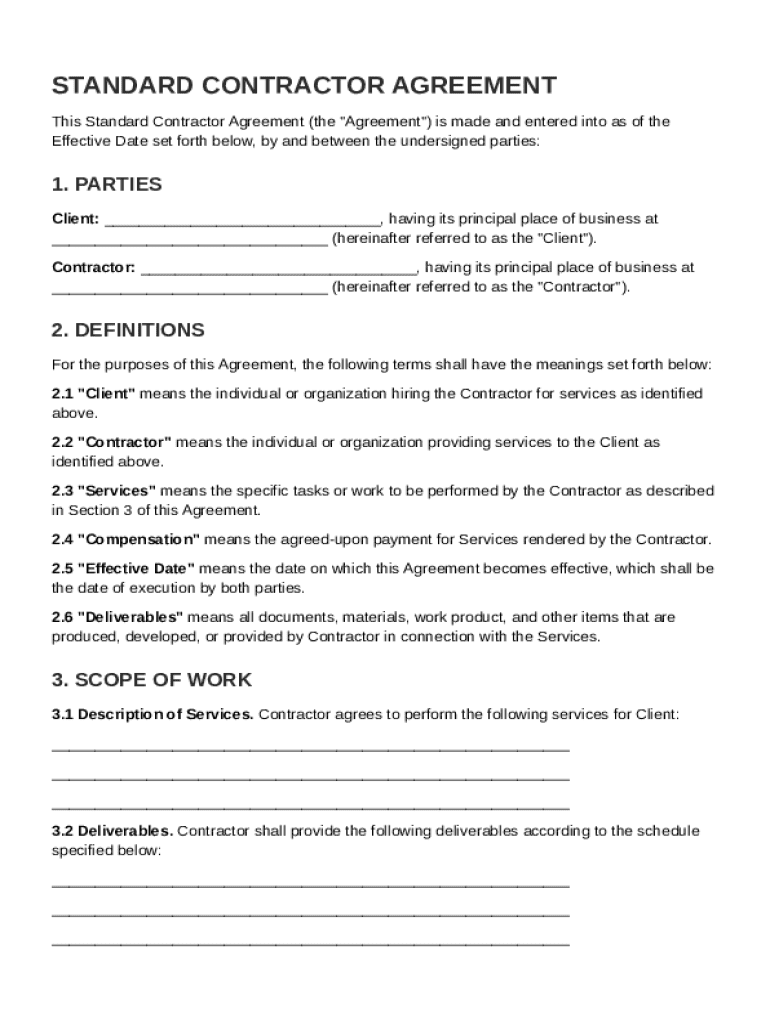







Definition & Meaning
The Standard Contractor Agreement Template is a formal legal document used to define the relationship between a Client and an independent Contractor. This agreement clarifies the terms and conditions under which services will be delivered. It sets a clear boundary between employer-employee relationships and independent contracting, highlighting that the Contractor is not an employee. This agreement includes multiple key components, each serving a specific purpose, such as scope of work, compensation, confidentiality, and dispute resolution processes.
Key Components
- Scope of Work: Details the specific tasks or services the Contractor is expected to perform, ensuring both parties understand the deliverables.
- Compensation: Specifies the payment structure, including hourly rates, lump-sum payments, or installment plans. It also outlines payment schedules and methods.
- Confidentiality: Includes clauses to protect proprietary information, requiring the Contractor to maintain confidentiality regarding sensitive company data.
- Liability and Indemnification: These clauses protect the Client from legal liabilities and damages that might arise from the Contractor's actions during the term of the agreement.
Key Elements of the Standard Contractor Agreement Template
The template includes essential sections that are critical for legal validity and clarity in the contractor-client relationship.
Primary Clauses
- Independent Contractor Status: This section defines the Contractor's status, affirming that they maintain independence in how they accomplish their work and use their resources/schedules.
- Modification and Termination: Details the conditions under which the agreement can be amended or terminated by either party, usually requiring written consent.
- Governing Law and Dispute Resolution: Specifies the jurisdiction whose laws will govern the agreement and outlines methods for resolving disputes, such as arbitration or mediation.
Supporting Sections
- Amendments: Describes the processes for making changes to the agreement, which typically require mutual agreement in writing.
- Notices: Outlines how communication regarding the agreement will be handled and delivered, including addresses for notices.
Steps to Complete the Standard Contractor Agreement Template
Filling out the Standard Contractor Agreement Template requires a systematic approach to ensure completeness and legal compliance.
- Gather Necessary Information: Collect all relevant details, including personal and business names, addresses, and contact information for both parties.
- Define the Scope of Work: Clearly describe the services or tasks to be provided by the Contractor, including timelines and deadlines.
- Specify Compensation Details: Enter the payment terms, frequency, and methods, ensuring clarity for both parties.
- Establish Confidentiality Obligations: Articulate the terms under which any shared information should be kept confidential.
- Outline Liability and Indemnification Terms: Detail the responsibility for legal liabilities and outline protections against potential claims.
- Detail Governing Law: Indicate the state laws governing the agreement to align with both parties' legal expectations.
Who Typically Uses the Standard Contractor Agreement Template
This template is commonly utilized by various parties who engage in contractual work agreements.


Common Users
- Freelancers and Consultants: Utilize the agreement to formalize their relationship with clients while maintaining their independence.
- Small Businesses and Entrepreneurs: Employ contractors for specific projects and need a clear framework to manage these relationships.
- Corporations: Engage independent Contractors for specialized projects outside the expertise of their in-house team.

Industries
- Technology: Often use contractors for software development, IT services, and consulting.
- Creative Arts: Graphic designers, writers, and artists use contractor agreements to formalize projects.
- Construction: Contractors in the construction industry often engage in projects that require standardized legal agreements.
Legal Use of the Standard Contractor Agreement Template
The agreement serves as a legally binding contract, offering protections and responsibilities under the law.
Legal Safeguards
- Establishes Boundaries: Clearly delineates employee vs. contractor status, preventing potential misclassification issues.
- Enforces Compliance: Mandates adherence to agreed terms, protecting against breaches such as unauthorized information sharing or non-payment.
- Dispute Management: Provides a predetermined method for resolving disputes efficiently and cost-effectively, often through mediation or arbitration.
Common Legal Terms
- Force Majeure: A clause that exempts parties from liability or obligation when an extraordinary event prevents one or both from fulfilling their responsibilities.
- Severability: Ensures that if one part of the agreement is invalid, the rest remains enforceable.
Examples of Using the Standard Contractor Agreement Template
Understanding practical applications of this agreement can assist in drafting effective and enforceable contracts.
Scenario 1: Technology Consulting
A software development company hires an independent IT consultant to optimize its infrastructure. By using the agreement, they clearly articulate project milestones, deliverables, and performance expectations.
Scenario 2: Graphic Design Project
An independent graphic designer engages with a marketing firm for a branding package, using a standard agreement to outline project phases, payment terms, and deliverable timelines.
Scenario 3: Construction Contracting
A homeowner hires a builder for a home renovation project. The agreement specifies the construction schedule, payment timelines, and materials to be used, ensuring clarity and adherence to the agreed plan.
Important Terms Related to Standard Contractor Agreement Template
Familiarity with key terminologies is essential for both parties involved.
Common Terms
- Work for Hire: Refers to intellectual property created by a Contractor that becomes the Client's property upon completion.
- Retainer: An upfront fee paid to a Contractor to secure services, independent of project work.
- Non-Compete Clause: Prohibits the Contractor from competing with the Client or working with competitors for a time after the contract ends.
State-Specific Rules for the Standard Contractor Agreement Template
Different states have varying regulations regarding independent contracting, which should be considered.
State Variability
- California: Known for its stringent worker classification laws, emphasizing strict adherence to defining contractor vs. employee roles.
- Texas: Generally offers more flexibility but requires clear delineation of independent status to avoid misclassification.
- New York: Requires detailed agreements to ensure each party's rights are protected, often favoring clearer terms around payment and work conditions.
Understanding these differences can prevent legal challenges and ensure compliance with local laws.




