




01. Edit your form online
Type text, add images, blackout confidential details, add comments, highlights and more.

Type text, add images, blackout confidential details, add comments, highlights and more.

Draw your signature, type it, upload its image, or use your mobile device as a signature pad.

Send it via email, link, or fax. You can also download it, export it or print it out.
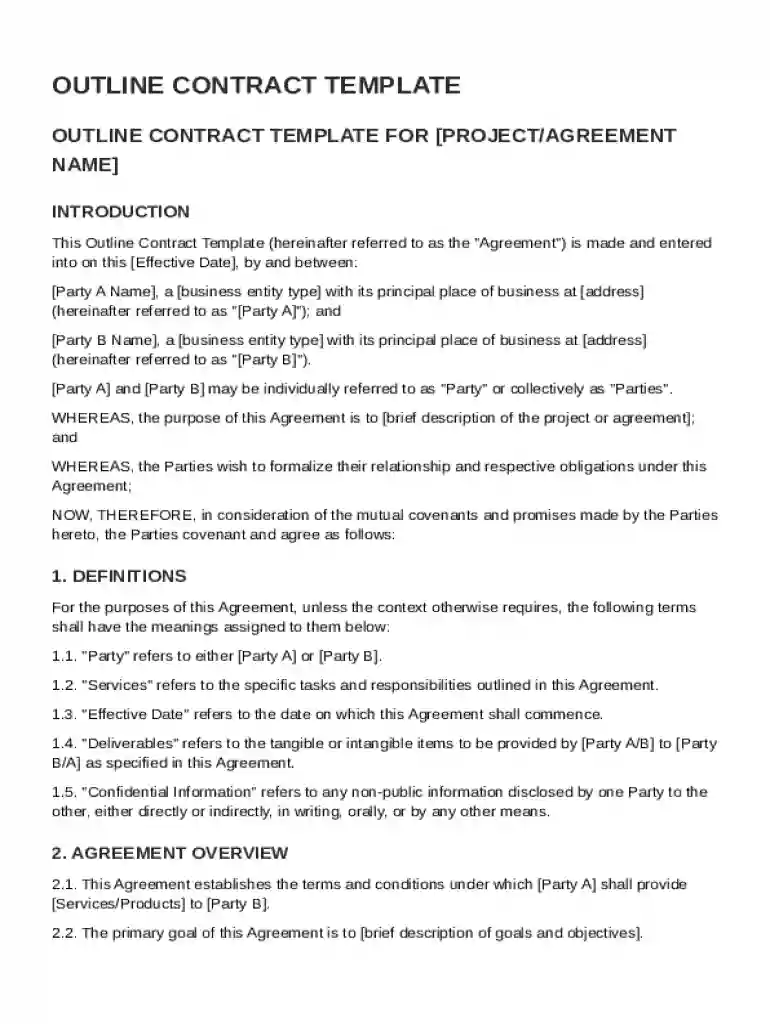
An Outline Contract Template is a structured document designed to formalize agreements between two parties. This template establishes the framework for detailing obligations, services to be provided, and terms such as compensation, confidentiality, and dispute resolution. It is crafted to ensure that both parties have clear expectations and legal protections when entering into a project or agreement. By using an Outline Contract Template, parties can streamline the contractual process, reducing ambiguity and facilitating smoother negotiations.
The Outline Contract Template comprises several critical sections that ensure comprehensive coverage of all necessary contractual details:
Scope of Work: Specifies the tasks and deliverables each party commits to completing. It defines the project objectives, timelines, and milestones, providing a clear blueprint for execution.
Payment Structure: Outlines the financial terms, including any upfront payments, scheduled payments, or milestones tied to compensation. This helps prevent disputes by clarifying how and when payments will be made.
Responsibilities of Each Party: Clearly assigns duties and responsibilities, reducing the potential for role overlap or unfulfilled obligations. Both parties agree to their roles, ensuring accountability.
Confidentiality Provisions: Protects sensitive information, stipulating how confidential data will be handled. It prevents unauthorized disclosure, safeguarding intellectual property and trade secrets.
Dispute Resolution Mechanisms: Establishes procedures for resolving conflicts, whether through mediation, arbitration, or court proceedings. This reduces confrontations and ensures a fair process for both parties.
Termination Conditions: Details the circumstances under which the contract can be dissolved before completion. It includes the rights and obligations of each party upon termination.
Filling out the Outline Contract Template involves a series of methodical steps to ensure accuracy and compliance:
Gather Necessary Information: Collect relevant data on both parties, such as names, addresses, and any specific roles or titles within the project.
Define the Scope of Work: Clearly articulate the objectives, deliverables, and timelines. This should include all responsibilities and expected outcomes.
Outline Payment Terms: Agree on the financial arrangements, including the total contract value and any payment schedules. Ensure both parties consent to the proposed payment structure.
Specify Confidentiality Clauses: Include terms that protect proprietary information and outline the consequences of any breaches.
Detail Dispute Resolution Procedures: Choose a preferred method for resolving disagreements and state it explicitly.
Finalize Termination Clauses: Define the permissible grounds for ending the contract and the steps to be followed in case of termination.
The Outline Contract Template is widely used by various entities that require structured agreements:
Businesses and Corporations: Often utilize templates for vendor agreements, service contracts, and partnerships to formalize their obligations and expectations.
Freelancers and Consultants: Use contracts to outline project details, payment terms, and responsibilities, ensuring clarity and protection while working with clients.
Non-Profits and NGOs: Employ these templates when entering agreements with donors, partners, or service providers to ensure transparency and accountability.


To maintain legality and enforceability of an Outline Contract Template:
Compliance with Applicable Laws: Ensure that the contract adheres to the governing laws and regulations of the jurisdiction in which it will be enforced. This prevents potential legal challenges.
Legally Binding Language: Use precise legal terminology to avoid ambiguities that could lead to disputes.
Signatures: Must be signed by authorized representatives of each party to indicate consent and intent to adhere to the contract terms. Electronic signatures, where permissible, offer a convenient alternative to traditional signatures.
Several scenarios illustrate the practical application of the Outline Contract Template:
Technology Product Development: A software company partners with a developer to build a custom application. The contract specifies project phases, deliverables, payment schedules, and confidentiality obligations, minimizing miscommunications.
Marketing Services Agreement: A marketing agency contracts with a client to provide advertising services. The document defines campaign goals, budgets, timelines, and reporting requirements, making expectations clear for both parties.
Event Planning Contract: An event planner uses a contract with a venue provider, covering logistics, payment structures, responsibilities, and any cancellation policies to prevent misunderstandings.
While Outline Contract Templates serve a universal purpose, variation by state can arise due to differing laws:
Governing Law: Specify the state laws that will govern the contract to ensure clarity on which jurisdiction’s rules apply.
Mandatory Clauses: Certain states may require specific language or clauses, such as those related to labor laws, privacy protections, or tax obligations.
Enforcement and Remedies: States can differ in how contracts are enforced or how remedies for breach of contract are assessed. Familiarity with state-specific regulations is essential.
Modern contracting often involves both digital and paper forms:
Digital Version: Provides convenience and accessibility, allowing parties to review, edit, and sign documents electronically. Digital contracts often include features like tracking changes or digital signatures.
Paper Version: Preferred when an ink signature or physical record is required, ensuring a tangible copy is available for reference.
Both versions must maintain the integrity and original terms to remain valid and enforceable.
At DocHub, your data security is our priority. We follow HIPAA, SOC2, GDPR, and other standards, so you can work on your documents with confidence.



Contract Templates. Services Agreements Interagency Cooperation Contracts Interlocal Cooperation Contracts Hotel Agreement Speaker Agreements
Outline Agreement Form Arkansas Department of Health Procurement/Support Branch Agency Name(Required) 0000 Other 0200 Abstracters Board
Mar 24, 2022 Defining the Statement of Work (SOW), or in other words, outlining your expectations for the project, comes first when creating the contract.


