




01. Edit your form online
Type text, add images, blackout confidential details, add comments, highlights and more.

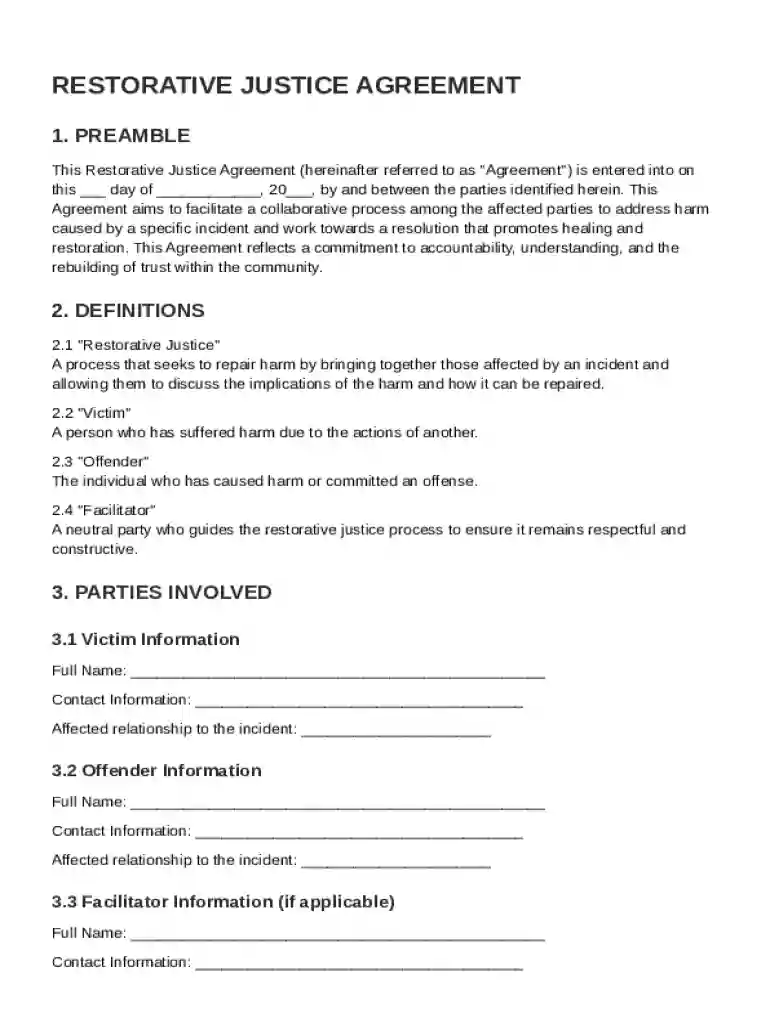
Type text, add images, blackout confidential details, add comments, highlights and more.

Draw your signature, type it, upload its image, or use your mobile device as a signature pad.

Send it via email, link, or fax. You can also download it, export it or print it out.
The Restorative Justice Agreement Template is a formal framework developed to address and repair the harm caused by an incident involving victims, offenders, and facilitators. This template ensures a structured approach to restorative justice, emphasizing accountability and community healing. It outlines specific roles, goals, and actions that participants will undertake to resolve and repair the harm, providing a clear path for resolution and reconciliation. The agreement typically includes confidentiality clauses to protect all parties involved and detailed communication methods to facilitate constructive dialogue.
Accessing the Restorative Justice Agreement Template is crucial for practitioners looking to facilitate an effective restorative process. This template can often be downloaded from platforms specializing in legal and social justice resources. For seamless integration into digital workflows, professionals may use document management services like DocHub that offer a wide range of legal templates, ensuring that the format is suitable and ready for use without additional modification.
Completing the Restorative Justice Agreement Template involves several meticulous steps:
Identify Participants: Clearly list all parties involved, including victims, offenders, and facilitators.
Define Objectives: Outline the primary goals for the agreement, focusing on healing and accountability.
Assign Roles and Responsibilities: Detail specific responsibilities for each participant to ensure clarity.
Document Actions and Timeline: Specify actions to be taken and establish a timeline for their execution.
Include Confidentiality Clauses: Draft confidentiality terms to protect sensitive information.
Ensure Signatures: Collect signatures from all parties to validate the agreement.
In a school setting, a Restorative Justice Agreement might be used to address bullying incidents, where the victim, the accused student, and a school counselor work together to create a resolution plan that emphasizes healing and behavior correction rather than punishment.
Several vital components make up a comprehensive Restorative Justice Agreement Template:
In situations involving workplace harassment, the template can include elements such as restitution measures and team-building initiatives to rebuild trust and ensure future prevention.
In the U.S., the legal standing of a Restorative Justice Agreement is often grounded in informal settings where alternative resolutions are preferred. These agreements are used with the understanding that they are non-legally binding unless integrated within a legal proceeding for cases diverted from criminal prosecution. However, they can influence judicial decisions if presented during court deliberations to demonstrate resolve towards rehabilitation and reconciliation.
Understanding specific terminology is essential for working with the Restorative Justice Agreement Template effectively:
Real-world examples of successful use of this agreement include:
This template is commonly employed by a diverse group of users:


Typically, the Restorative Justice Agreement Template is not issued by a centralized authority but can be adapted and distributed by organizations including community service groups, educational institutions, and legal aid societies. These entities ensure that the template aligns with local legal standards and cultural practices to maximize its effectiveness and acceptance among users.
At DocHub, your data security is our priority. We follow HIPAA, SOC2, GDPR, and other standards, so you can work on your documents with confidence.


Confidentiality Statement. Confidentiality Statement: Data and information contained in this document are considered to constitute trade secrets.
Restorative Practices is an educational intervention that emphasizes owning behaviors, actions and words in an effort to make things right.
Write 2 to 3 respect agreements for each box, for example I will keep my hands to myself. Words like dont. cant and wont should not be used. Try it


