
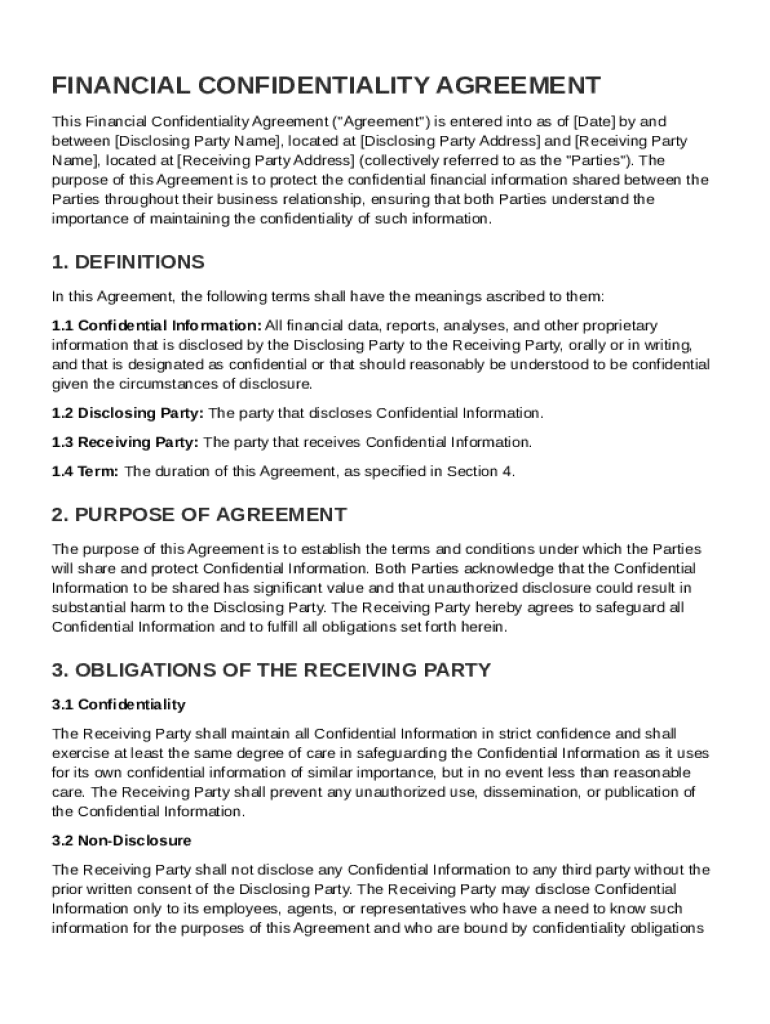







Definition and Meaning
A Financial Confidentiality Agreement Template is a structured legal document designed to protect sensitive financial information shared between parties. This type of agreement outlines the terms under which financial data is exchanged and ensures that the receiving party understands their obligations regarding confidentiality. By explicitly defining what constitutes confidential information, the agreement mitigates risks related to unintentional disclosure or misuse, providing a safeguard for sensitive financial transactions or business dealings.
Key Elements of the Financial Confidentiality Agreement Template
To draft an effective financial confidentiality agreement, certain key elements must be included. These typically encompass:
- Definitions: Clear explanations of what constitutes confidential information.
- Obligations: The duties of the receiving party to keep information secure.
- Exclusions: Specific scenarios where confidentiality may not apply, such as publicly available data.
- Duration: Timeframes for which the agreement remains in effect.
- Termination: Procedures for returning or destroying confidential information once the agreement ends.
- Dispute Resolution: Outlined methods for resolving disagreements related to confidentiality breaches.
Who Typically Uses the Financial Confidentiality Agreement Template
This template is commonly used by:
- Businesses: Companies involved in mergers, acquisitions, or partnerships often leverage these agreements to share sensitive financial data securely.
- Consultants and Contractors: Independent professionals who need access to a company's financial records to provide services.
- Investors and Venture Capitalists: Individuals or entities conducting due diligence before investments often use this agreement to safeguard the information they receive.


Legal Use of the Financial Confidentiality Agreement Template
The agreement serves a critical role in legally binding the parties involved to maintain confidentiality over disclosed financial information. By adhering to federal and state laws, this template ensures compliance with U.S.-centric legal frameworks. The enforceability of these agreements is contingent upon clear, mutually agreed-upon terms that conform to local legal standards, making it a vital tool for legal protection.
Important Terms Related to Financial Confidentiality Agreement Template
Understanding certain legal terminology is crucial when dealing with financial confidentiality agreements. Key terms include:
- Confidential Information: All non-public financial data shared between parties.
- Recipient: The party receiving the confidential information.
- Disclosing Party: The party sharing the sensitive information.
- Breach of Contract: Failure to uphold the confidentiality terms can lead to legal consequences.
- Non-Disclosure Clause: Specific language in the agreement detailing prohibitions against sharing information with unauthorized parties.
Steps to Complete the Financial Confidentiality Agreement Template
Completing this template involves several crucial steps:
- Identification of Parties: Clearly state who the disclosing and receiving parties are.
- Define Confidential Information: Specify what financial data is deemed confidential.
- Outline Restrictions: Discuss any limitations on sharing or using the information.
- Set Duration and Obligations: Define how long the agreement lasts and the duties expected.
- Sign and Date the Document: Both parties must sign to make the agreement legally binding.
State-Specific Rules for the Financial Confidentiality Agreement Template
While confidentiality agreements are generally uniform, certain U.S. states have unique requirements. It is essential to tailor the template to adhere to state-specific laws:
- California: Stringent rules govern non-compete clauses within confidentiality agreements.
- New York: Focus on trade secrets and additional employee protections.
- Texas: Enforceability often hinges on reasonable scope and duration.
Software Compatibility
DocHub, integrated seamlessly within various technological ecosystems, supports the use of this template across multiple platforms. Users can import, edit, and manage their confidentiality agreements through popular software solutions, including Google Workspace. This compatibility ensures a streamlined workflow, facilitating ease of use in digital formats without the need for excessive manual interventions.




