
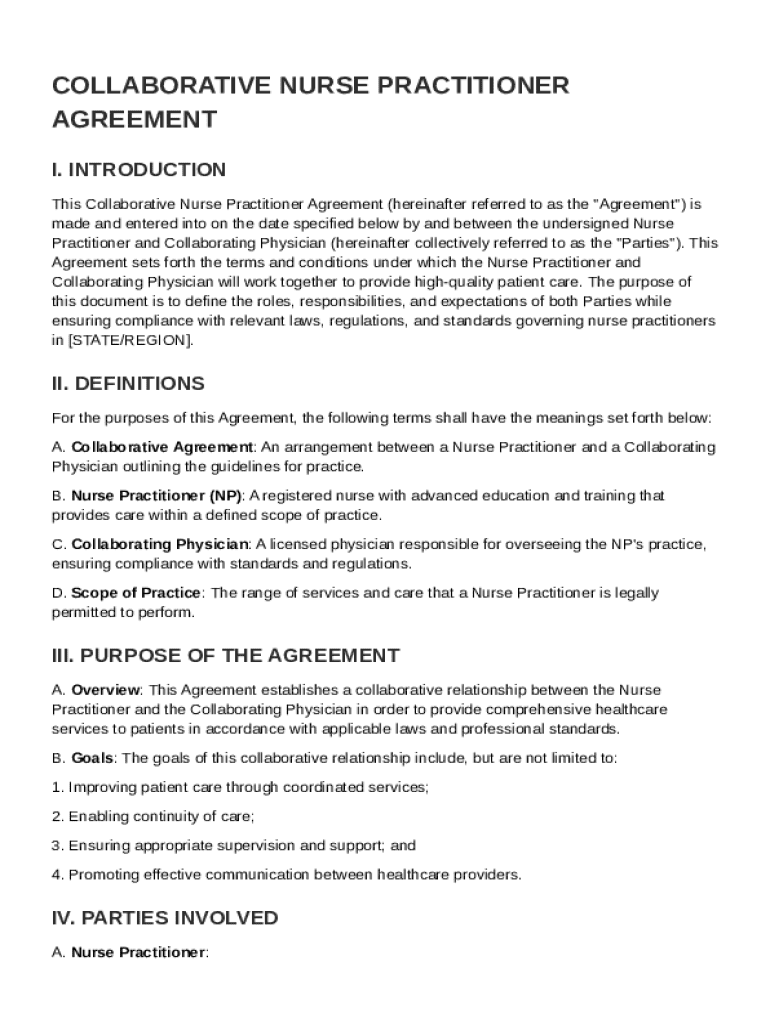







Definition & Purpose of Collaborative Nurse Practitioner Agreements
A Collaborative Nurse Practitioner Agreement Template formalizes the professional relationship between a nurse practitioner (NP) and a collaborating physician. This document establishes the roles, responsibilities, and expectations for maintaining high-quality patient care. Collaboration is critical to ensuring that both parties adhere to legal requirements and professional standards. Key components of the agreement include:
- Clear roles for both the NP and the physician.
- Defined communication protocols for regular consultations and case reviews.
- Guidelines for accountability and clinical decisions.
Such agreements not only support consistent patient care but also align with state regulatory standards governing collaborative practice.
Key Elements of the Collaborative Agreement
The Collaborative Nurse Practitioner Agreement Template includes several essential elements that provide structure and clarity. Each element is crucial for ensuring compliance and effectiveness:
- Roles and Responsibilities: Detailed descriptions of the NP's and physician's duties to avoid overlaps and omissions.
- Patient Care Protocols: Guidelines for delivering consistent patient care, including procedures for routine and emergency situations.
- Compensation and Reimbursement: Terms dictating the financial arrangements, which may include billing and reimbursement responsibilities.
- Quality Assurance: Processes for regular audit and evaluation to ensure standards of care are met.
These elements are vital for creating a comprehensive agreement that meets the needs of all parties involved.
Steps to Complete the Template
Completing the Collaborative Nurse Practitioner Agreement Template requires careful attention to detail and a thorough understanding of each party's expectations:
- Gather Required Information: Include personal and professional details about both the NP and the physician.
- Outline Clinical Collaboration: Define the scope of practice, including decision-making processes and settings where the NP can practice.
- Specify Communication Procedures: Establish regular meeting times and emergency contact protocols.
- Agree on Terms and Conditions: Discuss and document terms related to compensation, confidentiality, and dispute resolution.
- Final Review and Signing: Both parties should review the document thoroughly before signing to ensure all details are correct and mutually agreed upon.
Completing these steps ensures a well-rounded agreement that serves the intended purpose.
Legal Implications and Compliance
The Collaborative Nurse Practitioner Agreement Template must comply with federal and state laws to avoid legal complications:
- State Laws: Each state has specific regulations regarding NP practice and physician collaboration, which must be reflected in the agreement.
- Federal Standards: Compliance with the Health Insurance Portability and Accountability Act (HIPAA) for patient information protection.
- Professional Guidelines: Following guidelines provided by professional associations such as the American Association of Nurse Practitioners (AANP).
Failure to comply with these legal standards can result in penalties or revocation of practice rights.
Benefits of Using a Collaborative Agreement
Utilizing a Collaborative Nurse Practitioner Agreement Template offers numerous advantages, not only for the professionals involved but also for the patients:
- Enhanced Patient Care: Structured collaboration leads to more comprehensive patient care strategies.
- Clear Accountability: Establishing clear roles minimizes the risk of misunderstandings and legal issues.
- Professional Growth: Enables nurse practitioners to practice to the full extent of their training and expertise under the guidance of an experienced physician.
These benefits emphasize the importance of such agreements in modern healthcare settings.
State-Specific Rules and Considerations
States vary in their regulations governing the practice of nurse practitioners and their collaboration with physicians:
- Full Practice States: Allow NPs to operate independently, requiring fewer collaboration details.
- Reduced Practice States: Enforce more restrictive requirements, necessitating detailed supervision sections.
- Restricted Practice States: Require physician oversight for diagnosis, treatment, and prescribing medicines, which must be thoroughly documented.
Understanding these state-specific rules is crucial for drafting a compliant agreement.
Examples of Collaborative Scenarios
Collaborative agreements can be tailored to fit various clinical scenarios:
- Primary Care Settings: Foster regular consultations for comprehensive health assessments and management.
- Specialty Clinics: Facilitate focused collaboration for patients requiring specialized care, such as cardiology or endocrinology.
- Telehealth Services: Allow for remote collaboration, highlighting the importance of defined communication protocols.
These scenarios demonstrate the adaptability and necessity of well-crafted agreements.
Required Documentation for Completion
Several documents and information pieces are necessary to complete the Collaborative Agreement Template effectively:
- Professional Licenses: Provide proof of licensure for both the NP and the physician.
- Insurance Information: Include malpractice insurance details.
- Practice Credentials: Certification, areas of specialty, and other relevant credentials.
Ensuring all required documents are ready simplifies the process and ensures legitimacy.
Practical Use Cases for the Agreement
Nurse practitioners and physicians can utilize the Collaborative Agreement in various contexts:
- Hospitals and Clinics: Facilitate seamless collaboration for inpatient and outpatient care.
- Private Practices: Strengthen the operational foundation by ensuring legal and professional alignment.
- Educational Institutions: Support training and mentorship programs by clearly defining the scope of practice for student NPs.
These use cases highlight the versatility of collaborative agreements in enhancing healthcare delivery.




