
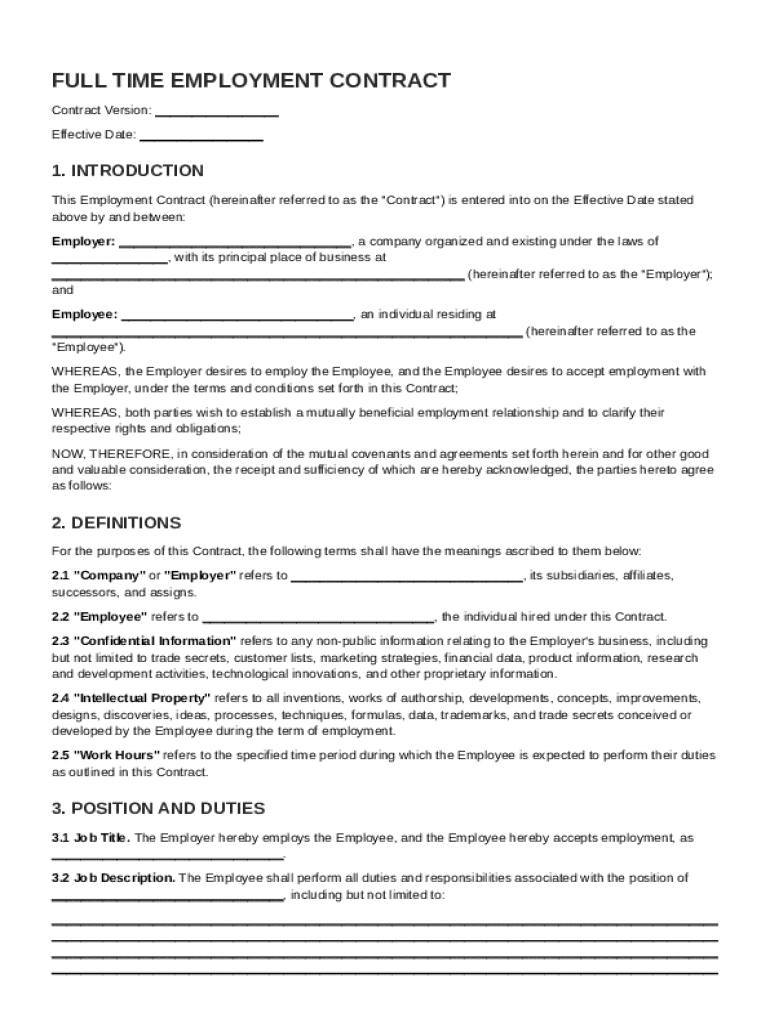







Definition and Importance of a Full-Time Employment Contract
A full-time employment contract is a formal agreement between an employer and an employee that outlines the terms of a full-time work arrangement. The contract covers aspects such as job responsibilities, compensation, benefits, work hours, and legal obligations. For both parties, having a clearly defined contract helps prevent misunderstandings and provides a foundation for a stable working relationship. It is particularly important in establishing mutual expectations and protecting both the employer's and employee's rights under employment law.
How to Use the Full-Time Employment Contract Template
Using a full-time employment contract template simplifies the creation of a comprehensive agreement. Begin by downloading or opening the template in a document editor compatible with DocHub. Review each section of the template to ensure it aligns with your specific employment terms. Customization may include adding specific job titles, adjusting salary figures, or incorporating unique company policies. DocHub's toolset allows users to edit text directly, add annotation for clarity, and insert legally binding electronic signatures to finalize the contract.
Steps to Complete the Full-Time Employment Contract Template
-
Opening the Template: Access the template via your cloud storage or download it to your device for local editing.
-
Reviewing Sections: Examine each section, such as job duties, compensation, and benefits, ensuring they reflect the agreed terms.
-
Customizing Content: Use DocHub's editing tools to adjust any generic content to fit specific needs, like inserting company-specific clauses.
-
Adding Signatures: Utilize the electronic signature feature to capture signatures from both parties.
-
Final Review: Conduct a thorough review for accuracy before saving the final document in a secure location.
Key Elements of the Full-Time Employment Contract Template
-
Job Description: Clearly defines the employee’s role and responsibilities within the company.
-
Compensation and Benefits: Details salary, bonuses, health insurance, and other benefits provided by the employer.
-
Work Hours: Specifies expected working hours, overtime policies, and flexible scheduling options.
-
Confidentiality Agreement: Outlines obligations regarding the protection of sensitive company information and intellectual property.
-
Termination Clause: Provides the conditions under which either party may terminate the contract.
Legal Use and Compliance for the Full-Time Employment Contract Template
A full-time employment contract must comply with federal and state labor laws to ensure its enforceability. This involves understanding regulations related to minimum wage, overtime eligibility, and workplace safety standards. Employers should ensure the contract also respects anti-discrimination laws. Legal consultation can be beneficial to confirm that the contract fulfills all local and national requirements, thus protecting the employer and employee against potential legal disputes. Always include dispute resolution procedures to address any potential conflicts.
Differences Across States for Employment Contract Templates
Employment laws can significantly differ from state to state, making it crucial to adapt the template to local jurisdictions. For example, California has stringent rules around at-will employment and employee rights that require careful integration into any employment contract. States like New York may have specific disclosure requirements or stipulations on employee benefits and leave. Consulting with regional legal experts or referring to state-specific guides can ensure that the contract is adequately tailored to meet local legal obligations.
Importance of Key Terms in Full-Time Employment Contracts
Understanding critical terms in an employment contract ensures clarity and prevents misinterpretation. Terms such as "at-will employment," "non-compete clause," "probationary period," "exempt vs. non-exempt," and "notice period" are commonly included and need to be adequately explained. Accurately defining these terms within the contract establishes transparency and fairness, facilitating a smoother employer-employee relationship.
Practical Scenarios and Examples of Using the Template
In a manufacturing industry setting, a full-time employment contract might include specific safety training requirements and mandatory overtime policies during peak production periods. Conversely, in a tech company, the emphasis might be on intellectual property rights and flexible work arrangements. Real-world scenarios aid in spotlighting how tailored contracts meet unique industry and role-specific needs, supporting organizational objectives while maintaining legal compliance.




