01. Edit your form online
Type text, add images, blackout confidential details, add comments, highlights and more.

Type text, add images, blackout confidential details, add comments, highlights and more.

Draw your signature, type it, upload its image, or use your mobile device as a signature pad.

Send it via email, link, or fax. You can also download it, export it or print it out.
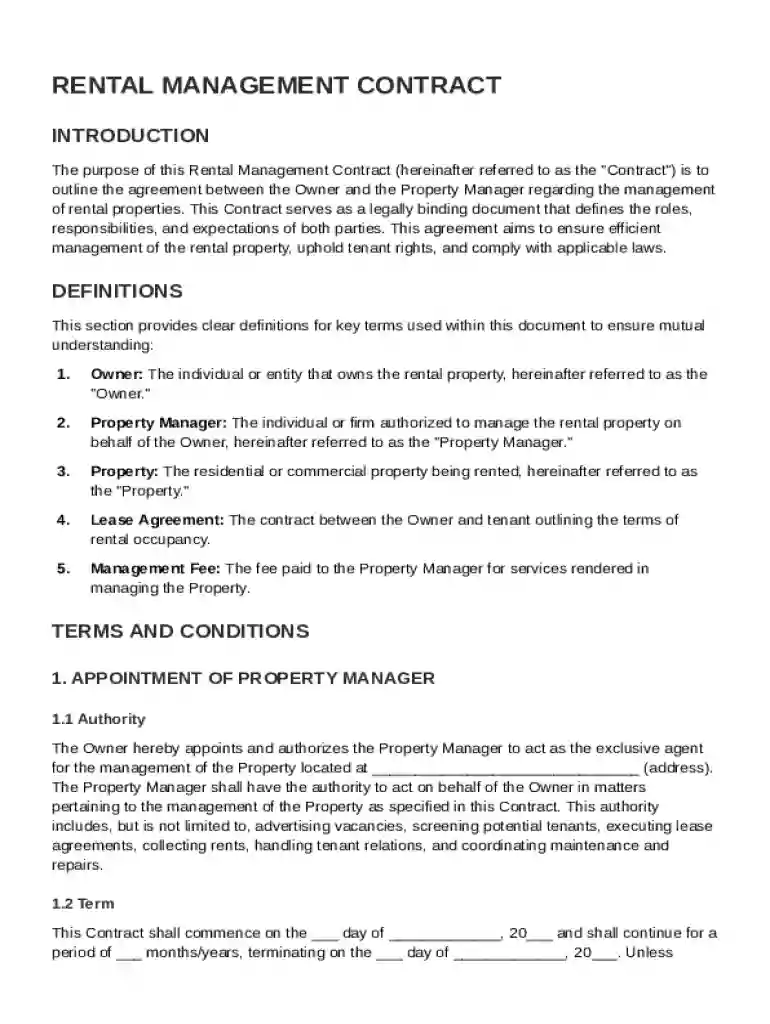
A Rental Management Contract Template serves as a critical document in defining the roles and responsibilities between a property owner and a property manager. This template encompasses several fundamental sections that facilitate transparent and efficient property management. These elements include:
Definitions: Offers clarity by describing essential terms used throughout the document, ensuring that both parties have a mutual understanding of terminology.
Appointment and Authority of the Property Manager: Outlines the formal assignment of the property manager and specifies their authority level, encompassing tasks like tenant selection, rent collection, and property maintenance.
Responsibilities of the Property Manager: Includes detailed expectations for marketing the property, managing tenant relations, ensuring compliance with relevant laws, and providing periodic financial reporting to the owner.
Owner's Responsibilities: Highlights the obligations of the property owner, primarily focusing on financial commitments and decision-making when extensive property-related issues arise.
Compensation Structure: Details how the property manager will be paid, typically through a percentage of collected rent, along with any additional fees for services rendered outside the standard duties.
Termination Conditions: Specifies the conditions under which the agreement may be terminated by either party, including required notices and potential termination fees.
Indemnification Clauses: Provides protection for both parties against specific legal liabilities that may arise during the contract term.
Governing Law and Amendments: Defines the legal framework governing the contract and outlines the process for making modifications to the agreement.
Each element plays an essential role in maintaining a professional and legally sound relationship between the owner and the property manager.
Completing a Rental Management Contract Template requires careful attention to detail to ensure all critical points are accurately addressed. Here's a structured process to guide you through filling out this document:
Gather Necessary Information: Compile all personal and property-related details, including contact information for both parties and property addresses.
Define Terms Clearly: Fill in the 'Definitions' section with mutually agreed-upon terms to eliminate any ambiguity in the agreement.
Specify Manager Duties: Outline specific tasks assigned to the property manager to avoid future disputes, such as tenant screening procedures and property inspection intervals.
Describe Owner Obligations: Clearly state the property owner's responsibilities, including financial duties related to maintenance costs and major repairs.
Determine Compensation: Agree on a compensation arrangement for the property manager, whether it's a fixed salary or a percentage-based model, and insert these details into the template.
Outline Legal Provisions: Insert clauses related to indemnification, governing law, and amendments to cover unforeseen issues and ensure legal compliance.
Review and Sign: Both parties should carefully review the completed document for accuracy before signing to acknowledge their agreement to the terms.
Store Securely: After execution, keep a digital and paper copy of the agreement in a safe, accessible location.
By following these steps, you can complete the Rental Management Contract Template methodically and efficiently.
This template is widely utilized by several key stakeholders involved in property management:
Property Owners: Individuals or companies who own rental properties and seek professional management services to maintain and enhance property value.
Property Managers: Professionals or firms appointed by owners to oversee daily property operations, tenant management, and financial accountability.
Real Estate Agents: Brokerages that offer property management services as part of their real estate portfolio might use this template to formalize agreements with clients.
Legal Advisors: Attorneys specializing in real estate may use these templates to provide guidance or draft tailored property management agreements for clients.
Each of these users benefits from the template's structure, which standardizes and clarifies the relationship dynamics in rental property management.


Understanding key terms within a Rental Management Contract Template is foundational to effective property management. Here are some critical terms:
Lease Agreement: A contract between a landlord and tenant outlining the rental terms, contrastable with the management contract focusing on the owner-manager relationship.
Rent Collection: The process overseen by the property manager to gather rental income from tenants and its inclusion in the scope of their duties.
Maintenance: The upkeep required to maintain property value, often described in the contract to specify the extent of the manager’s repair and maintenance duties.
Compliance: The adherence to local, state, and federal property rental laws, emphasized in the contract to ensure legal obligations are met.
Understanding these terms helps both parties set clear expectations and reduces potential disputes.
The legal integrity of a Rental Management Contract Template is essential for it to withstand scrutiny and be enforceable. Key considerations include:
Adherence to State Laws: While the template offers a general framework, customization in line with specific state rental statutes is often necessary.
ESIGN Act Compliance: In cases where the document is executed electronically, ensuring compliance with the Electronic Signatures in Global and National Commerce Act to confirm the legal standing of digital signatures.
Dispute Resolution: Including clauses that define the process for resolving disagreements, such as mediation or arbitration, to address conflicts without lengthy court proceedings.
By drafting the contract with these legal considerations in mind, parties can create a robust and enforceable agreement.
Each state in the U.S. may have unique requirements that influence the structure and provisions of the Rental Management Contract Template:
Security Deposit Regulations: Certain states have laws governing security deposit handling, necessitating specific clauses on how these funds are managed and returned.
Maximum Fees: Some jurisdictions limit fees that property managers can charge, requiring adjustments to the compensation section of the template.
Notice Periods: Different states enforce unique periods for contract termination notices, which must be reflected accurately in the termination conditions.
Awareness of these state-specific variations is crucial for drafting a contract compliant with both state and federal laws.
Utilizing the Rental Management Contract Template effectively involves several key practices:
Customization: Tailor the template to suit the specific needs and expectations of both parties without compromising any essential elements of the agreement.
Regular Updates: Periodically review and modify the contract content to reflect changes in laws or circumstances affecting the property management relationship.
Consultation: Engage a legal advisor to ensure that any alterations remain within the bounds of applicable law and to address any complex clauses.
Communication: Discuss and agree upon any outstanding or unclear parts of the template to ensure alignment between the owner and manager.
These practices optimize the use of the template, supporting clear communication and effective property management.
The choice between a digital and paper version of the Rental Management Contract Template can impact usability and compliance. Considerations include:
Accessibility: Digital versions allow for remote access, editing, and sharing, which can enhance communication between geographically dispersed parties.
Authentication: Digital documents can incorporate robust authentication measures, including encrypted signatures, adding an additional layer of security.
Environmental Impact: Digital documents reduce the need for physical resources, aligning with eco-friendly practices while maintaining document integrity.
Opting for a digital version enhances efficiency and security, particularly in tech-forward or geographically dispersed management scenarios.
At DocHub, your data security is our priority. We follow HIPAA, SOC2, GDPR, and other standards, so you can work on your documents with confidence.