
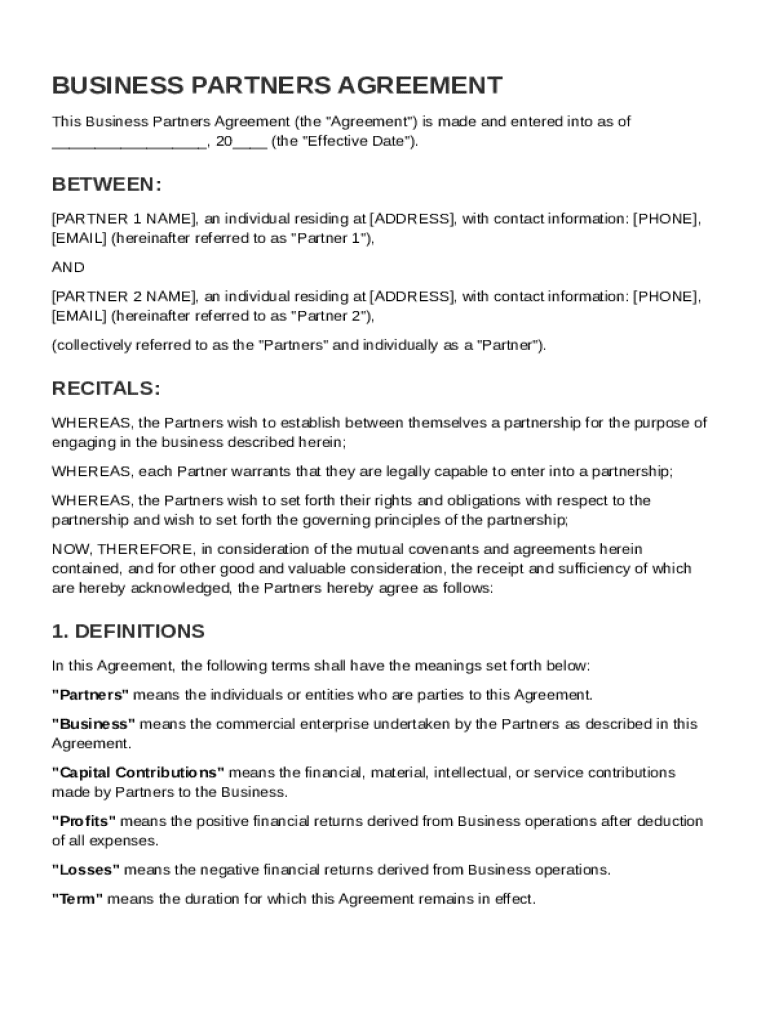







Definition & Meaning
The Business Partners Agreement Template is a formal document designed to outline the terms and conditions governing a business partnership between two or more parties. This template serves as a foundational contract that details the rights and obligations of each partner, as well as their roles and responsibilities within the partnership. By defining these parameters, the agreement aims to prevent misunderstandings and disputes by providing a clear framework for business operations. Typically, it includes clauses regarding capital contributions, profit and loss distribution, and management roles. This comprehensive approach ensures that all parties are aware of their expected contributions and compensations.
Key Elements of the Business Partners Agreement Template
The Business Partners Agreement Template consists of several critical components, each serving a specific purpose to ensure the agreement is comprehensive and legally binding. Key elements include:
-
Capital Contributions: Details the initial investment each partner will make into the partnership, setting expectations for financial commitment.
-
Profit and Loss Sharing: Outlines how profits and losses will be distributed among partners, which is crucial for financial transparency.
-
Management Roles and Responsibilities: Assigns specific duties to each partner, clarifying decision-making authority and operational involvement.
-
Dispute Resolution Procedures: Establishes methods for resolving disagreements, which can include mediation or arbitration to avoid lengthy legal battles.
-
Termination Clause: Defines conditions under which the partnership can be dissolved, including the process for asset distribution.
-
Miscellaneous Clauses: May include confidentiality agreements, non-compete clauses, and other terms tailored to the partnership's needs.
Steps to Complete the Business Partners Agreement Template
Completing the Business Partners Agreement Template involves several methodical steps to ensure accuracy and completeness. The process typically includes:
-
Gathering Information: Collect names, addresses, and roles of each partner involved in the agreement.
-
Defining Contributions: Accurately document each partner's financial or other contributions to the business.
-
Drafting the Agreement: Using the template, begin populating each section with relevant information, custom tailoring any clauses to fit the partnership’s specific requirements.
-
Reviewing and Revising: Conduct a thorough review, ensuring all terms are clear and reflect the partners’ discussions and decisions.
-
Legal Consultation: Seek advice from a legal professional to verify that the agreement complies with applicable laws and regulations.
-
Signing the Agreement: Once finalized, all partners must sign the document in the presence of a witness or notary, depending on state requirements.
Legal Use of the Business Partners Agreement Template
The legal integrity of the Business Partners Agreement Template is paramount to its enforceability. To ensure the agreement meets legal standards:
-
Compliance with State Laws: Verify that the agreement adheres to specific state laws governing partnerships, as these can vary widely.
-
Signature and Witness Requirements: Understand and incorporate any state-specific mandates related to document execution, which might include notarization or witness signatures.
-
Enforcement of Terms: Ensure that all terms and provisions outlined are legally enforceable and do not conflict with existing laws or regulations.
State-by-State Differences
Partnership agreements like the Business Partners Agreement Template can be subject to differing requirements and interpretations in various states. Some of these differences may include:
-
Filing Requirements: While some states require partnership agreements to be filed with a governmental entity, others do not, affecting how the agreement is executed and stored.
-
Tax Implications: State-specific tax laws can influence how partnerships are taxed, necessitating adjustments in the agreement to accommodate these variations.
-
Partnership Liabilities: State laws may differ regarding the liabilities of individual partners in the event of partnership debts, impacting the drafting of liability clauses.
Who Typically Uses the Business Partners Agreement Template
A broad spectrum of entities and individuals leverage the Business Partners Agreement Template to formalize their business relationships, including:
-
Small Businesses and Startups: New ventures often use such templates to establish clear operational guidelines and protect each partner's interests from the outset.
-
Professional Partnerships: Industries such as law and medicine utilize these agreements to outline roles and responsibilities among practitioners.
-
Joint Ventures: Separate businesses may form temporary partnerships to collaborate on projects, using the template to define project terms and responsibilities.


Digital vs. Paper Version
The Business Partners Agreement Template is available in both digital and paper formats, each offering unique advantages:
-
Digital Version: Offers convenient access and ease of modification, allowing partners to collaborate on edits in real-time. Electronic signatures via platforms like DocHub can streamline the signing process.
-
Paper Version: Provides a tactile, traditional means of completing agreements, which some parties may prefer for record-keeping or legal reasons. Hard copies can also serve as a backup to the digital version.
Software Compatibility
When utilizing the Business Partners Agreement Template, compatibility with various software platforms can enhance accessibility and ease of use:
-
DocHub Integration: Seamlessly integrates with Google Workspace, enabling easy import and export of documents from Google Drive or Gmail.
-
Other Platforms: Compatible with widely used document processing software such as Microsoft Word and Adobe Acrobat, allowing you to work within your preferred system for document drafting and editing.




