01. Edit your form online
Type text, add images, blackout confidential details, add comments, highlights and more.

Type text, add images, blackout confidential details, add comments, highlights and more.

Draw your signature, type it, upload its image, or use your mobile device as a signature pad.

Send it via email, link, or fax. You can also download it, export it or print it out.
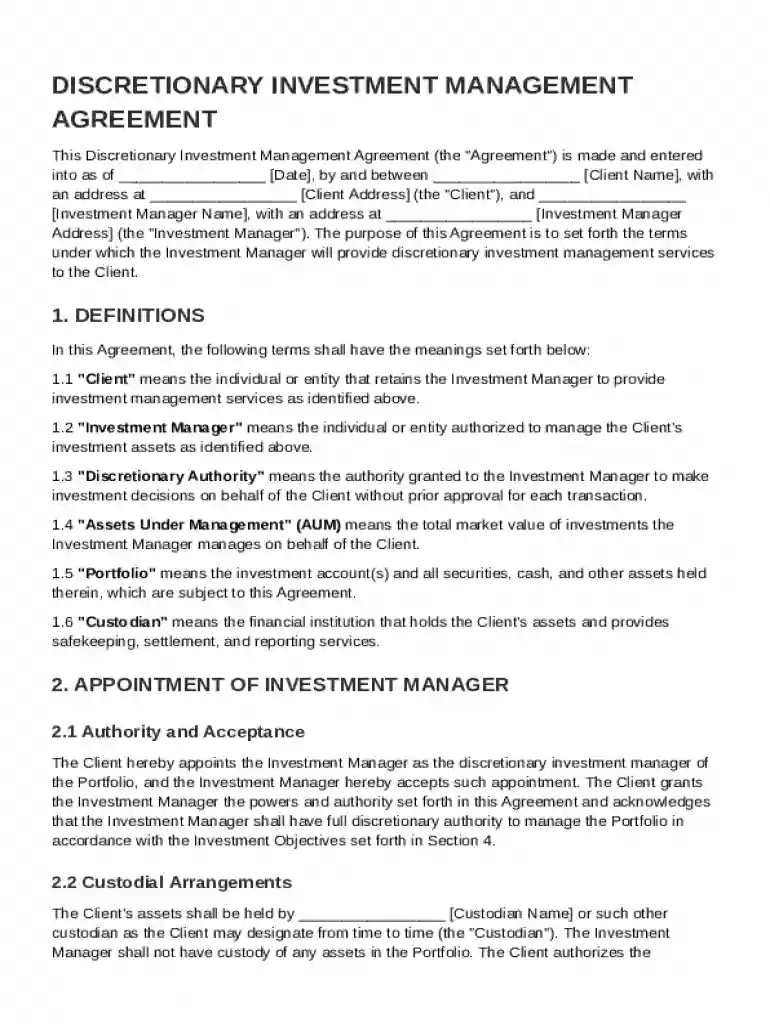
The Discretionary Investment Management Agreement Template is a legal document that formalizes the relationship between a client and an investment manager. This agreement grants the investment manager the authority to make investment decisions on the client's behalf within defined parameters. It typically outlines the scope of services, investment strategy, and the terms under which the manager operates, including performance reporting, fees, and expenses. The template ensures both parties are aligned on expectations and provides a framework for managing the client's investment portfolio.
Understanding the key elements of this template is essential to ensure that all critical aspects of the investment management relationship are covered. Important components include:
This template is designed to comply with U.S. regulations and ensures that the agreement is enforceable under federal and state laws. It adheres to the Investment Advisers Act, which governs the conduct and obligations of investment managers. By using this template, both parties can mitigate legal risks, knowing that the terms are structured to uphold legal standards. It is advisable for parties to consult with a legal professional to adapt the template to specific legal requirements applicable in their jurisdiction.
Completing this agreement involves several key steps:
Utilizing this agreement template is crucial for establishing a transparent and formalized relationship between the client and the investment manager. It helps prevent misunderstandings by explicitly outlining each party's responsibilities and the investment parameters. This clarity builds trust and provides both parties with a documented foundation for the management of the client’s portfolio, which is important for long-term investment success.
This template is predominantly used by financial advisors, investment management firms, and professional wealth managers who require structured agreements with their clients. It is also relevant for clients who wish to engage professional services for managing significant asset portfolios, such as high-net-worth individuals, corporations, and institutional investors.


Consider a financial advisor managing a portfolio for a high-net-worth individual. The agreement template would outline the advisor’s authority to make investments in equities and fixed-income securities to achieve a balanced growth strategy. In another scenario, an investment firm managing institutional funds might use the agreement to designate authority to adjust investment strategies within predefined environmental, social, and governance (ESG) criteria.
Although this template provides a general framework, investment management agreements can be subject to state-specific regulations. For example, states like California and New York have specific rules concerning investment adviser registration and the fiduciary responsibilities of financial professionals. It is important for parties to consult state laws and adapt the template to comply with any state-specific legal requirements to ensure enforceability.
While the discretionary investment management agreement is a comprehensive approach for outlining investment manager authority, other versions exist:
In each case, the choice between versions depends on the level of control and involvement desired by the client.
At DocHub, your data security is our priority. We follow HIPAA, SOC2, GDPR, and other standards, so you can work on your documents with confidence.