01. Edit your form online
Type text, add images, blackout confidential details, add comments, highlights and more.

Type text, add images, blackout confidential details, add comments, highlights and more.

Draw your signature, type it, upload its image, or use your mobile device as a signature pad.

Send it via email, link, or fax. You can also download it, export it or print it out.
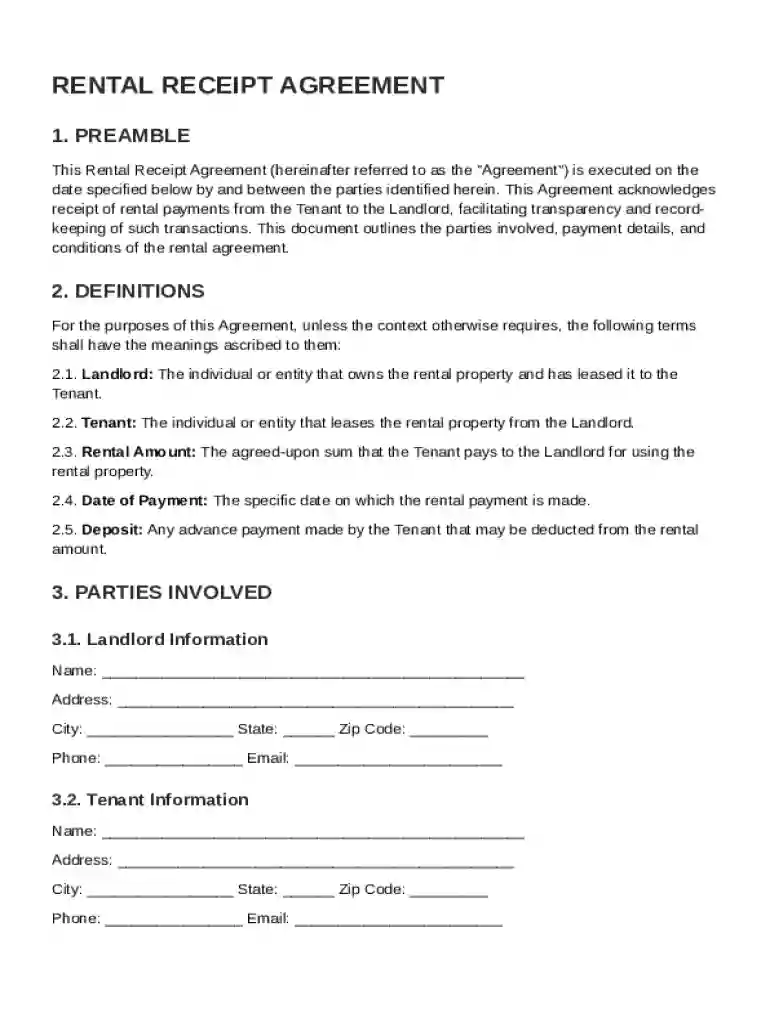
The Rental Receipt Agreement Template is an essential document that serves both landlords and tenants by acknowledging receipt of rent payments. This template is not merely a receipt but also a formal agreement outlining rental payment details, terms, and conditions. This document ensures transparency by detailing who made the payment, the amount, and the period it covers. It establishes a clear record that both parties can refer to in case of future disputes. Whether used in residential or commercial leasing, the template is a valuable tool for maintaining clear communication and avoiding misunderstandings between landlords and tenants.
Utilizing the Rental Receipt Agreement Template is straightforward, although certain steps should be followed to ensure accuracy and completeness. Start by identifying both parties involved: the landlord and the tenant, including their full legal names and contact information. Next, provide details about the property, such as its address and any other identifying information. Specify the payment terms, including the rental amount, due date, and the method by which payment was received. Lastly, include any additional terms, like late fees or acknowledgment of the receipt of a security deposit. It's crucial to review the completed template for accuracy before signing and sharing it with the involved parties.
The Rental Receipt Agreement Template serves a legal purpose by providing documented proof of a financial transaction between tenant and landlord. It is advised to tailor the template to comply with state-specific regulations to ensure its enforceability. In many jurisdictions within the United States, landlords are required by law to provide a receipt for rent payments, making this document not only useful but also necessary in some cases. The template can prevent legal disputes by offering a clear record of all payment-related terms agreed upon by both parties.
While the basic structure of the Rental Receipt Agreement Template is widely applicable, certain states may impose specific requirements. For instance, some states mandate that all rental agreements include particular disclosures about the rental property or the landlord’s obligations. States like California and New York have strict tenant-landlord laws that may affect what information must be included in a rental receipt. Landlords should verify their state’s housing laws to ensure that the template aligns with local regulations, thus safeguarding against legal challenges.
Both individual landlords and property management companies frequently use the Rental Receipt Agreement Template. It’s a vital tool for anyone involved in leasing residential or commercial properties. Tenants also benefit from this template as it provides them with a legal document confirming their payments. This document is especially useful for tenants when needing proof of payment for tax purposes or when applying for rental assistance programs. It is a crucial resource for ensuring transparency and accountability in rental transactions.

Consider a scenario where a tenant named John Doe pays his monthly rent for a New York City apartment. The landlord uses the Rental Receipt Agreement Template to confirm the receipt of payment. The document includes John's payment details, specifying the rental period and addressing any late fees due to a delay in payment. In another example, a property management firm handling multiple units can use this template to standardize the recording of payments from various tenants across different properties, ensuring consistent record-keeping.
At DocHub, your data security is our priority. We follow HIPAA, SOC2, GDPR, and other standards, so you can work on your documents with confidence.