Deed Contract Template 2026

Get Form
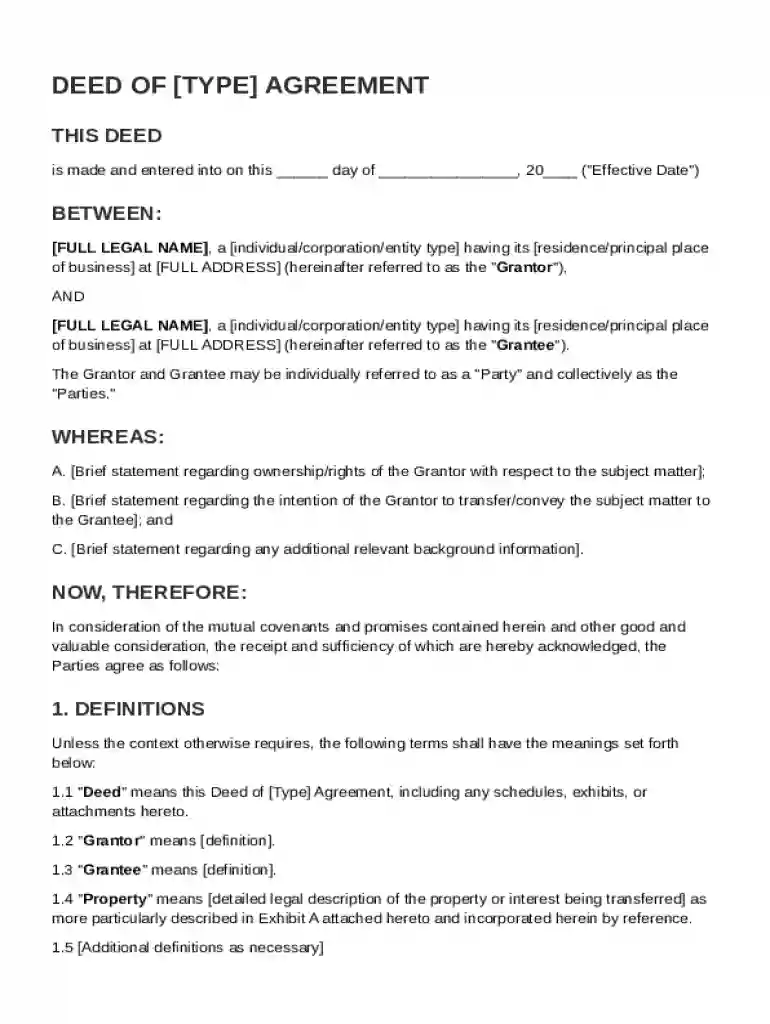
Deed Contract Template Preview on Page 1

Here's how it works

01. Edit your form online
Type text, add images, blackout confidential details, add comments, highlights and more.

02. Sign it in a few clicks
Draw your signature, type it, upload its image, or use your mobile device as a signature pad.

03. Share your form with others
Send it via email, link, or fax. You can also download it, export it or print it out.

Definition and Meaning

A "Deed Contract Template" is a standardized document used to facilitate the transfer of property rights from one party to another, commonly referred to as the grantor and grantee. This legal form typically includes several critical components such as definitions, recitals, and terms of the agreement. The template aims to provide a clear structure for specifying the obligations, rights, and warranties agreed upon by both parties in a property transaction. By using a deed contract template, all involved parties can ensure they are abiding by established legal standards and that their agreement is documented clearly and thoroughly.

Core Elements

  • Definitions and Recitals: Clarifies key terms and sets the context for the rest of the agreement.
  • Title Transfer Agreements: Outlines the conditions under which the property rights are transferred.
  • Representations and Warranties: Provides assurances from both parties regarding their legal capacity and the state of the property.
  • Covenants and Indemnification: Details ongoing obligations such as property maintenance and protection against potential liabilities.

How to Use the Deed Contract Template

The "Deed Contract Template" allows users to create a legally binding agreement with ease. Here's how to use it effectively:

  1. Prepare the Necessary Information: Gather all relevant details about the property and parties involved, including legal descriptions and identification numbers.

  2. Fill in the Blanks: Use the template to insert specific information like names of the grantor and grantee, property descriptions, and signatures.

  3. Customization: Adjust or add clauses as needed to address specific terms agreed upon by both parties. Retain legal counsel if unsure about any changes.

  4. Review for Completeness: Ensure all necessary fields are filled and all attached documents, such as property surveys or disclosure forms, are included.

  5. Execute the Agreement: Both parties should sign the document in the presence of a notary or witness, depending on jurisdictional requirements.

Steps to Complete the Deed Contract Template

Completing a "Deed Contract Template" involves several key steps:

  1. Collect Data: Identify and compile all pertinent information.
  2. Drafting the Document: Use the template to outline the deed agreement, ensuring that all standard clauses and sections are accurately represented.
  3. Legal Review: Have a lawyer review the final draft for compliance with local laws.
  4. Sign the Document: Obtain signatures from all necessary parties, including witnesses or a notary public if applicable.
  5. File the Deed: Submit the completed deed to the appropriate government or municipal office for official recording.

Tips for Filing

  • Ensure all legal descriptions of the property are precise.
  • Double-check witness requirements, as they vary by state.
  • Maintain copies of all signed documents for personal records.

Key Elements of the Deed Contract Template

Key components of the "Deed Contract Template" include:

  • Legal Descriptions: Precisely identify the property being transferred.
  • Payment Details: Outline any consideration exchanged between parties.
  • Transfer Clauses: Detail the nature of the interest being conveyed and any conditions attached.
  • Compliance Clauses: Ensure both parties meet statutory requirements and local laws.
  • Signatures and Notarization: Formalize the agreement with the necessary endorsements.

State-Specific Rules for the Deed Contract Template

Real estate laws and requirements vary significantly from state to state, impacting how a "Deed Contract Template" is completed and filed.

Key Considerations

  • Witness and Notary Requirements: Some states may require witnesses in addition to a notary.
  • Filing Fees: Each state has specific fees associated with filing a deed. Research these fees to budget accordingly.
  • Recording Statutes: Determine the deadlines for recording a deed to avoid legal complications.

Legal Use of the Deed Contract Template

A "Deed Contract Template" serves as a binding legal document once completed and signed. It ensures transparency and clarity in property transactions, which is instrumental in reducing disputes and ensuring that all legal obligations are met.

Common Legal Applications

  • Transfer of Ownership: Legal tool for transferring property titles.
  • Proof of Ownership: Official record for proving property ownership in disputes.
  • Real Estate Transactions: Facilitates smooth closure of real estate deals by laying out terms clearly.

Important Terms Related to Deed Contract Template

Understanding key terms is crucial when drafting or reviewing a deed contract:

  • Grantor/Grantee: The parties involved in the transfer.
  • Consideration: Something of value exchanged between parties.
  • Quitclaim Deed: Transfers any interest the grantor has without warranties.
  • Warranty Deed: Offers the highest level of protection, assuring clear title.
  • Easement: Grants rights to use or pass over another's land.

Examples of Using the Deed Contract Template

Employing a "Deed Contract Template" can facilitate various transactions:

  • Buying a Home: Simplifies the process of title transfer from a seller to a buyer.
  • Intra-family Transfers: Useful for transferring property within families for estate planning purposes.
  • Real Estate Development: Uses in acquiring land for development projects, ensuring clear, legal transfer of property rights.

By utilizing a comprehensive "Deed Contract Template," you can effectively ensure that all aspects of a property transaction are legally documented and binding, granting security and peace of mind to all parties involved.

be ready to get more

Complete this form in 5 minutes or less

Get form

Got questions?

We have answers to the most popular questions from our customers. If you can't find an answer to your question, please contact us.
Contact us
Deeds: To validly execute a deed, two methods are permitted. The individual may: sign in the presence of a witness to evidence the execution; or. direct another person to sign the deed in the individuals presence and in the presence of two witnesses to evidence execution.
In contract law, a land contract, (also known as contract for deed or agreement for deed), is a contract between the buyer and seller of real property in which the seller provides the buyer financing in the purchase, and the buyer repays the resulting loan in installments.
What is an example of deed? A warranty deed is the most common example of a deed. A warranty deed is a deed that indicates that the property has been fully researched, and the grantor guarantees (warrants) that the grantor has full legal rights to sell the property with no liens or other encumbrances.
A deed is a much more formal and intricate type of contract than an agreement and has more stringent legal requirements. What are the benefits of a deed? The formalities of a deed can provide more legal certainty to parties when they are transferring large property and other valuable assets.
Here is how to prepare a deed effectively: Identify the Parties: Clearly state the names and addresses of the grantor(s) and grantee(s) involved in the transaction. Property Description: Provide an accurate description of the property, including its legal description, address, and any relevant parcel numbers.

Security and compliance

At DocHub, your data security is our priority. We follow HIPAA, SOC2, GDPR, and other standards, so you can work on your documents with confidence.

Learn more
ccpa2
pci-dss
gdpr-compliance
hipaa
soc-compliance

People also ask

Under English law there are two main ways that parties can execute agreements; as a deed or as a simple contract (also known as a contract under hand).
Contract for deed is a contract for the sale of land which provides that the buyer will acquire possession of the land immediately and pay the purchase price in installments over a period of time; but, the seller will retain legal title until all payments are made.

Related links