
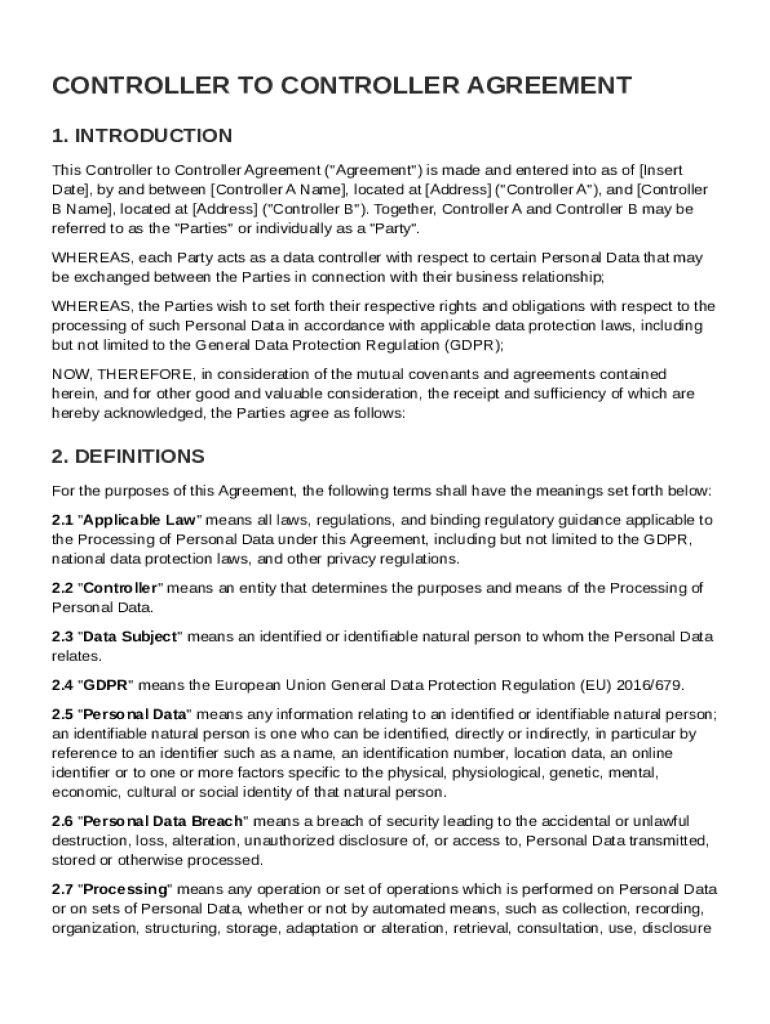







Definition and Meaning of the Controller to Controller Agreement Template
A Controller to Controller Agreement Template is a legal document designed to outline the terms and conditions for sharing and processing personal data between two data controllers, often referred to as Controller A and Controller B. This agreement serves as a framework to ensure compliance with data protection regulations such as the General Data Protection Regulation (GDPR) and aims to protect the rights of individuals whose personal data is being handled. Key aspects include delineation of data processing responsibilities, establishment of security measures, provision for data subject rights, and definition of procedures for managing personal data breaches.
Key Elements of the Controller to Controller Agreement Template
- Data Processing Responsibilities: Clearly outlines the roles and obligations of each controller regarding data processing activities.
- Security Measures: Specifies the security protocols in place to protect personal data, such as encryption and access controls.
- Data Subject Rights: Details how each party will uphold the rights of data subjects, including rights to access, rectification, and erasure.
- Breach Procedures: Defines steps for notifying and managing data breaches, ensuring swift action to mitigate potential risks.
- Mutual Cooperation: Ensures both parties coordinate to maintain compliance with applicable laws and to address any data protection issues that may arise.
How to Use the Controller to Controller Agreement Template
- Review the Template: Carefully read through the document to understand all provisions and terms.
- Customize Legal Terms: Adapt the template to reflect specific requirements such as relevant legal jurisdictions and any sector-specific mandates.
- Identify Responsibilities: Assign and document data processing responsibilities for both parties, ensuring clarity.
- Consent and Approval: Both controllers should review, agree, and sign the document to establish a legally binding agreement.
Steps to Complete the Controller to Controller Agreement Template
- Gather Required Information: Obtain details about the data types to be handled, the purpose of data exchange, and the parties involved.
- Input Party Details: Enter the names and contact information of Controller A and Controller B into the template.
- Define Data Processing Terms: Specify the scope, duration, and purpose of data processing activities.
- Draft Security and Compliance Measures: Outline the security practices and compliance checks that both parties will implement.
- Consult Legal Expert: Have the document reviewed by a legal advisor to ensure all compliance requirements are met.
- Finalize and Execute: After making necessary revisions, both parties should sign the agreement to make it official.
Important Terms Related to the Controller to Controller Agreement Template
- Data Controller: An entity that determines the purposes and means of processing personal data.
- Personal Data: Information that relates to an identified or identifiable individual.
- Data Processing: Operations performed on data, such as collection, storage, and dissemination.
- GDPR: The General Data Protection Regulation, a comprehensive data protection law in the European Union.
- Breach Notification: The requirement to inform relevant authorities and affected individuals about unauthorized data access or loss.
Legal Use of the Controller to Controller Agreement Template
The Controller to Controller Agreement Template must be used in accordance with applicable legal and regulatory requirements. This means that the document should be compliant with data protection laws, such as the GDPR in the European context, ensuring that both parties involved agree on provisions related to data sharing. The agreement must reflect current legal standards and should be updated to capture any legislative changes. Ensuring that the agreement is legally robust helps protect both entities from legal and financial liabilities related to data breaches and non-compliance.
Who Typically Uses the Controller to Controller Agreement Template
Organizations that handle substantial amounts of personal data and are required to share this data with other entities typically use the Controller to Controller Agreement Template. It is commonly utilized by:
- Multinational Corporations: Companies operating across borders that need to transfer employee or customer data between different branches or partner organizations.
- Healthcare Providers: Hospitals and clinics sharing patient data with research institutions for study purposes.
- Financial Institutions: Banks or insurance companies exchanging customer information with credit agencies or underwriting firms.
- Government Agencies: Departments that require inter-agency data sharing under strict compliance guidelines.


Benefits for Business Entities Using the Controller to Controller Agreement Template
- Risk Management: Minimizes risks related to data breaches by clearly defining security measures and responsibilities.
- Regulatory Compliance: Assures adherence to relevant data protection laws, decreasing the likelihood of legal infractions and associated fines.
- Trust Building: Reinforces trust with customers and partners by demonstrating a commitment to data privacy and protection.
- Operational Clarity: Provides clear guidelines for managing data interactions, streamlining cooperation between the involved parties.
Digital vs. Paper Version of the Controller to Controller Agreement Template
Businesses can complete the Controller to Controller Agreement Template in both digital and paper formats. Digital versions are advantageous for ease of access, updates, and electronic signatures, which streamline the agreement process and allow for efficient archival and retrieval. Conversely, paper versions might be preferred in contexts where digital access is limited or for entities with traditional documentation policies. However, digital versions foster real-time updates and collaboration, making them increasingly favorable, especially in environments prioritizing speed and sustainability.




