
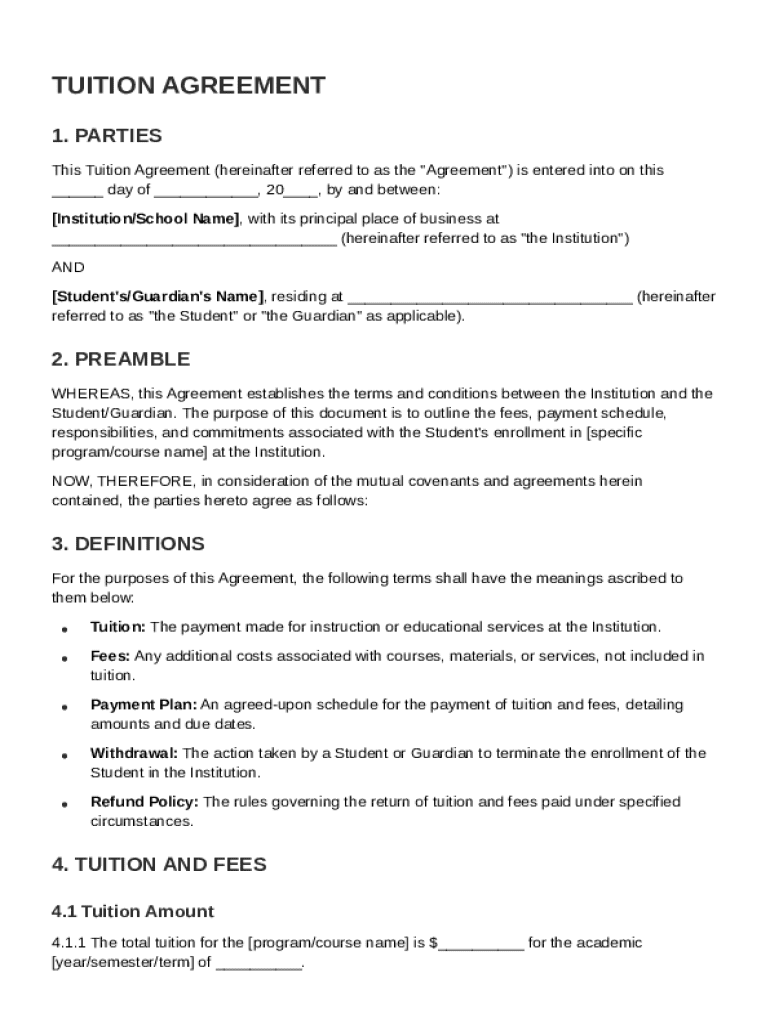







Definition and Meaning
A Tuition Agreement Template is a detailed document that sets out the terms and conditions between an educational institution and a student or their guardian regarding tuition fees and related financial obligations. This template defines the roles and responsibilities of both parties, including specifics on tuition payments, refund policies, and withdrawal procedures. The template serves as a legal contract ensuring clarity and mutual understanding about financial commitments associated with enrollment in a specific educational program.
Key Components
- Tuition Fees: It outlines the total cost of the program, including any additional fees.
- Payment Schedules: Specifies when payments are due, covering installment options if applicable.
- Refund Policies: Provides conditions under which refunds are granted in instances of withdrawal.
- Amendments: Specifies that any changes to the agreement must be in writing and agreed upon by both parties.
- Governing Laws: Ensures that the agreement complies with local and federal regulations.
Key Elements of the Tuition Agreement Template
The Tuition Agreement Template contains several critical elements that ensure all parties know their duties and rights. Understanding these key elements is crucial for both the educational institution and the student.
Tuition and Fees
- Base Tuition: The foundational cost for the student's educational program.
- Additional Fees: Includes lab fees, material costs, equipment usage charges, etc.
- Non-refundable Deposits: Initial payments required to secure a spot in the program.
Payment Methods and Plans
- Accepted Methods: Details permissible payment methods (e.g., credit card, check, wire transfer).
- Installment Plans: Options for spreading out payments over time, including any interest charges.
- Late Payment Penalties: Consequences for failing to meet payment deadlines.
How to Use the Tuition Agreement Template
The Tuition Agreement Template is designed for easy customization, allowing institutions to adapt it to their specific needs. Here’s how you can utilize the template efficiently:
Customization Steps
- Download the Template: Obtain the document in a compatible format such as DOC or PDF.
- Edit Details: Input institution-specific data, including program names, fees, and schedules.
- Review Legal Terms: Ensure all legal terminology aligns with jurisdictional requirements.
- Add Additional Clauses: Include unique conditions or rules pertinent to your institution.
Implementation
- Training Staff: Ensure personnel understand the agreement’s scope and execution.
- Student Instructions: Provide clear guidance to students and guardians on completing and signing the document.
- Update Regularly: Revise the template annually or as needed to reflect policy changes.
Legal Use of the Tuition Agreement Template
The legal standing of the Tuition Agreement Template necessitates strict adherence to governing laws. The document serves not only as a financial agreement but also as a binding legal contract.
Compliance Requirements
- ESIGN Act Compliance: For electronic signatures to be legally binding in the U.S.
- Consumer Protection Laws: Must ensure terms are fair and fully disclosed.
- State Laws: Adhere to educational and contractual regulations specific to each state.
Security Considerations
- Data Protection: Employs encryption and password protection to safeguard sensitive information.
- Audit Trails: Provides a record of document interactions and signature timestamps.
Who Typically Uses the Tuition Agreement Template
The primary users of the Tuition Agreement Template include but are not limited to educational institutions, students, and guardians.


Educational Institutions
- Universities: For various degree programs and courses.
- Community Colleges: For diploma and certification courses.
- Private Schools: For specialized programs and extracurricular activities.
Students and Guardians
- Prospective Students: Those enrolling for upcoming academic terms.
- Guardians: Parents or legal guardians managing the financial responsibilities on behalf of minors.
Examples of Using the Tuition Agreement Template
A Tuition Agreement Template can be applied in various educational scenarios, ensuring flexibility and robustness in diverse situations.
Real-World Scenarios
- Undergraduate Programs: Structuring payment plans for full-time students.
- Short-term Courses: Facilitating clear agreements for intensive workshop-style classes.
- International Students: Adapting terms to accommodate currency exchange and international laws.
Practical Examples
- Scenario 1: A private high school uses the template to define tuition obligations for day students versus boarding students.
- Scenario 2: A university implements it to manage tuition fees, lab fees, and equipment rentals in its engineering department.
State-Specific Rules for the Tuition Agreement Template
Tuition agreements in the U.S. may be subject to state-specific guidelines and regulations that can affect how they are constructed and enforced.
Common State Variations
- Refund Policies: Some states have mandatory refund timelines.
- Disclosure Requirements: Varying levels of information transparency and clarity.
- Consumer Rights: States such as California have specific education statutes protecting student rights.
Customizing for Compliance
- Federal vs. State Laws: Ensure federal compliance without contradicting state laws.
- Periodic Reviews: Regular audits to update the template according to legislative changes.
Important Terms Related to the Tuition Agreement Template
Understanding the terminology involved in tuition agreements ensures clarity and prevents misunderstandings.
Glossary of Terms
- Term: The duration of the educational program.
- Withdrawal: The formal process of leaving the program before completion.
- Installment: A series of payments made over time rather than in a lump sum.
Contextual Examples
- Withdrawal Deadline: The last date when a student can leave the program and still receive a refund.
- Payment Grace Period: A timeframe in which late payments are accepted without penalties.




