
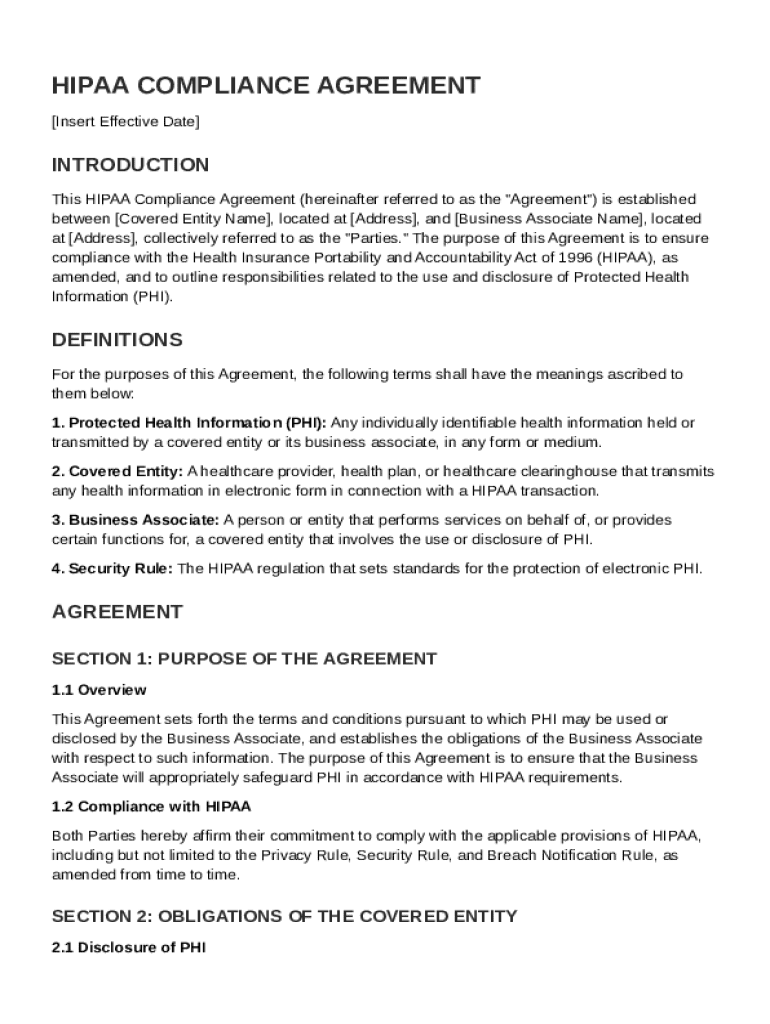







Definition and Meaning
The HIPAA Compliance Agreement Template is a legal document that outlines the responsibilities and obligations of both Covered Entities and Business Associates to ensure adherence to the regulations set forth by the Health Insurance Portability and Accountability Act (HIPAA). This agreement is essential for defining the use and disclosure of Protected Health Information (PHI) as it mandates specific safeguards to protect such information. The template also delineates procedures for reporting breaches and provides sections on termination, amendments, indemnification, and liability. Ultimately, the agreement ensures that both parties comply with HIPAA regulations and understand their roles in maintaining healthcare privacy.
How to Use the HIPAA Compliance Agreement Template
To effectively use the HIPAA Compliance Agreement Template, follow these steps:
-
Customizing the Template: Tailor the template to reflect the specific relationship between the Covered Entity and the Business Associate. This includes filling in relevant details such as names, roles, and responsibilities of each party.
-
Understanding Terms and Conditions: Thoroughly familiarize yourself with the key terms, conditions, and clauses within the document. This ensures that both parties have a shared understanding of their obligations.
-
Review and Adjust Safeguards: Ensure that the outlined safeguards for PHI protection are aligned with both parties' operational capabilities and regulatory requirements.
-
Legal Review: Have legal counsel review the document to ensure compliance with federal and state laws. Legal advice is integral to mitigating risks associated with non-compliance.
-
Signing the Agreement: Once both parties agree to the terms, the agreement should be signed. DocHub facilitates this by enabling parties to apply legally binding electronic signatures easily.
Steps to Complete the HIPAA Compliance Agreement Template
Completing the HIPAA Compliance Agreement Template requires careful attention to detail:
-
Review the Template: Begin by reading through each section of the template to understand the scope and requirements.
-
Gather Required Information: Collect necessary information such as the identities of the parties involved, contact details, and specific information on usage and disclosure procedures related to PHI.
-
Fill in Specifics: Accurately complete all relevant fields in the template. This includes specifying roles, responsibilities, and the types of PHI involved.
-
Detail Data Protection Measures: Clearly outline the specific technical and organizational measures in place to protect PHI against unauthorized access or breaches.
-
Include Breach Notification Procedures: Detail the protocols for reporting and managing any potential breaches of PHI.
-
Review and Sign: Conduct a final review to ensure accuracy and completeness before both parties sign the document.
Key Elements of the HIPAA Compliance Agreement Template
The HIPAA Compliance Agreement Template includes several critical components:
-
Definitions: Clear explanation of key terms such as "Covered Entity," "Business Associate," and "Protected Health Information."
-
Use and Disclosure Rights: Guidelines for appropriate use and disclosure of PHI by the Business Associate.
-
Safeguards: Specified security measures to protect PHI, including technical, administrative, and physical safeguards.
-
Breach Notification: Detailed processes for notifying involved parties in the event of a data breach involving PHI.
-
Amendments and Modifications: Provisions to update or modify the agreement as needed due to changes in laws or operational procedures.
-
Termination Clause: Conditions under which the agreement can be terminated, including procedures for handling PHI post-termination.
Legal Use of the HIPAA Compliance Agreement Template
The template ensures that the legal framework for HIPAA compliance is upheld, fulfilling several functions:
-
Legal Framework: Establishes a legally binding agreement between Covered Entities and Business Associates regarding the handling of PHI.
-
Regulatory Compliance: Ensures adherence to HIPAA requirements, including respecting privacy rights and safeguarding confidential health information.
-
Risk Mitigation: Helps reduce legal and financial risks by clearly defining responsibilities and the consequences of non-compliance.
-
Dispute Resolution: Provides a reference point for resolving disputes related to the handling of PHI and breaches of agreement terms.
Who Typically Uses the HIPAA Compliance Agreement Template
The HIPAA Compliance Agreement Template is primarily used by:
-
Healthcare Providers: Entities that need to ensure compliance while sharing PHI with partners or service providers.
-
Business Associates: Organizations or individuals who handle PHI on behalf of a Covered Entity and must ensure that they meet HIPAA compliance standards.
-
Legal Teams: Professionals who assist healthcare organizations in drafting, reviewing, and enacting these agreements to maintain regulatory compliance.

Important Terms Related to HIPAA Compliance Agreement Template
Understanding certain key terms is essential when dealing with the HIPAA Compliance Agreement Template:
-
Protected Health Information (PHI): Any information about health status, healthcare provision, or payment for healthcare that can be linked to an individual.
-
Covered Entity: A health plan, healthcare clearinghouse, or healthcare provider who transmits health information in electronic form.
-
Business Associate: A person or entity that performs functions on behalf of, or provides services to, a Covered Entity that involves access to PHI.
-
Security Rule: A set of standards to protect electronic health information.
Penalties for Non-Compliance
Failing to adhere to the HIPAA Compliance Agreement can result in severe penalties, including:
-
Monetary Fines: The Office for Civil Rights (OCR) can impose fines ranging from $100 to $50,000 per violation, with an annual maximum of $1.5 million.
-
Legal Action: Non-compliance may lead to legal proceedings initiated by affected individuals or entities.
-
Reputational Damage: Breaches and non-compliance can significantly damage an organization's reputation, affecting patient trust and business operations.
Understanding these penalties underscores the importance of thorough, honest completion and adherence to the HIPAA Compliance Agreement.




