






Definition & Meaning
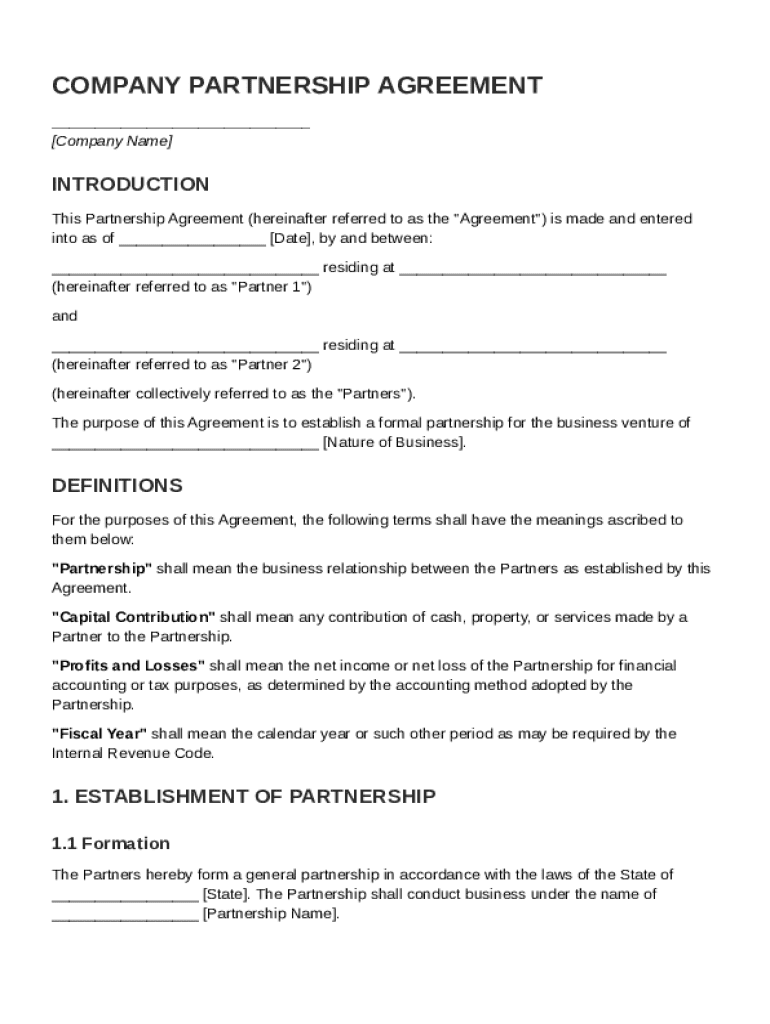
A Company Partnership Contract Template is a standardized document designed to formalize the business relationship between two or more partners. It outlines essential aspects of the partnership such as capital contributions, management structure, profit and loss distribution, and procedures for changes in partnership. This document ensures all parties are clear about their roles, responsibilities, and legal obligations, reducing potential for conflicts.
In a partnership, the contract serves as a foundational agreement that details how partners will collaborate. It typically includes clauses on confidentiality, dispute resolution, and how the partnership can be dissolved. Legality and accountability are central, ensuring compliance with U.S. business laws and regulations.
Key Elements of the Company Partnership Contract Template
-
Capital Contributions: This section details the initial investment each partner will contribute to the business. It clarifies financial obligations and shares in net profits based on these contributions.
-
Management Structure: Defines decision-making processes, the role of each partner, and managerial duties. It may include voting rights regarding major business decisions.
-
Profit and Loss Allocation: Specifies how profits and losses will be distributed among partners. It often follows the proportion of capital contributions but can vary based on specific agreements.
-
Confidentiality: This clause helps protect sensitive business information, requiring all partners to refrain from disclosing proprietary data to outside parties.
-
Dispute Resolution: Outlines procedures to resolve disagreements, such as mediation or arbitration, to prevent lengthy legal battles.
-
Dissolution Procedures: Details the process for winding down the partnership, including asset distribution and settling liabilities.
Steps to Complete the Company Partnership Contract Template
-
Review the Requirements: Ensure you understand all components of the template and gather necessary information, such as partner details and financial investments.
-
Fill in the Partner Information: Include names, addresses, and roles of all partners involved in the business agreement.
-
Detail Financial Contributions: Clearly articulate each partner's investment, whether monetary or asset-based, with relevant documentation.
-
Define Management and Voting Rights: Establish roles and responsibilities within the company hierarchy, including how decisions will be made.
-
Set Profit and Loss Terms: Agree on the terms for sharing financial outcomes, supported by consistent documentation.
-
Draft Additional Clauses: Include confidentiality, dispute resolution, and dissolution specifics tailored to your business needs.
-
Review and Finalize: Partners should carefully review the completed contract for accuracy and compliance before signing.
Legal Use of the Company Partnership Contract Template
The validity of a partnership contract hinges on adherence to state and federal business laws. The Company Partnership Contract Template is a tool to ensure compliance with such regulations, offering protection against legal disputes. Important legal principles lie in ensuring financial transparency and establishing a framework for accountability among partners.
Partners should consult with a legal professional to verify that the drafted agreement complies with state-specific laws and to make any necessary amendments for additional legal safeguards. Contracts should be periodically reviewed and updated to reflect any business changes or legal developments.
Who Typically Uses the Company Partnership Contract Template
-
Small and Medium Enterprises (SMEs): Businesses seeking to establish formal relationships with partners.
-
Start-Ups: New businesses forming partnerships where roles and financial contributions need clarity.
-
Multinational Corporations: For division or subsidiary partnerships, often involving international partners where precise agreements minimize risks.
-
Nonprofit Organizations: Collaborative projects where multiple entities pool resources or expertise.
-
Law and Accounting Firms: Professional firms where clear partnership terms are critical for operational and financial management.


State-Specific Rules for the Company Partnership Contract Template
State laws govern partnership agreements, and specific requirements can vary significantly. Some states may require particular disclosures or filing fees, while others might impose distinctive tax or legal considerations. Critical differences include regulations related to:
-
Filing Requirements: Whether or not the partnership agreement must be filed with the state’s Secretary of State office.
-
Taxation: States may have diverse tax obligations, affecting how partnerships report income and distributions.
-
Legal Protections: Certain states offer unique protective measures regarding partner liabilities and responsibilities.
Business Entity Types
A partnership contract may support various types of business entities, each with unique characteristics:
-
General Partnerships: Partners have equal responsibility for management and liabilities.
-
Limited Partnerships (LPs): Includes both general and limited partners; limited partners have reduced liability.
-
Limited Liability Partnerships (LLPs): Each partner receives protection from individual liabilities.
-
Limited Liability Companies (LLCs): Flexible management structure and liability protections distinct to members.
-
Corporations: May form intra-company partnerships, governed by more complex corporate laws.
Digital vs. Paper Version
While traditional paper contracts are still used, digital versions are becoming preferred due to their accessibility and integration with document management systems. Key advantages of digital contracts include:
-
Convenience: Easily edited, shared, and stored without the need for physical space or materials.
-
Security: Digital contracts can be encrypted and password-protected, adding layers of security not available with paper versions.
-
Efficiency: Electronic signing enables faster execution and real-time updates, crucial for dynamic business environments.