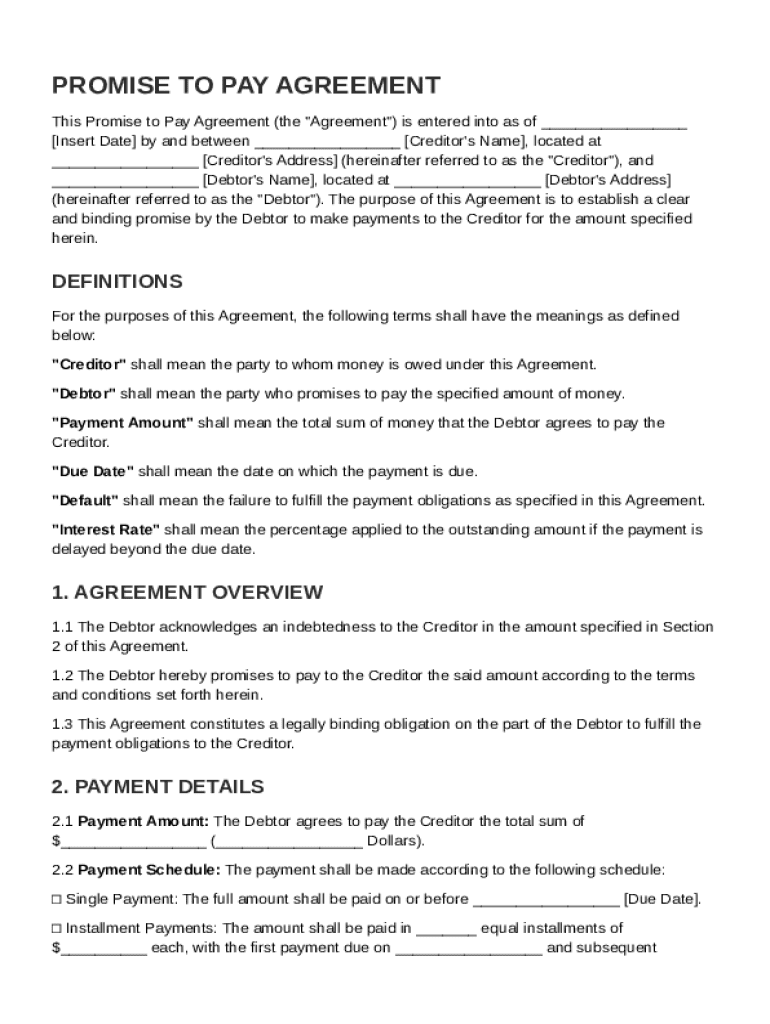







Definition and Meaning of Promise to Pay Agreement Template
A Promise to Pay Agreement Template, often used between a Creditor and a Debtor, serves as a legally binding document outlining the terms under which a Debtor agrees to repay a specified amount of money to a Creditor. This agreement details significant components such as the repayment amount, schedule, interest rate, and consequences of default. The template is integral in formalizing a debtor's commitment to repay a loan or debt, offering legal protection and clarity to both parties involved. Beyond monetary transactions, this agreement underscores the Borrower's obligation and the Creditor's rights, ensuring that repayment terms are transparent and enforceable under applicable laws.
Key Elements of the Promise to Pay Agreement Template
The Promise to Pay Agreement Template comprises several essential components that serve to protect both the Creditor and the Debtor:
-
Payment Details: Specifies the total amount to be repaid, frequency, and due dates of payments. Interest rates, if applicable, are also included.
-
Consequences of Default: Outlines penalties and actions that may be taken if the Debtor fails to meet repayment obligations, including potential legal actions.
-
Amendments: Provides a pathway for modifications to the agreement, requiring consent from both parties.
-
Governing Law: States which jurisdiction's laws apply to the agreement, usually aligning with the Creditor's or Debtor's location.
These elements ensure clarity in the agreement, helping prevent disputes by explicitly detailing each party's responsibilities and expectations.
How to Use the Promise to Pay Agreement Template
Utilizing the Promise to Pay Agreement Template involves several steps to ensure its effectiveness:
-
Download the Template: Obtain the template from a reliable source, ensuring it fits the specific transaction needs.
-
Customize the Agreement: Fill in essential details, including names, addresses, payment amounts, schedules, and any specific terms agreed upon by both parties.
-
Review and Revise: Both parties should review the agreement, suggesting revisions where necessary to clarify terms.
-
Finalize and Sign: Once both parties agree on the terms, the document should be signed. Electronic signatures are valid and legally binding if this method is preferred.
-
Store the Agreement: Keep copies of the signed document in a safe place, whether digital or physical, for future reference.
Using the template correctly ensures that both parties have a clear understanding of their obligations and helps facilitate a smooth financial transaction.
Legal Use of the Promise to Pay Agreement Template
The Promise to Pay Agreement Template is legally enforceable, provided it complies with applicable laws. It should clearly define the Debt, the agreement terms, and include the signatures of both parties. Additionally, the document must follow any specific legal requirements, such as being witnessed or notarized if necessary. In a legal context, this agreement serves as evidence of the promise to repay a debt, offering protection in the event of disputes. It's paramount to tailor the document to fit the applicable legal framework, often necessitating a review by legal counsel to ensure compliance with state and federal laws.
Steps to Complete the Promise to Pay Agreement Template
Completing the Promise to Pay Agreement Template involves a detailed process to ensure accuracy and completeness:
-
Read the Entire Document: Familiarize yourself with the template to understand all sections and requirements.
-
Input Basic Information: Enter the names and contact details of both the Creditor and Debtor.
-
Specify the Debt Information: Detail the amount owed, any interest rates, and the repayment schedule.
-
Define Default Consequences: Clearly state what constitutes a default and the subsequent actions that will be taken.
-
Include Amendment Provisions: Specify how changes to the agreement can be made, requiring mutual consent from both parties.
-
Legal Sections: Ensure the governing law, signatures, and dates are properly executed to solidify the agreement's legality.
-
Review for Completeness: Double-check all information for accuracy before signatures are obtained.
Thoroughly completing each step reinforces the agreement's validity and clarity, promoting an understanding between both parties involved.
State-Specific Rules for the Promise to Pay Agreement Template
While the basic structure of a Promise to Pay Agreement remains consistent across the United States, state-specific regulations may influence certain terms. States may have unique rules regarding interest rates, required disclosures, or signing requirements. For instance, usury laws vary, limiting the maximum interest rate that can be charged. Additionally, some states may require notarization or witnessing of signatures to validate the agreement. It's critical to research and comply with these state-specific legal requirements to ensure the agreement is enforceable in the intended jurisdiction.
Examples of Using the Promise to Pay Agreement Template
The Promise to Pay Agreement Template finds application in various scenarios:
-
Personal Loans: When lending money to friends or family, this agreement formalizes the transaction and helps prevent misunderstandings.
-
Business Transactions: Companies can use this template to outline repayment terms for loans or credit extended to other businesses or individuals.
-
Debt Settlement: This template can support settlements by detailing new payment plans that are agreed upon by the Debtor and Creditor.
These scenarios illustrate the template's versatility, offering a structured approach to managing financial agreements across different contexts.
Important Terms Related to Promise to Pay Agreement Template
Several terms are crucial within the Promise to Pay Agreement Template, providing context and clarity:
-
Obligation: The responsibility of the Debtor to repay the owed amount as agreed.
-
Creditor: The entity to whom the debt is owed, responsible for providing the loan or credit.
-
Debtor: The entity that borrows the money and agrees to repay it according to the terms.
-
Default: A failure to meet the payment obligations as stipulated in the agreement, leading to potential legal consequences.
Understanding these terms is essential for both parties, ensuring they fully comprehend their roles and responsibilities within the agreement.
Who Typically Uses the Promise to Pay Agreement Template
Various individuals and entities can benefit from using the Promise to Pay Agreement Template:
-
Lenders and Creditors: Secures the promise of repayment in personal or professional financial arrangements.
-
Borrowers and Debtors: Provides clear terms and conditions for repayment, promoting financial planning and accountability.
-
Legal Professionals: Uses it as a reference document when creating enforceable lending agreements.
This template is a critical tool for anyone involved in financial transactions, offering legal clarity and reducing potential disputes through well-defined terms.