






Definition and Importance of Public-Private Partnership Agreement Template
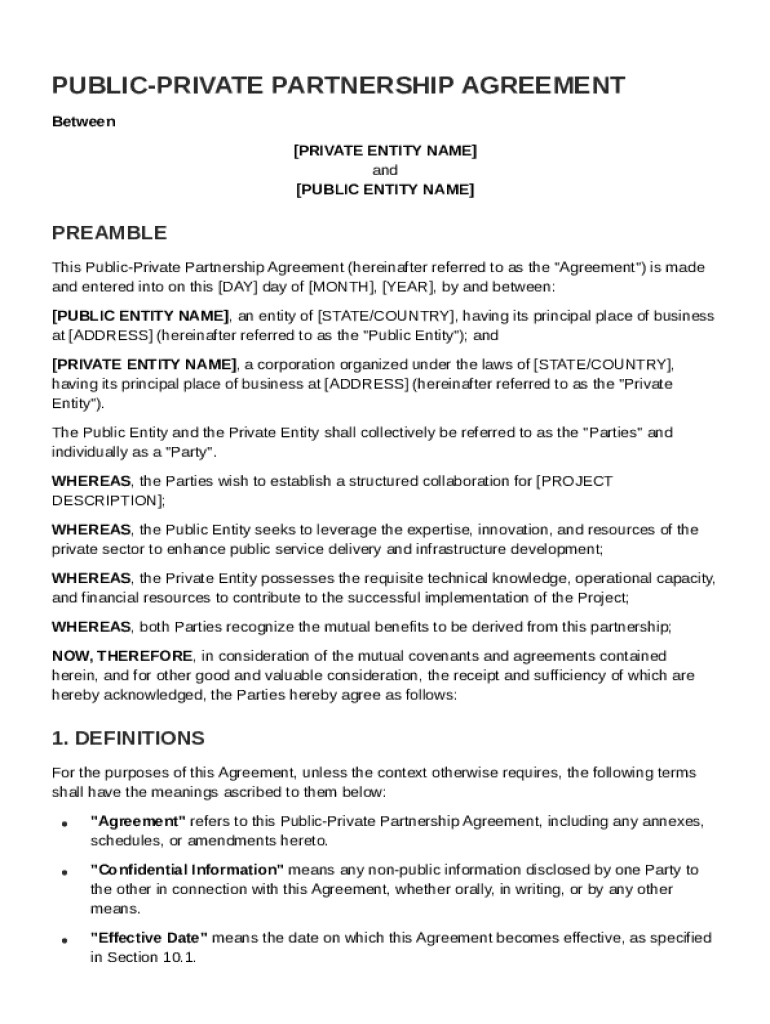
Public-Private Partnership (PPP) agreements serve as a contract between a public entity, like a government department, and a private entity to collaborate on a specific project. These agreements outline the framework for cooperation, detailing roles, responsibilities, financial arrangements, and governance structures. Their primary purpose is to leverage the expertise and resources of the private sector to enhance public service delivery and infrastructure development, ensuring mutual benefit for both parties involved.
Core Components of PPP Agreements
- Roles and Responsibilities: Clearly defined roles for each party, emphasizing who is responsible for specific tasks and decision-making processes.
- Financial Arrangements: Detailed financial obligations, including funding sources, revenue-sharing models, and financial risk allocations.
- Risk Management: Strategies to identify, assess, and mitigate risks associated with the project.
- Governance Structure: Framework for decision-making, monitoring progress, and resolving disputes.
How to Use the Public-Private Partnership Agreement Template
Utilizing a Public-Private Partnership Agreement template involves several structured steps to customize it for specific projects. The template provides a standardized format, ensuring consistency and compliance with legal standards.
- Review Standard Clauses: Understand pre-existing clauses to determine their applicability to your project.
- Customize Sections: Modify roles, financial arrangements, and timelines to fit the project's unique requirements.
- Consult Legal Advisors: Engage with legal experts to ensure the document meets legal standards and accurately reflects intentions.
- Stakeholder Input: Collect input from relevant stakeholders to finalize roles, responsibilities, and expectations.
- Finalize and Execute: After agreement by all parties, formalize the document through signatures for execution.
Practical Considerations in Customization
- Assess the project's goals and align them with template clauses.
- Consider geographic and regulatory factors that might affect the agreement.
- Ensure all parties have a clear understanding of the finalized agreement to prevent ambiguities.
Key Elements of the Public-Private Partnership Agreement Template
A comprehensive PPP agreement template encompasses several key elements that must be tailored to each unique project.
Essential Clauses
- Purpose & Scope: Defines the project's objectives, scope, and expected outcomes.
- Duration & Termination: Specifies the agreement's term length and conditions for termination or renewal.
- Performance Metrics: Establishes criteria for evaluating the project's success and benchmarks for progress tracking.
Additional Important Aspects
- Dispute Resolution: Mechanisms for resolving disagreements, such as mediation or arbitration.
- Confidentiality: Provisions to protect sensitive information exchanged during the collaboration.
Who Typically Uses the Public-Private Partnership Agreement Template
PPP agreements are widely utilized by several key stakeholders across various industries to facilitate collaborative efforts in infrastructure and service delivery projects.


Primary Users
- Government Agencies: Local, state, and federal departments implementing infrastructure or public service projects.
- Private Corporations: Companies investing in public infrastructure projects for revenue generation and social impact.
- Non-Profit Organizations: Entities involved in community service projects requiring collaboration with public institutions.
Benefits for Diverse Stakeholders
- Efficiency: Combines public sector oversight with private sector efficiency and innovation.
- Cost-Effectiveness: Shares financial burdens and rewards among parties to lower costs and risks.
- Quality Improvement: Enhances service delivery through private sector expertise and technology.
Legal Use and Compliance of the Public-Private Partnership Agreement Template
Legal compliance is a cornerstone of any Public-Private Partnership Agreement. Ensuring the agreement adheres to the relevant legal frameworks is essential for its enforceability and effectiveness.
Regulatory Compliance
- Jurisdictional Laws: Must comply with specific state or national laws governing public-private partnerships.
- Contractual Obligations: Clearly outlines legal obligations of each party, with recourse measures for breach of contract.
Legal Considerations
- Ensure provisions for liability and indemnity are thorough.
- Include clauses adhering to labor laws, environmental regulations, and community impact assessments.
Examples of Using the Public-Private Partnership Agreement Template
Real-world applications of PPP agreements provide valuable insights into their potential benefits and challenges.
Example Scenarios
- Transport Infrastructure: Private firms financing and managing public transportation projects like highways and rail systems.
- Utilities and Public Services: Partnerships for constructing and maintaining public utilities, such as water and energy facilities.
- Urban Development: Collaborative efforts between city authorities and real estate developers for urban regeneration projects.
Case Studies
- A major city's partnership with a technology firm to develop a smart city infrastructure, resulting in improved traffic management and energy efficiency.
- A state government collaborating with a construction firm for a sustainable housing initiative, aligning with green building standards.
Steps to Complete the Public-Private Partnership Agreement Template
Completing a PPP agreement template requires a systematic approach to ensure all sections are accurate and comprehensive.
- Initial Assessment: Analyze the project goals, scope, and stakeholder requirements.
- Drafting: Create the initial draft using the template, incorporating basic project details and standard clauses.
- Review and Revise: Engage stakeholders to review the draft, suggest revisions, and refine the document.
- Legal Review: Pass the revised draft to legal advisors for examination to ensure legal compliance and completeness.
- Final Agreement: Integrate feedback, finalize the document, and have all parties review and sign it.
Implementation Tips
- Schedule regular meetings with stakeholders to ensure continuous alignment on the agreement content.
- Keep meticulous records of all drafts, changes, and stakeholder inputs for transparency and accountability.
Important Terms Related to Public-Private Partnership Agreement Template
Understanding key terminology can enhance clarity when navigating PPP agreements.
Glossary of Terms
- Concession: A grant of rights, lands, or property by a government to a private entity for specific purposes.
- BOT (Build-Operate-Transfer): A form of project financing where a private entity receives a concession to finance, design, construct, and operate a facility before transferring it back to the public sector.
- Stakeholder Engagement: Involvement of all parties with an interest in the project's outcome throughout the lifecycle of the PPP.
Clarifications
- Risk-Sharing: The equitable distribution of project risks among partners based on their capacity to manage and mitigate them.
- Revenue Models: Strategies for generating income streams from the project, often linked to service delivery or user fees.
How to Obtain the Public-Private Partnership Agreement Template
Accessing a PPP agreement template can be achieved through several channels to suit diverse needs.
Sources for Templates
- Legal and Consultancy Firms: Many offer customizable templates tailored to specific industries and project types.
- Online Legal Document Services: Platforms like DocHub provide templates that can be easily downloaded and customized online.
- Government Portals: Some state and local governments provide sample agreements and guidelines on their official websites.
Customization Considerations
- Ensure templates from online sources are legally vetted and jurisdiction-specific.
- Always consult with legal professionals to adapt the template to the particularities of each project.
This comprehensive guide on the Public-Private Partnership Agreement Template provides an in-depth exploration of its components, uses, and customization techniques, empowering users to efficiently draft and execute effective agreements.